
Humanecy as a response
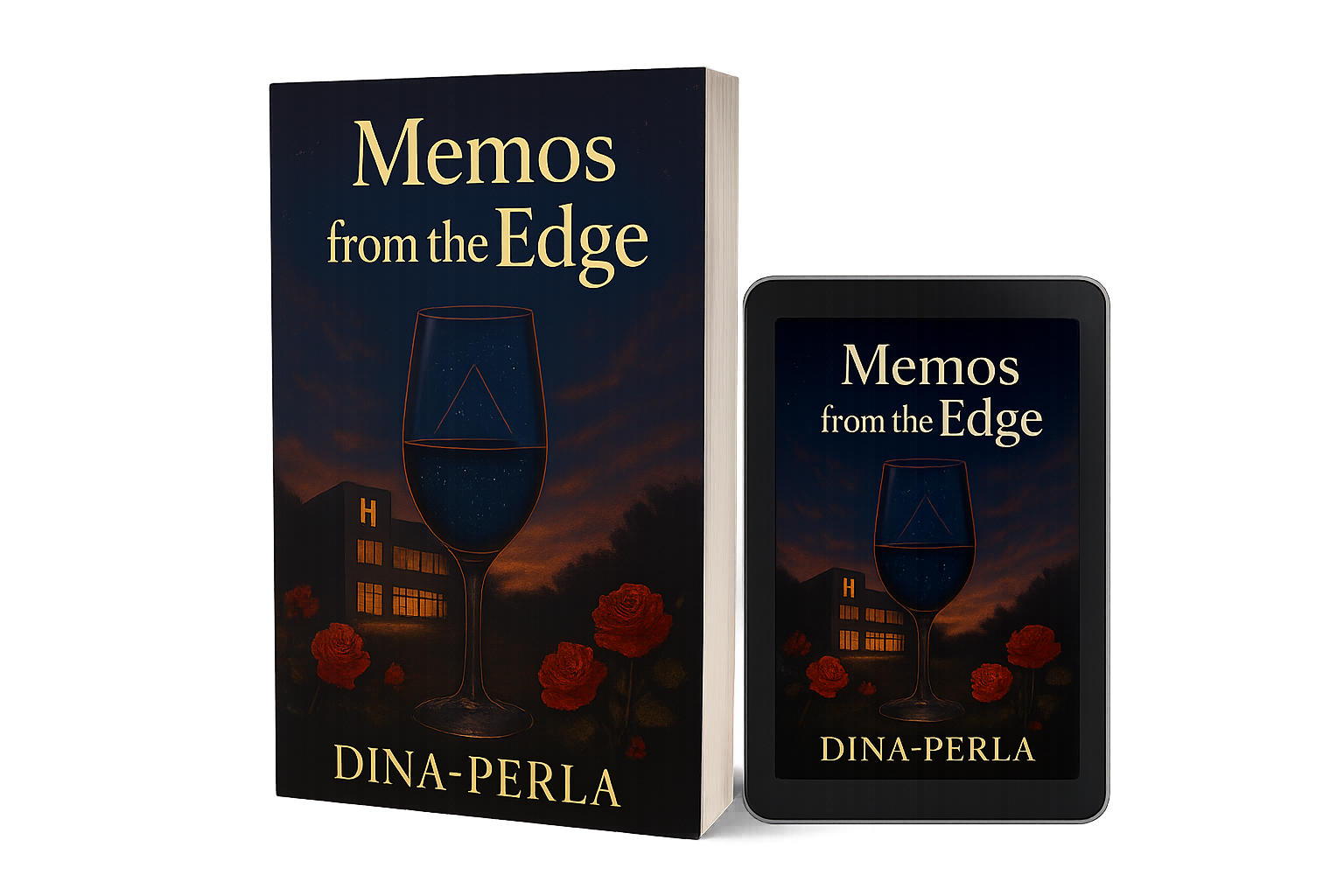
They accused her of murder, but the real crime is what she uncovered inside the fertility clinic. And someone tries to kill to keep it hidden.
Memos from the Edge, a philosophical novel with elements of cozy crime, introduces humanecy as a response to an era defined by ideological exhaustion and growing polarization. As public and digital spaces continue to harden through ideological conflict, moral absolutism, and collective outrage, the book emerges as a philosophical work that not only reflects what is going wrong, but also formulates a precise alternative in the form of humanecy.
Blending elements of fiction, essay, and letters, the novel dissects the deeper structures behind contemporary polarization. The letters serve as critical nodes, revealing how systems of belief evolve from meaningful frameworks into closed structures. What begins as a search for meaning gradually solidifies into rigidity.
What once provided direction for societies increasingly becomes a boundary within which empathy is applied disproportionately. The problem isn’t only a lack of empathy. Empathy without boundaries can be equally destructive. Between dehumanization and limitless empathy, a mature middle ground is missing. Humanecy occupies that space. It can be understood as conscious and bounded empathy.
The book exposes how patterns such as moral superiority, victimhood, and group identity reinforce one another. These aren’t isolated phenomena, but recurring mechanisms that have shaped and destabilized civilizations throughout history. They influence personal identity, particularly among individuals who are highly sensitive or intellectually gifted.
Its central premise is that polarization isn’t a deviation from the system, but a logical outcome when systems are prioritized over human beings for extended periods of time. The narrative shows how language, belief, and identity shift from tools of connection into instruments of division. Readers are confronted with the uncomfortable realization that forces such as exclusion, racialization, and territorial thinking stem from a fundamental inability to engage with difference without attempting to dominate or eliminate it.
Humanecy is explicitly not an ideology or a religion, but a necessary step beyond both. It transcends borders and geopolitical leadership. It represents a state of awareness in which individuals no longer act primarily from collective identification, but from an internal compass grounded in responsibility, reciprocity, and limitation.
Where media and politics tend to amplify division, humanecy raises the question of what that division costs and how social cohesion can be preserved. Where systems pursue dominance or uniformity without balance, humanecy introduces the capacity to hold tension, difference, and complexity without collapsing into dehumanization or extremism. This perspective gives Memos from the Edge its urgency.
At a time when nuance is increasingly replaced by dogma and confrontation, the novel offers an alternative that challenges the very conditions that produce polarization. It responds to a growing international need for new frameworks of thought that move beyond entrenched oppositions without falling into relativism.
Stylistically, the book reinforces this vision. Its nonlinear structure and layered narrative, supported by an above average use of dialogue, require the reader to actively construct meaning. The text resists simplification and mirrors the complexity of the reality it explores. Lightness and gravity alternate, allowing accessibility without compromising intellectual sharpness.
“I attempt to examine, disrupt, and transcend the underlying logic of our time through intellectual and emotional maturity. At the same time, I refuse to place responsibility outside the reader when it comes to reflecting on moral dilemmas. The book also remains a light and engaging cozy crime story. Readers decide how deep they want to go. It is created with care, intention, and craftsmanship. I offer a perspective that is rarely found in fiction, and I explore themes that have not previously appeared in a novel, including the sabotage of fertility treatments as a means of influencing population dynamics,” says Dina-Perla Portnaar.
Blurb
When Fertility Doctor Imane-Safae is accused of throwing a newborn in a glass recycling container, her world fractures overnight. The accusation is unthinkable, yet the truth she carries is more dangerous than the accusation itself. In the fertility clinic where she works, medicine and ideology intertwine in ways that threaten to destroy society.
As pressure from the investigation mounts, Imane-Safae’s longing to belong collides with her refusal to stay silent about her discovery. Betrayed by those she had to trust and shadowed by questions she never knew she needed to ask, she begins to confront the hidden threads of her life. Each revelation forces her to choose between safety and truth, and complicity and justice. She uncovers parts of herself that had long remained buried.
While the nation watches her trial unfold, Imane-Safae’s personal reckoning becomes a public battle over power, belonging, and the right to know the truth. Out of ruin and loss, she must find the courage to reclaim her sense of self, to redefine what it means to be human in a system built to divide.
Memos from the Edge is a provocative, philosophical novel about the fragile border between justice and revenge. Ideal for book club discussions about life’s dilemmas and the price of integrity.
Practical information
The local and digital book launch will take place on April 9, 2026 at approximately 18:00 CET and can be followed live via this link, or through the TikTok account. Due to an upcoming relocation to Cyprus, international launches will follow later this year, and media efforts are more focused than audiences may be accustomed to. The paperback is available via this link. The e book can be translated into any language. A PDF is available for press upon request.