
Where Objectivity Meets Reality
Hunger as a weapon – not by, but against Israel
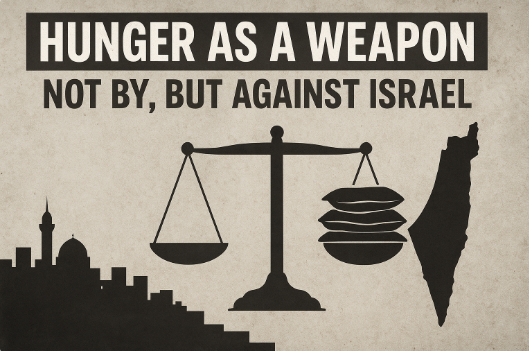
In August 2025, the Integrated Food Security Phase Classification (IPC) declared famine in Gaza for the first time. At first glance, this appears to be an objective scientific classification, based on hard data on food shortages, acute malnutrition, and mortality. But upon closer examination, it becomes clear that the criteria for Gaza were adjusted.
Where the standard IPC thresholds require that at least 20% of households experience extreme food shortages, 30% of children under five suffer from acute malnutrition, and the daily mortality rate is ≥2 per 10,000 people, in Gaza the threshold for acute malnutrition was lowered to 15%. A significant deviation from the international standard.
For comparison, in Sudan, where famine was also recently recognized, the traditional criteria were fully applied. There, the prevalence of acute malnutrition among children under five meets the ≥30% threshold, and the percentage of households experiencing extreme food shortages exceeds 20%. The mortality rate also meets ≥2 per 10,000 people per day. Historically, all IPC-recognized famines, from Sudan to South Sudan and parts of Ethiopia, have been measured against these uniform criteria. Gaza is therefore a notable exception.
The political context is hard to ignore. The situation in Gaza illustrates how the international community views events differently when Israel is involved, a phenomenon some summarize as “no Jews, no news”. The criteria were adjusted, deliberately or not, to make the crisis appear more severe and to increase political pressure on Israel. This is nothing new; it fits a long tradition of selective and often consistently demonizing portrayals of Israel, largely driven by leftist or Muslim groups. No other country would tolerate a terrorist attack like the one on October 7, and no other country would be forced to negotiate with terrorists who kidnap and attack their own citizens. Yet, in public and international perception, Israel is more often blamed, while Hamas’s role in this crisis is hardly questioned.
The subjectivity of the UN and its agencies is also evident in the number of resolutions against Israel: Israeli issues receive over 20% of all UN resolutions annually, compared to only a fraction for other countries. In Eastern Congo, current brutal conflicts rage on, and in China, both the concentration camps for the Uyghurs and the systematic oppression of Tibet continue. Despite these severe human rights violations, international attention and political pressure remain disproportionately low compared to Israel. Amnesty International and other NGOs consistently behave the same way: their criticism of Israel is structural, often independent of the actual situation, purely because it concerns Israel.
Under pressure from a limited but vocal group of the public, governments are also forced to adjust their positions. In this context, it is striking that hardly any questions are asked about Hamas’s responsibility in this food crisis. Meanwhile, restaurants in Gaza remain partially open despite the official famine declaration, and images of the Gaza population do not show a universal picture of starvation, in contrast to the innocent hostages who have been confined in tunnels for two years, and those who have been released, whose images provided by Hamas clearly show them emaciated and starving, not to mention the physical and sexual abuse they endured. It is also strange that during previous blockades of aid, the term “famine” was never used, whereas aid supply is now abundant, and only as Israel moves to eliminate the last Hamas stronghold is it dramatically declared a famine.
The implications are significant. On one hand, the adjusted classification can lead to faster assistance and life-saving interventions. On the other hand, it undermines the consistent scientific standard on which the international system of food security and famine is based, and makes it clear that politics, perception, and ideology play a role in what should be objective data. The situation in Gaza is a striking example of how political selectivity, media pressure, and subjective interpretation of figures create a narrative that deviates strongly from the reality on the ground.
In short, this is not merely a technical discussion about percentages and figures. The adjusted IPC criteria for Gaza show that political considerations, selective attention, and a consistently demonizing narrative about Israel converge in a context where other countries and crises, no matter how severe, receive hardly the same focus. It is a classic illustration of how facts, media, and international institutions are sometimes filtered through ideology and geopolitical interests, fundamentally distorting the public perception of a crisis. All of this clearly shows that the UN, its agencies, and, by extension, most NGOs, including Amnesty International, simply adopt an anti-Israel stance, not because of what is happening, but simply because it is Israel.
Of course, the situation in Gaza remains precarious, as it is wherever war occurs, and the civilian population deserves attention and aid. However, it is essential to distinguish between true famine and a politically inflated and manipulated interpretation of the figures, and to recognize that responsibility and blame cannot be placed solely on Israel.
Related Topics
Related Posts