
I Am a Zionist: A Button, a Resolution, and a Lesson From 1975
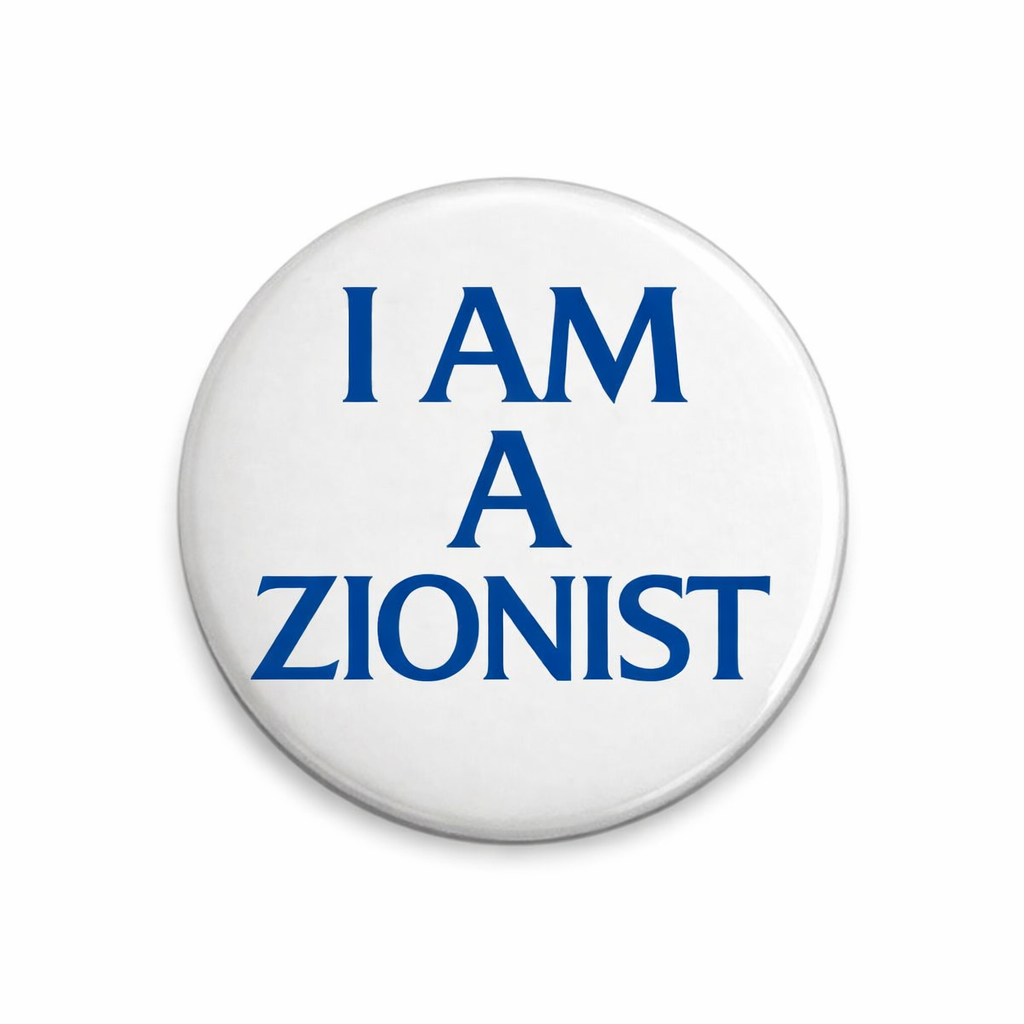
They say history repeats itself. That isn’t always true—but every so often, you live through a moment that feels eerily familiar. Lately, it feels like we’re back where we were fifty years ago.
Those of you old enough may remember United Nations General Assembly Resolution 3379, passed in November 1975, which declared that “Zionism is a form of racism and racial discrimination.” Seventy-two countries voted in favor. Thirty-five voted against. Thirty-two abstained.
The resolution came in the aftermath of the 1973 Yom Kippur War, at a time when Arab states were using diplomatic pressure—and oil power—to isolate Israel on the world stage. Supporters of the resolution insisted they weren’t attacking Jews, only a political ideology. Sound familiar?
Zionism, they argued, was a colonial project—an extension of European imperialism—and an apartheid movement comparable to South Africa. And just as we’ve seen since October 7, antisemitism was carefully rebranded as “anti-Zionism,” complete with disclaimers meant to sound reassuring.
But for Jews, the reaction was visceral. Zionism wasn’t some abstract ideology; it was—and still is—a movement for Jewish self-determination, deeply woven into Jewish identity. To label it racism felt like an attack on the legitimacy of the Jewish people themselves.
The outrage was immediate and intense. I was only a teenager at the time, but I remember being glued to the news. What stands out most for me, though, isn’t a speech or a headline—it’s a small blue-and-white button that I wore, and that Jews across the country wore, which read: “I am a Zionist.”
Those buttons popped up everywhere—on college campuses, at rallies, in synagogues. Jewish activists, students, even Holocaust survivors wore them proudly. The message was deliberate and defiant. It was identity as protest.
For many Jews—especially those who were politically liberal or uneasy with nationalism—the resolution forced a reckoning: If Zionism is racism, and I believe Israel has a right to exist… then fine. I guess I’m a Zionist.
Resolution 3379 became a defining moment for a generation of American Jews. It deepened skepticism toward the United Nations, accelerated Jewish political organizing, strengthened emotional ties to Israel, and made clear that Jewish legitimacy could be challenged—even in the most “respectable” global forums.
Many people my age will tell you this was the moment they truly understood what Zionism was all about.
It took more than a decade, but as the Cold War thawed, the resolution was finally repealed in 1991. Israel’s ambassador, Chaim Herzog, had already made history years earlier by tearing up a copy of Resolution 3379 at the UN podium, calling it a “moral disgrace.” Still, even after the repeal, the damage lingered. For many Jews, the episode remains a touchstone whenever the line between criticism of Israel and the delegitimization of Jewish self-determination is debated.
And while that “I am a Zionist” button is now more than fifty years old, it still matters. Most political buttons haven’t aged well—but this one endures. It remains a declaration of dignity, a refusal to be shamed, and a reminder that Jewish identity and Zionism were—and always will be—deeply intertwined.
What’s most striking today isn’t just that the phrase “Zionism is racism” has resurfaced—it’s how familiar the entire pattern feels to those who remember 1975.
It’s almost a carbon copy. Same language. Same disclaimers. Same Jewish reaction.
In 1975, the United Nations insisted it was condemning an ideology, not a people. Today, the phrase reappears in activist spaces with nearly identical framing:
“This isn’t about Jews.”
“Anti-Zionism isn’t antisemitism.”
“Zionism is just a political movement.”
The rhetorical move hasn’t changed: separate Zionism from Jewish identity in theory, even though for most Jews, that separation is artificial.
That was true in the 1970s. And it’s true now.
What has changed is where the phrase lives. Back then, it began at the United Nations. Today, it shows up on university campuses, in activist coalitions, and across social media.
But the logic remains the same: recast Zionism as a uniquely immoral nationalism, place it outside the bounds of legitimate political belief, and treat Jewish attachment to Israel as suspect, backward, or supremacist. In the 1970s, this was wrapped in the language of anti-colonialism. Today, it’s wrapped in the language of racial justice, decolonization, and even genocide.
And the Jewish response mirrors the past almost perfectly.
Back then, Jews who had never called themselves Zionists began doing so publicly. Many lost faith in international institutions overnight. Today, Jews—even those with nuanced or critical views of Israeli policy—still feel a responsibility to defend Zionism. And once again, there’s growing skepticism toward organizations that claim universal justice while excluding Jewish narratives.
So once more, many Jews arrive at the same conclusion they did in 1975: If Zionism is defined as racism, and I reject that definition, then I guess I’m a Zionist.
For those of us who remember the UN resolution and were shaped by its aftermath, today’s debate doesn’t feel new. It feels like history resurfacing with 21st-century branding.
In 1975, we learned that Jewish legitimacy can be challenged even in polite, global institutions such as the United Nations; that language meant to sound principled can still be deeply exclusionary; and that silence doesn’t protect you—self-definition does.
Which is why that old blue-and-white button still resonates with me…and with others.