Welcome to the Ongoing Situation
Featured Post
I stood up to fight stigma. I didn’t expect it to follow me home
A year after going public as a methadone patient, I've learned that honesty doesn't always come back to you the way you hoped it would
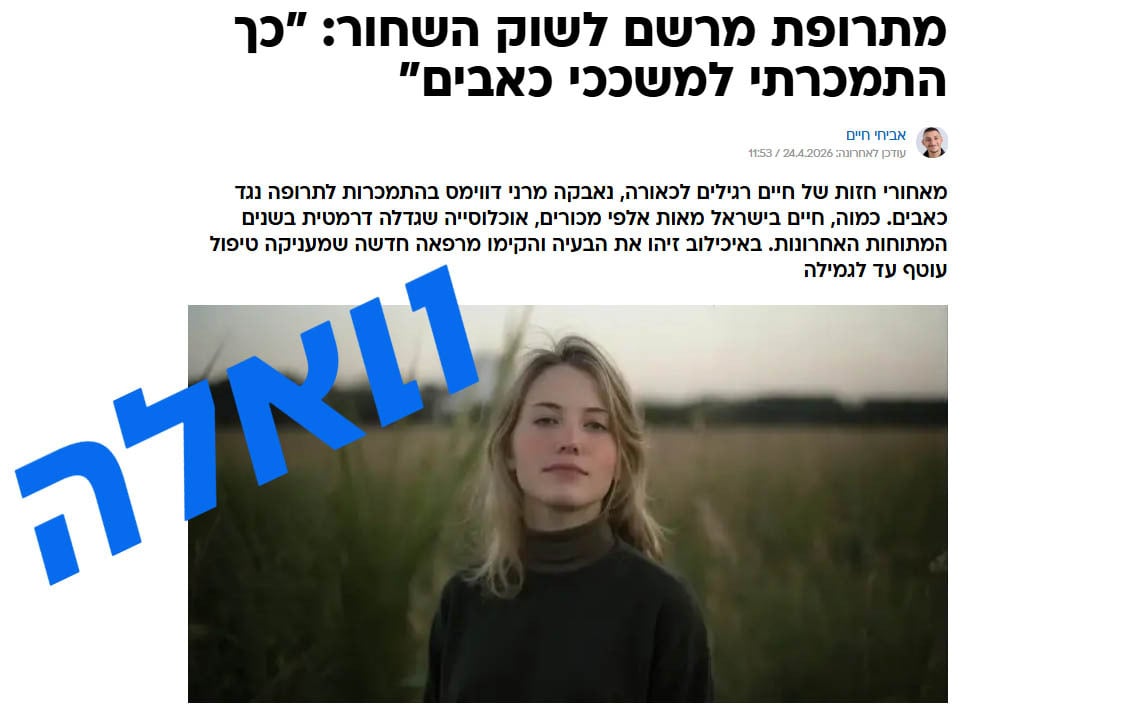
Screenshot of the Walla!NEWS article" 'From Prescription Drug to the Black Market: 'This is how I got addicted to pain relievers'' (Montage by The Times of Israel)
A year ago, I briefly became Israel’s accidental poster child for opioid addiction. I also wrote a small essay a few months after the story was published. I waived my anonymity, put my name and face to a methadone clinic profile, and told a slightly skeptical country that addiction doesn’t come with a uniform. That it can look like a blonde, articulate magazine editor with strong opinions about politics and skincare, just as easily as it can look like whatever image people default to when they hear the word “junkie.”
I wrote, at the time, that the response was underwhelming. A flurry of disbelief. A few date requests. No flood of solidarity, no visible dent in the stigma. I ended that essay on a note of cautious optimism anyway — it counts for something, I hope.
I’m writing this in Elul, which feels almost too on the nose, even for a secular girl. This is the month set aside for cheshbon hanefesh — an accounting of the soul — before the gates supposedly narrow for the new year. It’s the season for honest confession, for admitting the things you did and why, on the theory that saying them out loud is the beginning of being understood, maybe even forgiven, for them. I did my own public version of that a year early, and not in a synagogue. I did it in a Tel Aviv clinic office, to a journalist, on the record.
I want to tell you what it has actually cost me.
I don’t have the freedom right now to talk about the specifics of my personal life in any detail — I’m in the middle of a private legal matter, and I’m not going to litigate it here. But I can say this much plainly: going public about my addiction has not stayed contained to the story I told. It has followed me into rooms I never expected it to enter, and it has been used, by someone who once knew exactly what that disclosure cost me and supported it anyway, in ways that have nothing to do with helping other people understand addiction and everything to do with hurting me.
That’s the part nobody warns you about when they tell you that honesty is brave. Bravery doesn’t come with an expiration date on how it can be used against you, and it doesn’t come with a guarantee that the people who encouraged it will still be on your side when it stops being convenient for them.
Here is what almost nobody who isn’t in it understands: being medically stabilized on methadone, showing up to a clinic, holding a job, raising a child, filing my taxes on time — that is not a person in the throes of active addiction. That is, by every clinical definition, a person managing a chronic illness responsibly. It is closer to a diabetic managing insulin than to the image most people still carry in their heads. But Israel, for all its progress in a hundred other areas, has not caught up to that understanding yet. And in a country where the stigma is still this thick, “she was on methadone” doesn’t need context to land. It just needs to be said in the right room, at the right moment, by someone who knows exactly how little public education there still is.
That’s the cruelty of it, in the abstract, and it’s a cruelty I now understand from the inside rather than the outside. The very ignorance I was trying to chip away at is ignorance that can still be turned into a tool, by anyone who decides to use it that way.
I’ve asked myself, more than once this year, whether I regret it. Whether the honest, mildly self-satisfied woman who sat in a clinic director’s office and said yes, use my name was a fool.
I don’t think she was. I think she told the truth in good faith, in a country that still isn’t fully ready to receive it in good faith. Those are two different failures, and only one of them is mine.
I still believe addiction is a disease. I know it is. I still believe the people who need to hear that most are the ones who’ve never had to think about it — the ones who assume it only happens to people who “look like” something. I still believe visibility helps, even when it’s clumsy, even when it doesn’t land the way you hoped, even when it later gets used against you by people who were never operating in good faith to begin with.
What I no longer believe is that honesty is safe. I no longer believe that doing the right thing protects you from people who will use anything they can find, including your own openness, as a weapon when it suits them.
I don’t have a tidy ending this time. Last time I at least had the small, stubborn hope that visibility might do something for other people in recovery. This time I mostly have a caution, for anyone else weighing whether to put their name to their own recovery in a place that isn’t fully ready for it yet: know exactly who is standing next to you when you do it, and remember that the people who encourage your honesty in one season of their life are not obligated to honor it in the next.
I don’t regret trying to destigmatize something that deserves to be destigmatized. I regret nothing about the patient I was, sitting in that clinic, laptop open, deadline looming, dose in hand. I regret only that I once believed truth-telling was a fixed, stable thing — that it couldn’t later be picked up by someone else and repointed at parts of my life I never meant to expose.
It still might count for something. I still hope that. I’m just no longer naive about the price.
Related Topics
Related Posts