I went to the West Bank to bear witness to the destruction there
I recently spent a day in the Jordan Valley, after following the news about the increase of deadly violence in the West Bank for months. Those attacks, awfully, have become murderous and not only injurious. From what I understand, the violence is largely carried out with impunity by the Jewish hilltop and farming youth, who have stated proudly that their aim is to make life so hellish for the Palestinians who live in the area that they leave their land of their own will so that the land becomes “Jewish.”
The desire to make the West Bank and the Jordan Valley free of Arabs (reminiscent of the Nazis’ goal I learned as a child: Judenrein, free of Jews), pursued in violent, fearful ways, is impossible for me to square with anything I know to be Jewish.
In my visit to the area, I was taken aback by the many things I did not know, despite my attention to the news:
- The extent of the poverty. The Palestinians on these farms, under attack, are terribly poor. They live in makeshift tents. They farm or they shepherd. It’s a subsistence life. They want their kids to go to school, but the conditions of living in an area under IDF control often make this impossible. One mother explained to me that five children are limited to one phone for learning over Zoom. When there is reception. What some of the shepherds in this area seek, and what these settlers want to deny them, is the freedom to bring their sheep across what is now a highway to graze on abundant green land that has been claimed by one Jewish clan.
- Palestinians are chased away from the land designated for them by attacks of fire, gunfire, sadistic slaughter of animals, and the threat of worse. I saw abandoned areas lying empty as if no one had lived there. In Hamam Al Maliah, where I visited, the morning after my visit to an abandoned spot, Jewish Israelis had set up a prayer service there, and a video celebrating the return of the land from “Ishmaelite” hands to Jewish hands was published on social media.
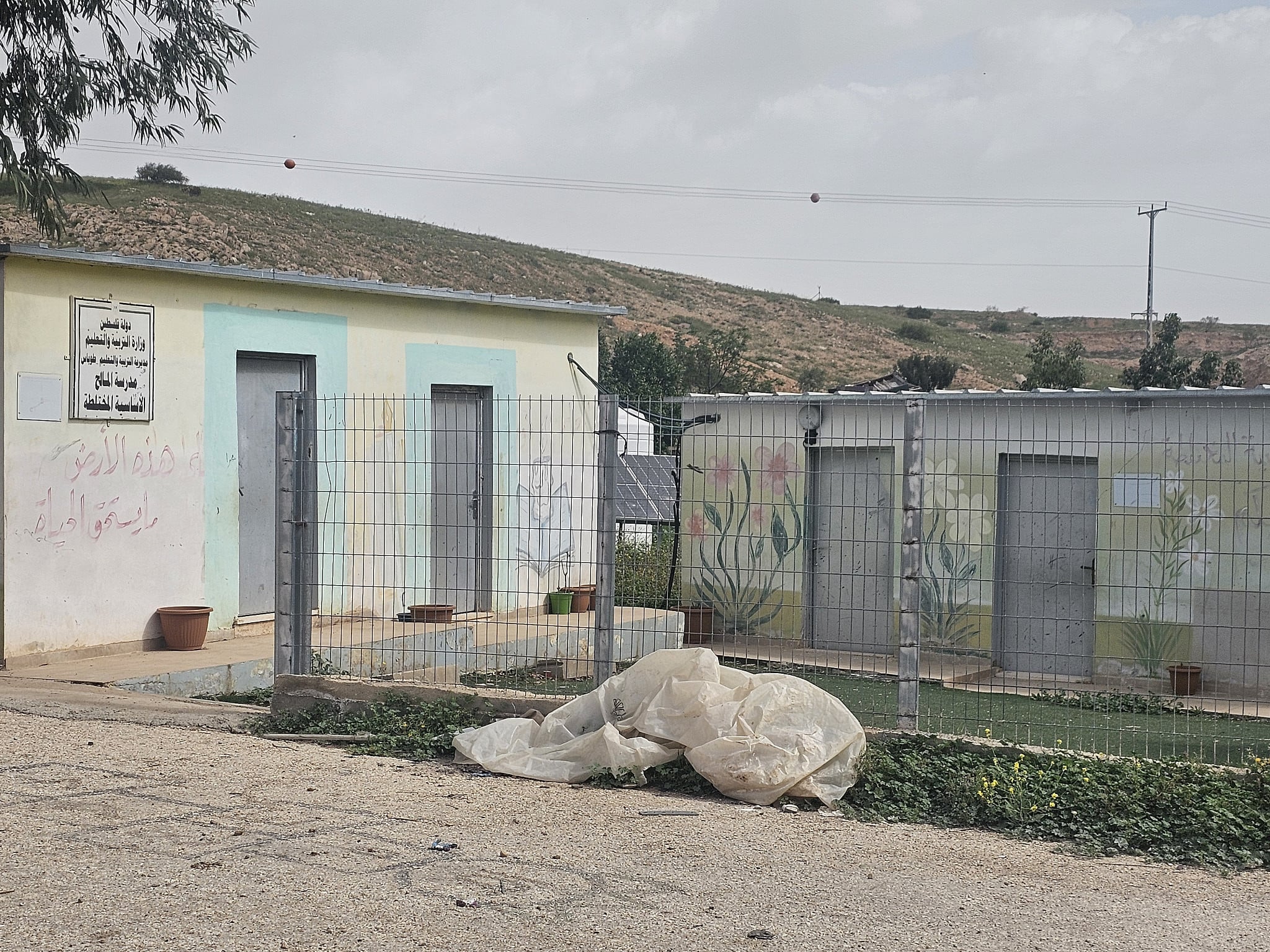
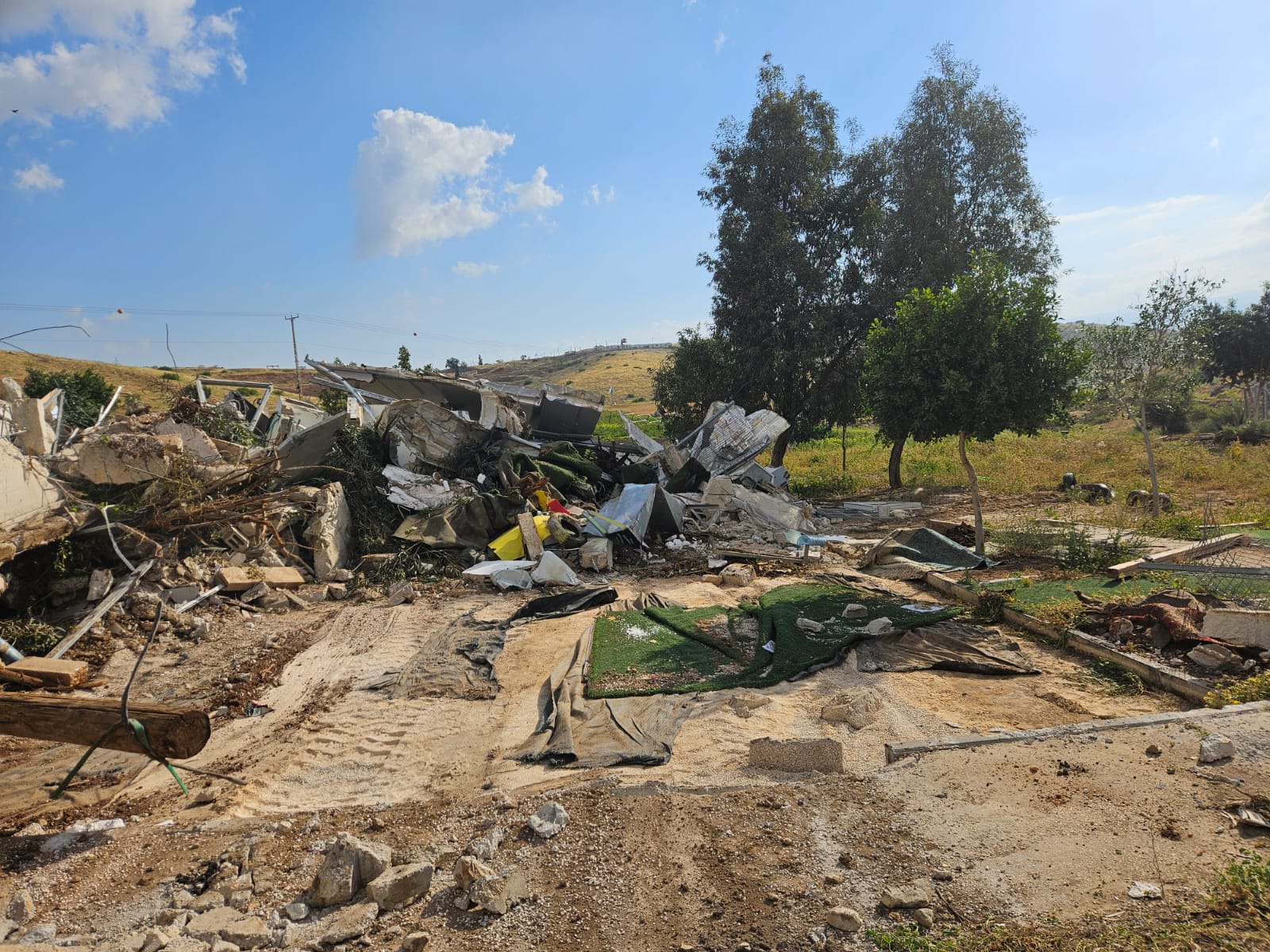
BEFORE. (courtesy) The people sang Hallel, marking both the end of Pesach and their “victory.” Days later, the town’s small schoolhouse was torn down overnight. Everything in it, including the children’s picture book, Dirah Lehaskir, (“Apartment To Let”), in Arabic translated from the Hebrew, was destroyed. The army camp across the road reported seeing nothing.
AFTER. (Yuval Dor) - There are heroes among us. A small minority of Jewish Israelis are deeply disturbed by Jewish violence against Palestinian shepherds and against Jewish Israelis who stand by the shepherds. A smaller minority of Jewish Israelis are even more disturbed, to the extent that they are willing to spend hours walking up and down green hills, watching sheep, watching the army watch them watch sheep. Some of these people live in the Jordan Valley and they believe that the land can hold all of us. They have lived their lives on the land, loving and serving the state and the people, and they have made it their mission to protect, bodily, the Palestinians whom they see as their neighbors. Others have joined them, from across Israel. Volunteers show up in rotation, day after day, and night after night, for thankless work, without the support of the Jewish state. Too often, they, too, are beaten and hospitalized by their fellow Israelis – those settlers who no longer relate to them as “brothers” or “sisters,” but as “the enemy.”
* * *
I should note that I was frightened to drive to the Jordan Valley to join this tour with the Jordan Valley Activists (otherwise known as two gray-haired, weathered Israeli kibbutznikim and one small Israeli woman, with wrinkled skin, a strong tongue, and potato chips for all). I was frightened to drive while missiles from Iran and the north were raining down and I was frightened to be two hours from home where my kids were. I was frightened that I might get attacked by settler teenagers or arrested for looking at what I am not supposed to see (an army vehicle pulled up to watch us watch sheep), or caught in a bad scene of one kind or another. I was frightened that I was not aware enough of the danger in the region. I know enough about Israel to realize that distances are tiny, and that the places that have exploded in flame and gunfire were minutes from where I was going.
At the same time, when distances are tiny, I know that Jerusalem is the Jordan Valley is the West Bank is the Gaza envelope is Kiryat Shmonah is Ramat Gan. Our daily conditions are not the same – far, far, far from it – but what it does mean is that we have to be aware that nothing stops at an imposed or imagined border. We are all living in this world of terror and violence regardless of whether we feel like we are.
As a citizen of the state, all those places are in a way my home. Not in the way of ownership, but in the way of responsibility.
That’s why Itamar Ben Gvir’s approach of letting everyone know who owns the land – who’s in charge – misses the mark. Sovereignty does not mean that the people with power can coerce, oppress, harm or kill whomever they choose to target. Those with sovereignty are the ones with responsibility.
If we wanted to get out on the streets the way we did to insist that our government bring home the hostages, we could do so. In numbers. With Israeli flags. With signs. Over and over. Some Israelis are doing this, but their numbers are typically in the hundreds and, here and there, in the thousands. Of course, anyone who wants to, can show up in these places, see with our own eyes, and support the Jewish Israelis and the Palestinians on the scene (see organizations Bnei Avraham and Jordan Valley Activists who will readily lead you on a tour and seek volunteers).
Taking it to the streets does not mean that the government would respond. They almost certainly would not. They responded in the case of the hostages not to a vocal, persistent majority of the Israeli people but only to Trump’s diktat.
But if we took this to the streets, as we should, and as we know how to do, the statement Israelis would be making would be heard worldwide and it would be heard throughout Israel: we do not tolerate racist violence as an expression of Jewish sovereignty. It would be a start.