Professor of Jewish Philosophy at Bar Ilan University
Ibn Rushd and the Maharal go to the Knesset: Defending Academic Freedom
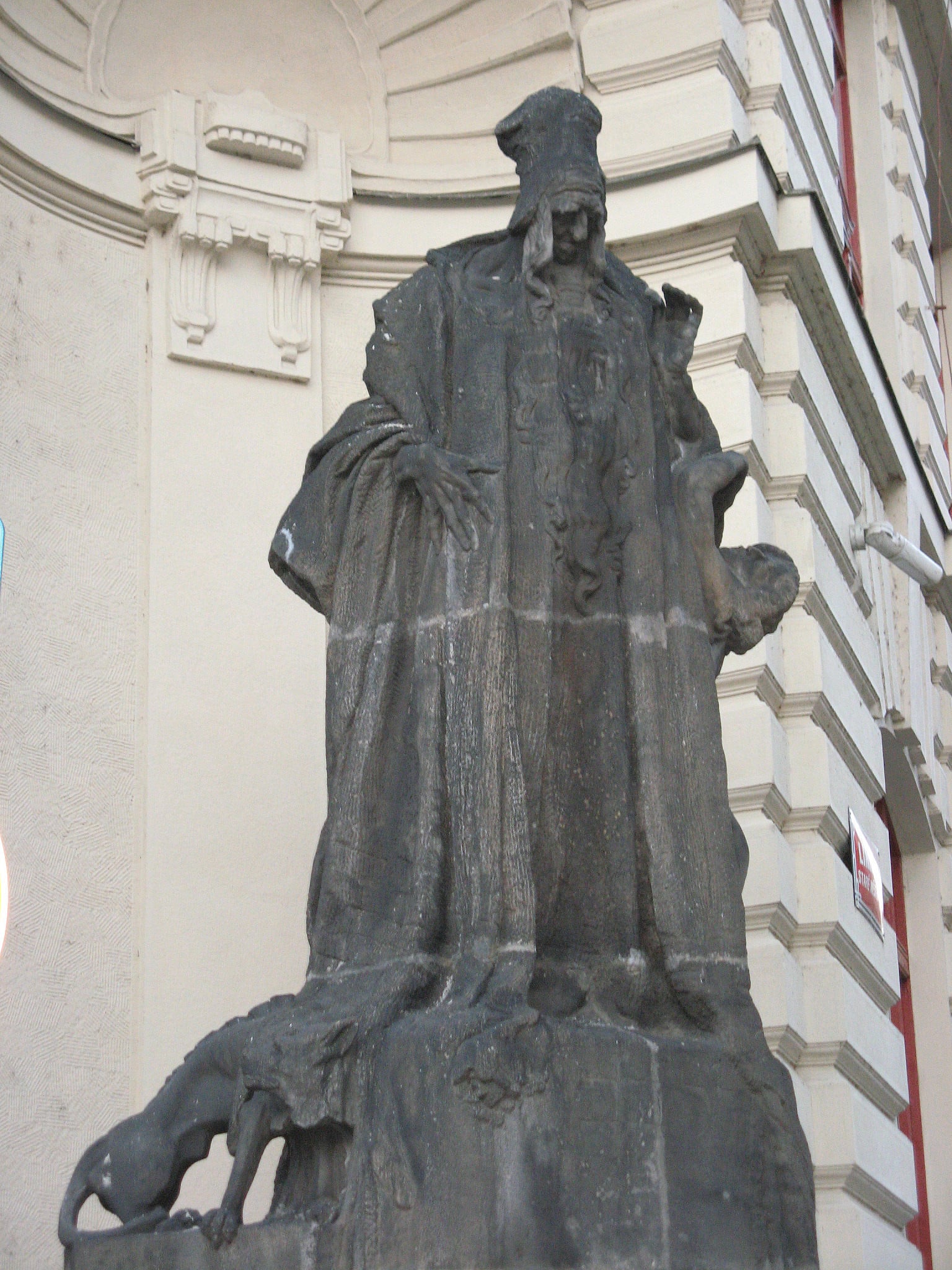
R. Judah Loew statue at the New City Hall, Prague, Photo by Buchhändler - Own work, Public Domain, https://commons.wikimedia.org/w/index.php?curid=2873898
Framed as a defense against “political” academic strikes, Likud MK Avihai Boaron’s proposed law would grant the Minister of Education full discretion to lower or cancel university budgets in order to prevent such strikes. Historically, I am told by my lawyer friends, university strikes that are not directly related to work conditions have always been stopped within a few hours by the Israeli courts. In any case, the framing of the law lumps in threats to strike along with actual strikes and makes special mention of cases where university presidents disagree with the Minister of Education. Boaron’s proposed law makes some concession to the importance of academic freedom with a quote from R. Judah Loew, known as the Maharal of Prague:
It is not fitting to remove any word of an opposer to one’s opinion on account of love of inquiry and knowledge … For it is through this that a man comes to the content of the truth of the words and attains a hold on the complete truth (Be’er Ha-Goleh 7, 7).
In fact, the very words this law quotes have a long history of rising in defense against precisely the kind of government censure it is trying to promote.
In context, Maharal is commenting on an extensive quotation he brings from Ibn Rushd’s Middle Commentary on Aristotle’s On the Heavens and the Earth. Ibn Rushd, who served as the Qadi of Cordoba in the 1180s, wrote numerous commentaries on every book of Aristotle he could find, nearly all of which were preserved in Hebrew translations made in the 13th-15th centuries. These Hebrew works formed the backbone of scientific study for Jews who were not allowed to study in Christian universities before the 16th century. In this passage, Ibn Rushd notes the importance of engaging with disagreeing views. He argues that challenging these views gives one an opportunity to resolve doubts about them and in so doing, hold one’s previous views with more vigor. Ibn Rushd is particularly concerned with arguments about the eternity of the world, a view held by Plato and Aristotle, but rejected by traditional Islam. His discussion is intended to allay fears that he himself is adopting or encouraging others to adopt a heretical view.
Ibn Rushd’s caution turned out to be justified. In 1197, he was himself declared a heretic. He was exiled from Cordoba and his books were burned. The Almohad regime – the same regime from which Maimonides had fled Cordoba not long before –no longer permitted the study of Aristotelean philosophy. It was in Hebrew and Latin translation that the works of Ibn Rushd were preserved and able to have an enormous impact on the development of science.
Maharal quotes a full paragraph of Ibn Rushd (whom he calls “the inquirer,” ha-ḥoqer) before saying that this same approach should apply to religion. One should not simply reject the views of others, he says, especially those who are weak, but one should engage with them. This may involve stating and arguing for beliefs that are contrary to one’s own, says Maharal, but this sort of engagement is crucial for reaching the truth. Thus says, Maharal one should not say to the weaker, “Do not speak! Close your mouth!” For, he continues, “one who closes someone else’s mouth forbidding him from speaking about this matter, indicates the weakness of his own religion.” These words somehow do not appear in the wording of Boaron’s proposed law.
Giving the Minister of Education full discretion over what positions (political, religious, or otherwise) the universities can or cannot have is precisely the kind of thing Maharal and Ibn Rushd wanted to avoid. It is not enough to quote the Jewish tradition, one should really study it, turning it over and over, as we learn in Aboth, because everything is in it, even what we disagree with.
Related Topics
Related Posts