
Geopolitical Analyst: Bridging Somaliland & Israel to the world
If Bab el-Mandeb Cannot Be Restored, the Strategic Map Moves to Berbera
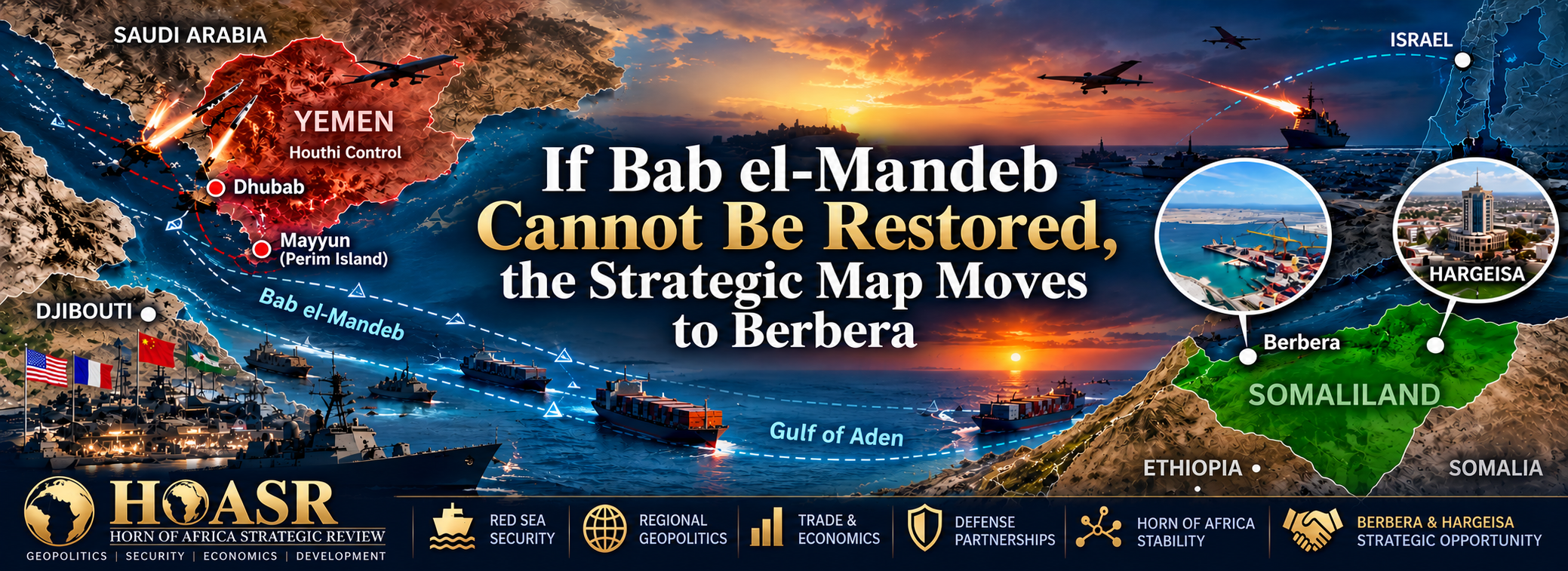
The battle over Bab el-Mandeb is reshaping the strategic geography connecting Yemen, Djibouti and Somaliland, increasing attention on Berbera and Hargeisa. Original HOASR infographic illustration.
The coming battle over the Red Sea chokepoint will determine more than who controls a Yemeni coastline. It could reshape the strategic value of the African shore—and place Berbera and Hargeisa closer to the center of a security system stretching from Hormuz to the Horn of Africa.
The Attempt to Restore the Old Map
Three weeks after the Houthis overturned the military balance around Bab el-Mandeb, Saudi Arabia is preparing to find out whether the old map can be restored. Reuters reports that Riyadh is considering a major Yemeni-led counteroffensive, potentially mobilizing more than 100,000 troops with Saudi air support, American intelligence and targeting assistance, Pakistani equipment and advisers, and other defensive support from Saudi partners. T
The objective is unusually clear: reverse the Houthi gains around the southern Red Sea and recover the strategic position lost in September. [Reuters]
Can they reverse it?
The answer will reach far beyond Yemen. Bab el-Mandeb has become the point where several crises that appeared separate only months ago are beginning to converge: the Houthi expansion, Saudi Arabia’s vulnerability between Hormuz and the Red Sea, The Geography that Riyadh ignored and the renewed war in Ethiopia, the Saudi-UAE rivalry and tentative reconciliation, Israel’s security calculations, American reluctance to enter another large Middle Eastern war, and the growing strategic importance of the African shore.
Reuters reports that the Houthis’ September advance placed them in control of the Red Sea coastline and Bab el-Mandeb positions that Riyadh now considers too consequential to leave in their hands. [Reuters]
From Missile Threat to Geography
As I argued earlier in this Blog The Red Sea Map Has Changed. Western Strategy Has Not. The significance of Mayyun and Dhubab was being underestimated because governments were still looking at the Houthis principally through the familiar lens of missiles and drones.
Geography had become the more important development. Mayyun sits inside the strait; Dhubab provides mainland depth; Mokha extends the position northward.
Once those locations are connected to surveillance, missiles, drones, tunnels and protected logistics, the problem is no longer simply intercepting weapons launched toward commercial vessels. It becomes the problem of dislodging an entrenched military presence overlooking the maritime corridor itself.
Saudi Arabia appears to have reached the same strategic conclusion. Reuters reports that Riyadh believes it cannot comfortably return to negotiations while the Houthis retain the leverage created by their position around Bab el-Mandeb.
The options under discussion reportedly range from a concentrated coastal operation to a broader campaign involving simultaneous fronts in Taiz, Marib, Al-Bayda and Al-Jawf. Washington has stopped short of joining the offensive directly, but American advisers and intelligence, including targeting information, are supporting Saudi operations. [Reuters]
The numbers can be misleading. More than 100,000 Yemeni troops sounds overwhelming until the experience of the September collapse is considered. The anti-Houthi camp remains fragmented among formations with different patrons, political objectives and command structures, and Reuters notes that the effectiveness of those forces is considered one of the central uncertainties surrounding the operation.
Obviously, the military contest will be decided less by the size of the mobilization than by whether Riyadh can create coherent command, intelligence, logistics and air-ground coordination from forces that have repeatedly struggled to operate as one cohesive army unit. [Reuters]
The Houthis face their own problem. Capturing territory in a rapid offensive is easier than permanently defending an exposed strategic coastline. Their ability to hold Mayyun and Dhubab depends partly on protecting their gains on the ground, maintaining supply routes and preventing government forces from dominating the high ground behind the coast.
By the same token, the battles around Taiz and Lahj are important almost as much as the positions immediately beside the strait. Fighting around Taiz intensified sharply this week, while the UN warned that the escalation was worsening an already severe humanitarian emergency. [The National]
Ultimately, the counteroffensive has two possible strategic consequences. If Saudi-backed forces recover Dhubab, isolate Mayyun and push the Houthis away from the strait, September may eventually be remembered as a dramatic but temporary disruption.
If they fail, the implications are much larger because failure would demonstrate that the Houthi breakthrough is not simply an unexpected battlefield victory but a durable alteration of the Red Sea security architecture.
The African Shore Comes Into Focus
The second possibility is where the African shore is gaining strategic importance.
Djibouti will remain central regardless of what happens in Yemen. Its ports, airfields and concentration of American, French, Chinese and other military facilities cannot simply be replicated elsewhere.
Yet the events across the water demonstrate the strategic limitation of concentrating so much international military infrastructure immediately opposite a contested Yemeni coastline.
The September fighting has already produced a humanitarian spillover across the strait, with thousands of Yemenis reaching Djibouti and more than 120,000 displaced inside Yemen by September 21. [Al Jazeera]
Military planners think in terms of redundancy precisely because indispensable facilities can become exposed. Djibouti remains a critical strategic port; however, a more dangerous Bab el-Mandeb naturally increases the value of additional ports, airfields, surveillance locations and logistics nodes elsewhere on the African shore.
Berbera becomes harder to ignore as it provides something increasingly scarce in the immediate vicinity of the chokepoint.
Berbera sits far east of Bab el-Mandeb to avoid being physically inside the narrowest part of the confrontation, yet close enough to support Gulf of Aden maritime awareness, logistics and aviation. Its deep-water port, expanded commercial facilities and long runway already existed before the Houthi breakthrough.
What September changed was the environment against which those assets are measured.
A Wider Horn and Red Sea Convergence
This week’s wider Horn of Africa picture reinforces the point. Fighting has again erupted in northern Ethiopia, with Reuters reporting a rebel alliance confronting federal forces and warning of the risk of a wider regional war.
Ethiopia’s diplomatic confrontation with Eritrea has simultaneously deepened, placing another layer of uncertainty along the western approaches to the Red Sea.
A region already debating Ethiopia’s search for reliable maritime access is now watching instability spread across the hinterland behind several of the ports on which the Horn depends. [Reuters]
The result is a remarkable strategic dilemma. Yemen’s war is moving toward Bab el-Mandeb. Ethiopia’s internal conflict is again acquiring regional dimensions. Saudi Arabia is reconsidering its military posture in Yemen.
Türkiye and Pakistan are entering the Saudi security architecture through the Makkah Joint Defence Agreement, while Pakistan has already supplied air-defense systems, drones, anti-drone equipment and advisers for the Saudi-backed effort. [Reuters]
Even the Saudi-UAE rivalry is being tested by the new environment. The Financial Times reported this week that Saudi Crown Prince Mohammed bin Salman met UAE Vice President Sheikh Mansour bin Zayed in Riyadh, the first public visit by a senior Emirati figure since relations deteriorated sharply earlier this year.
The renewed Houthi threat has increased Riyadh’s incentive to repair a relationship whose breakdown had weakened the anti-Houthi coalition and complicated relations with southern Yemeni forces. [Financial Times]
The UAE is not a distant actor on the African shore. Abu Dhabi’s commercial and security investment has already made Berbera part of its wider Red Sea and Gulf of Aden network.
Recent analysis continues to identify Berbera and Bosaso in Puntland as important ports in the UAE’s regional strategy, while reporting from Berbera has highlighted how the port’s commercial development increasingly intersects with wider strategic competition. [Somalia Today]
Israel’s recognition of Somaliland in December 2025 placed the Hargeisa-Berbera relationship inside Israel’s broader Red Sea calculations. The Washington Institute has argued that the relationship expands Israel’s strategic reach toward the southern Red Sea, while other analysis has warned that Israeli or allied military activity on the African shore could itself become a Houthi target.
The implication is a double-edged sword and cuts both ways: Berbera’s value rises as Bab el-Mandeb becomes more dangerous, but so does the risk attached to being drawn visibly into the confrontation. [Washington Institute]
What It Means for Hargeisa
The strategic opportunity is not simply that foreign militaries may want access to Berbera. A port can become militarily valuable while becoming commercially vulnerable; an airfield can attract international attention while simultaneously attracting hostile surveillance or threats.
Hargeisa faces a more complex equation than the familiar proposition that regional instability automatically strengthens Somaliland’s recognition campaign.
The more consequential possibility is that Somaliland becomes useful across several layers of the emerging security architecture at once. Berbera can function commercially as an alternative corridor for Ethiopia and the Horn, strategically as a logistics and aviation port, and geographically as a location for maritime-domain awareness outside the immediate Bab el-Mandeb concentration.
Meanwhile, Hargeisa becomes the political gateway through which any government seeking durable access to those assets must negotiate. This provides Somaliland a potential bargaining power, something geography alone never provided.
But bargaining relevance and diplomatic recognition are not the same thing. The current crisis can increase the number of governments interested in Berbera without determining what political relationship those governments ultimately choose with Hargeisa.
Some American analysts continue to argue that existing facilities in Djibouti make additional U.S. bases unnecessary, demonstrating that the strategic case for Berbera remains contested even in Washington. [Somalia Today]
There is another reason for caution. U.S. officials have recently warned about growing Houthi cooperation with al-Shabaab, including reported weapons transfers, drone and explosives training and tactical coordination. If that relationship deepens, the Gulf of Aden begins to look less like a body of water separating two security theaters and more like a bridge connecting them.
For Somaliland, that would elevate the importance of coastal surveillance and counterterrorism while simultaneously increasing the exposure associated with closer security relationships with Israel, the United States or Gulf states. [Financial Times]
The Red Sea Map Enters Its Second Phase
This is where the argument I made in this blog, “The Red Sea Map Has Changed. Western Strategy Has Not” now develops further. The map is no longer merely changing because the Houthis advanced. Saudi Arabia is preparing to change it back. Whether Riyadh succeeds will determine whether Mayyun becomes a temporary disruption or the beginning of a new strategic reality.
If the counteroffensive succeeds, Berbera does not suddenly lose its importance. The crisis will already have demonstrated how quickly Bab el-Mandeb can become contested and why redundancy along the African shore has strategic value.
European concern is already growing: Italy said on October 2 that contributions to the EU naval mission protecting Red Sea shipping remain insufficient and called for greater allied involvement. [Reuters]
If the counteroffensive fails, the consequences are considerably larger. A durable Houthi position around Mayyun and Dhubab would leave an Iran-aligned armed movement entrenched at the southern gateway of the Red Sea, Saudi Arabia facing persistent pressure on its western maritime route, Israel confronting a more complicated approach to Eilat, and international forces in Djibouti operating opposite a militarized Yemeni shore.
Under that scenario, geographic redundancy moves from an interesting planning option toward a more serious strategic requirement. Berbera would then be evaluated differently—not because Hargeisa moved closer to Washington, Riyadh or Jerusalem, but because the security environment moved closer to Berbera.
The Scoop: Berbera Becomes Harder to Ignore
For Hargeisa, the deeper consequence is political rather than military. Somaliland has spent decades arguing that its stability, coastline and location deserve international attention.
The emerging Red Sea order is beginning to test those claims against actual strategic demand. The geopolitical measure of the moment will be Berbera’s importance as a durable commercial port with security cooperation, diplomatic access and greater participation in decisions affecting the Gulf of Aden. and not how often Berbera appears on foreign military maps.
The danger for Somaliland: if it becomes strategically useful without becoming strategically influential. Foreign powers have used valuable ports throughout history without allowing the territories around them meaningful influence.
Berbera’s growing relevance therefore does not automatically translate into political leverage for Hargeisa; that depends on the terms under which access, investment and security cooperation develop.
This week’s Horn and Red Sea developments bring the issue into unusually sharp focus. A Saudi counteroffensive is being prepared in Yemen.
The United States is supporting it without yet entering the combat directly. Türkiye and Pakistan are appearing more prominently in the Saudi security structure.
Saudi Arabia and the UAE are testing whether the Houthi threat is serious enough to overcome their recent rupture. Ethiopia is again at war in the north while its maritime problem remains unresolved. Europe is asking for more naval capacity in the Red Sea. [Reuters]
Berbera sits near the intersection of all of them
What would the map look like after the attempt to remove them? Even a successful Saudi operation will not erase the lesson of September: Bab el-Mandeb can no longer be treated as permanently secure, and reliance on a narrow collection of ports and bases leaves governments exposed when the military map changes suddenly.
If Riyadh succeeds, the old map may partially return, but the old assumptions will not.
If Riyadh fails, a new map begins to harden.
Either way, Berbera becomes even harder to ignore—and Hargeisa finds itself confronting something Somaliland has sought for decades: not simply international attention, but the possibility that events beyond its control are finally making its geography consequential to decisions far beyond the Horn of Africa.
Related Topics