
Writer covering Israel–Africa, Jewish affairs, and Israel worldwide
If Hezbollah Is Defending Lebanon, Who Keeps Attacking Israel?
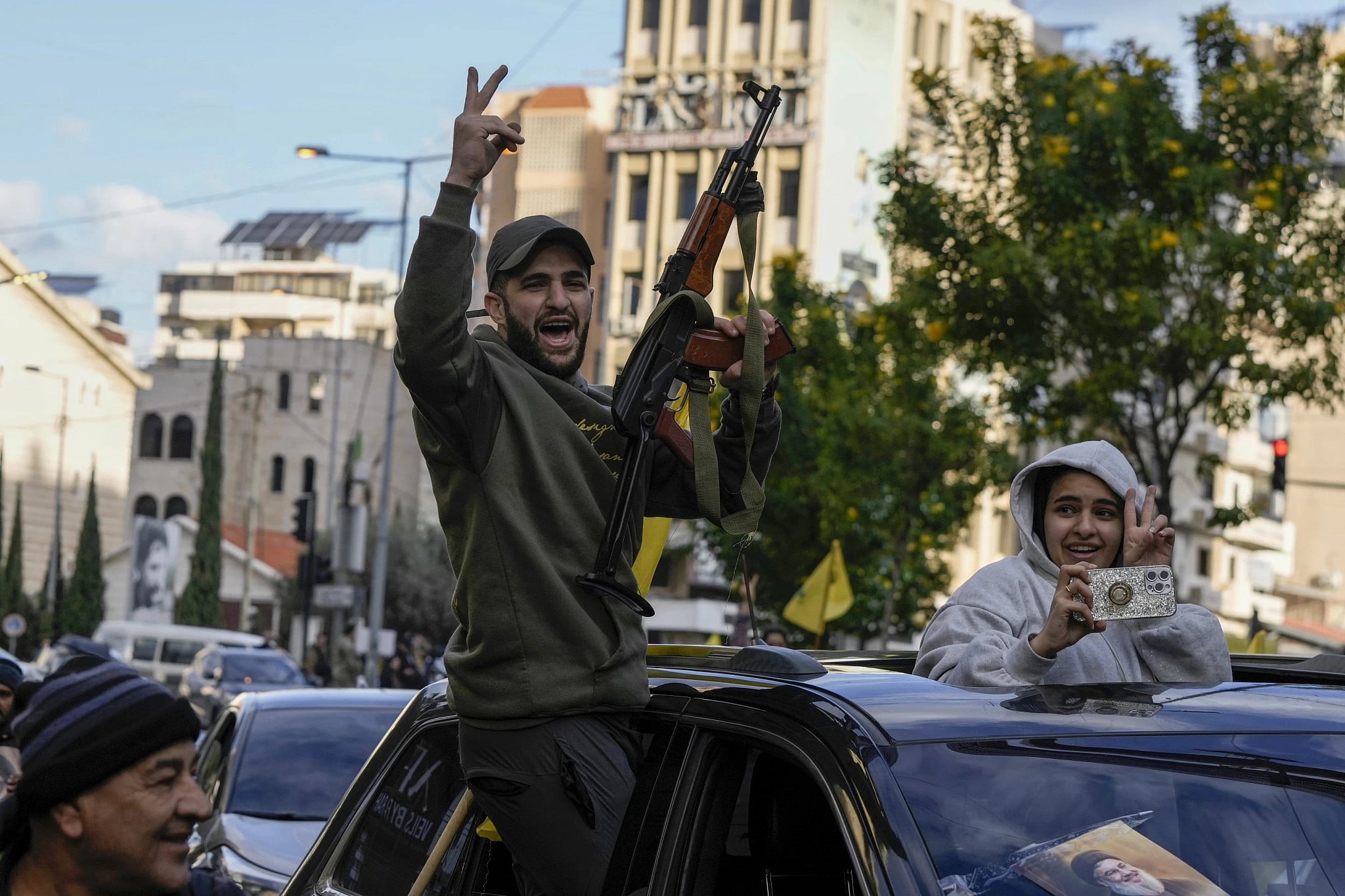
A Hezbollah supporter shoots in the air in celebration as displaced residents return to Dahiyeh, in Beirut, Lebanon, following a ceasefire between Israel and Hezbollah that went into effect on Wednesday, Nov. 27, 2024. (AP Photo/Bilal Hussein)
Hezbollah’s greatest victory is convincing people that every crisis it creates proves why it is needed.
The claim that Hezbollah is Lebanon’s defender is one of those remarkable Middle Eastern ideas that survives not because it makes sense, but because it has been repeated for so long that many people have stopped examining it. Like the claim that every dictatorship in the region is only one election away from becoming Denmark, it survives through repetition, not evidence.
The argument goes something like this: Hezbollah protects Lebanon from Israel. Hezbollah resists Israel. Hezbollah defends Lebanese sovereignty. Hezbollah alone stands between Lebanon and occupation.
There is only one small problem.
Hezbollah keeps opening fronts and then cites the existence of those fronts as proof that only it can defend the nation. In any other context this would be recognized as a contradiction. In Hezbollah’s case it is called resistance.
To understand how absurd the argument is, one must begin where many of Hezbollah’s defenders prefer not to begin.
The story did not start with Hezbollah.
Nor did it start with Israeli tanks crossing into Lebanon in 1982.
The story began years earlier when the PLO transformed southern Lebanon into a launching pad for attacks against Israel. Northern Israeli communities were subjected to raids, shelling, and terrorism planned and coordinated from Lebanese territory. Yet many modern retellings of the conflict conveniently skip this chapter altogether. Israel simply appears one morning as though it woke up, looked north, and decided Lebanon would make a charming territorial acquisition.
In reality, Israel entered Lebanon because terrorist organizations were operating there with relative freedom.
One may debate whether every Israeli decision during that period was wise. One may criticize mistakes, excesses, and strategic failures. But pretending the story began with Israel’s arrival is like beginning a crime documentary with the police showing up and concluding that the police caused the crime.
Hezbollah emerged in the aftermath of Iran’s 1979 Islamic Revolution and was influenced, funded, trained, and guided by Tehran. Its founding vision was not simply defending Lebanon. It was part of a broader revolutionary project inspired by the Iranian model. Hezbollah was not conceived merely as a shield for Lebanese sovereignty. It was conceived as an instrument of an ideological movement that viewed itself as part of a much larger struggle.
This distinction matters.
A national defense force exists to serve the nation.
A proxy exists to serve a mission.
The two are not always the same thing.
Indeed, if Hezbollah were primarily concerned with defending Lebanon, one might reasonably ask why so many of its most celebrated adventures seem to occur outside the realm of Lebanese defense.
Take 2006.
According to Hezbollah’s own mythology, it is a defensive force. Yet in July of that year, Hezbollah crossed the border and abducted two Israeli soldiers, triggering a devastating war.
Obvious questions follows.
Which Lebanese village was being defended during the kidnapping operation?
What imminent threat to Beirut was neutralized by crossing into another sovereign country and seizing soldiers?
Because once actions are examined rather than slogans repeated, the mythology begins to wobble.
Then there is Syria.
For years Hezbollah sent thousands of fighters into Syria to support Bashar al-Assad’s regime during the civil war. Again, one is compelled to ask rather impolite questions.
How exactly was fighting for Assad in Aleppo an act of defending Lebanon?
Did the borders of Lebanon suddenly expand to include large portions of Syria?
Was Damascus secretly a suburb of Beirut all along?
The remarkable thing about Hezbollah’s definition of defense is its geographical flexibility. Under normal circumstances, defense involves protecting one’s own country. Under Hezbollah’s interpretation, defense can apparently occur wherever Iran’s regional interests require reinforcement.
Then came October 2023.
Following Hamas’s atrocities in Israel, Hezbollah chose to open another front against Israel from Lebanon. Notice the order of events.
Nobody compelled Hezbollah to do this.
Nobody dragged Hezbollah into the conflict.
Nobody forced Hezbollah’s hand.
It was a choice.
This brings us to perhaps the most revealing development of all, Lebanon itself appears to be slowly losing patience with the mythology. For years, Lebanese governments tolerated Hezbollah’s independent military status. In 2009, Hezbollah’s weapons were effectively legitimized as part of Lebanon’s defense posture. The argument was familiar: Hezbollah’s arsenal was necessary because Israel existed.
But reality has a habit of eventually presenting the bill.
Today, Lebanon’s government is pursuing measures aimed at restricting Hezbollah’s military role. Prime Minister Nawaf Salam administration, backed by President Joseph Aoun, is pursuing a gradual disarmament process and reinforcing the principle that military authority belongs to the state.
After decades of being told that the militia was protecting the country, many Lebanese have begun noticing that the country keeps ending up in crises brought about by the militia. This is not an entirely irrational observation, If every road somehow leads back to the same armed organization, eventually people begin questioning the road signs.
The mythology however, survives because it performs an important political function, It removes responsibility.
If Hezbollah launches attacks and Israel responds, Hezbollah is defending Lebanon.
If Hezbollah enters Syria, Hezbollah is defending Lebanon.
If Hezbollah opens another front in a regional war, Hezbollah is defending Lebanon.
No matter the action, the conclusion remains fixed.
The slogan arrives before the event.
Reality is expected to adjust accordingly.
It is a remarkably efficient system. The verdict is rendered before the trial begins.
Yet slogans eventually collide with facts, and the facts are stubborn. Hezbollah was not founded merely as a defensive force. Its ideological roots extend far beyond Lebanese nationalism and its operations have repeatedly extended far beyond Lebanese territory. And increasingly, even Lebanon itself appears to be questioning whether a heavily armed Iranian-backed militia operating outside full state control is truly the guardian of Lebanese sovereignty.
Which brings us back to the original claim.
Is Hezbollah Lebanon’s defender?
In one sense, yes.
Every time Hezbollah creates a confrontation, Hezbollah is there when the confrontation arrives. Every time Hezbollah starts a crisis, Hezbollah is available to explain why the crisis proves Hezbollah is necessary. Every time Lebanon pays the price for another escalation, Hezbollah’s supporters emerge to insist that the escalation demonstrates Hezbollah’s importance.
It is a remarkable model. The organization starts the argument, survives the consequences, and then submits itself for recognition as the solution. The mafia at least had the decency to call it a protection racket.
Hezbollah calls it resistance.
Related Topics
Related Posts