
A Moroccan Journalist
If Judaism Called Others Goyim, Islam Called Them Cattle
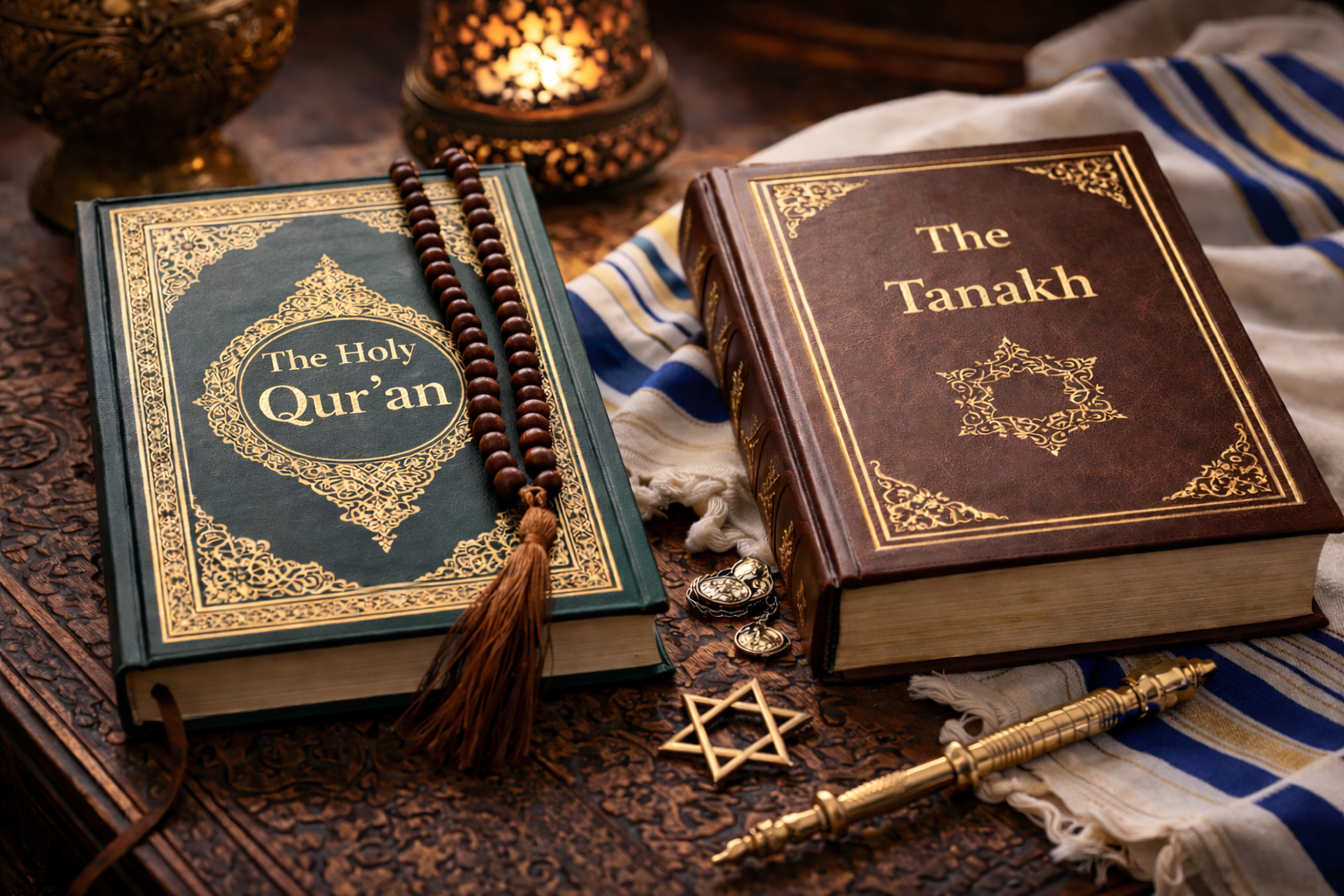
The Holy Qur’an and the Tanakh placed side by side. (AI-generated)
The concept of divine election – the theological claim that God has singled out a particular community for covenant, mission, and metaphysical favor – has been so thoroughly associated with Judaism that most people assume it begins and ends at Sinai. And historically, there is reason for this association. The Hebrew Bible, particularly Deuteronomy 7:6, declares Israel an am segulah, a treasured people, set apart not for numerical greatness but for an inexplicable divine love.
Surprisingly – and often inconveniently for polemical readings – Islam itself explicitly confirms this historical chosenness, acknowledging that divine preference was once granted to the Israelites in a concrete, worldly sense. “O Children of Israel, remember My favor which I bestowed upon you, and that I preferred you over the worlds” (Surah al-Baqarah 2:47). This Qur’anic recognition aligns with the Jewish self-understanding that emerged from the Sinaitic covenant and was later elaborated into a dense covenantal architecture by rabbinical tradition.
The Talmud, the Midrash, and centuries of responsa literature all grappled with what it means to be nivchar, chosen – and the dominant rabbinic consensus, from Saadia Gaon through Maimonides to modern Conservative and Reform theologians, has been that chosenness implies obligation, not supremacy. It is a yoke, not a crown; a burden of law, discipline, and accountability rather than a license for metaphysical arrogance or racial elevation.
Yet the concept metastasized. Christianity built an entire supersessionist theology on the claim that the Church had replaced Israel as Verus Israel, the true people of God, inheriting the covenant the Jews had supposedly forfeited. Mormonism located chosenness in the lineage of Ephraim. Rastafari re-localized it in Ethiopia. The Maasai believed Ngai granted them custodianship over all cattle on earth. Christian Identity movements in America constructed an elaborate racial theology in which Anglo-Saxon and Nordic peoples were the real descendants of Abraham and Jews were the cursed seed of Cain. Chosenness, it turns out, is the most contagious idea in the history of religion. Anthropologists rightly note that chosenness almost always functions as a legitimizing narrative: it explains why “we” possess truth, authority, or destiny while others do not.
And the great irony embedded in the very term that supposedly marks the boundary between chosen and unchosen – goyim – is that the word itself was first applied to Israel. Exodus 19:6 calls the Israelites a goy kadosh, a holy nation. The term carried no pejorative weight; it simply meant a people, a collective body. Its later semantic narrowing into a designation for non-Jews, carrying centuries of accumulated disdain, is itself a case study in how theological categories curdle into ethnic boundary markers. Jews are, by their own founding text, goyim – a goy kadosh, but a goy nonetheless. The very architecture of exclusion rests on a misreading of the original grammar.
Now here is what almost no one discusses with sufficient seriousness: Islam did not reject the concept of chosenness. It absorbed it, universalized it, and in many ways intensified it to a degree that would make the most triumphalist reading of Deuteronomy seem modest by comparison. The Quran does not whisper its claims. It declares, with the force of unmediated divine speech, inna al-dina ‘ind Allahi al-Islam – the only religion acceptable to God is Islam (3:19). Not one religion among many. Not a path among paths. The singular, exclusive, final dispensation.
And lest this be read as merely theological, the Quran immediately follows with the declaration that constitutes the Islamic charter of chosenness: kuntum khayra ummatin ukhrijat li al-nas – you are the best community ever raised for humanity (3:110). This is not a conditional promise. It is an ontological designation. The Muslim ummah is not merely good, or blessed, or favored – it is khayr, the superlative, the best, raised not for itself but li al-nas, for all of mankind, which positions every other civilization as the passive recipient of Islamic guidance.
The hadith literature amplifies this further. The Prophet Muhammad is reported in the Musnad of Ahmad and the Sunan collections to have said: antum tuwaffuna sab’ina ummah, antum khayruha wa akramuha ‘ala Allah – you complete seventy nations, and you are the best and most honored of them before God. Seventy nations rendered secondary in a single prophetic sentence. This is not subtle. This is not ambiguous. This is the most explicit claim to collective divine favoritism in any Abrahamic scripture.
And yet Muslims have developed a peculiar amnesia about this. They will criticize Jewish chosenness as ethnic supremacism while reciting, five times daily in their liturgical consciousness, a worldview that positions Islam not merely as true but as the only truth, and its adherents not merely as faithful but as the finest community in human history. The concept of kufr – disbelief – is not a neutral theological category; it is a moral verdict.
The kafir is not simply someone who believes differently; in classical Islamic jurisprudence, from the Hanafi usul to the Shafi’i fiqh manuals, the kafir occupies a diminished ontological station. The dhimmi system, often romanticized as tolerance, was in its juridical essence a hierarchy: Muslims at the apex, Ahl al-Kitab beneath them under conditional protection, and polytheists beneath even that. This is not a distortion of Islamic theology. It is its classical articulation, found in al-Mawardi’s al-Ahkam al-Sultaniyyah, in Ibn Khaldun’s Muqaddimah, in the fatwa collections of every major madhhab.
The theological conviction that Islam is al-din al-haqq, the religion of truth, and that its community is al-firqa al-najiyah, the saved sect, produces an exclusivism so total that it does not even recognize itself as exclusivism – it presents itself as mercy, as rahmah li al-’alamin, mercy to all worlds, which is perhaps the most sophisticated form of supremacism ever devised: one that reframes its own dominance as generosity.
To understand the Muslim political and psychological disposition across centuries – from the Umayyad conquests to contemporary Islamist movements – one must understand this: the average believing Muslim does not think Islam is a truth. They think it is the truth, the final, uncorrupted, supreme word of God, and that every other dispensation is either a corrupted predecessor or a deviation. This is not extremism. This is mainstream aqidah, mainstream creed, taught in every madrasa from al-Azhar to Deoband.
The Muslim sense of chosenness does not wear a kippah or carry a Torah scroll, so the world does not recognize it for what it is – but it is there, woven into every salah, every khutbah, every shahada: the unshakeable conviction that God spoke last, spoke best, and spoke to us.
There is a further dimension to this that elevates Islamic chosenness beyond even the covenantal exclusivism of Sinai: the doctrine of khatm al-nubuwwah, the seal of prophethood, which positions Islam not merely as a religion among the Abrahamic sequence but as the terminus of divine speech itself. God, in the Islamic theological imagination, did not simply send another messenger – He sent the last one, after whom revelation closes permanently, and the Quran is not simply another scripture but al-muhaymin, the guardian and corrector that supersedes all prior texts (5:48).
This is a staggering metaphysical claim when examined without devotional anesthesia. It means that the Torah, the Psalms, the Gospels – al-Tawrah, al-Zabur, al-Injil – are acknowledged only to be demoted, recognized only to be declared corrupted through the doctrine of tahrif, textual distortion, which renders every prior scripture theologically unreliable and every prior community epistemologically orphaned.
Judaism and Christianity are not, in classical Islamic hermeneutics, parallel religions deserving coequal respect; they are earlier sharias, legislative codes sent for specific peoples at specific times, now abrogated – mansukh – by the universal and final legislation of Muhammad. The very word din, which the Quran reserves almost exclusively for Islam in its superlative sense, is distinct from shariah: a din is a complete cosmic order, a total orientation of existence toward God, while a shariah is merely a legal pathway, provisional and replaceable. Moses brought a shariah. Jesus brought a shariah. Only Muhammad brought the din in its consummate, irreplaceable, eternal form.
Even the Islamic etiquette of greeting encodes this hierarchy with striking precision: the full benediction of al-salamu alaykum – peace be upon you – is, according to the dominant position in the Hanbali and Shafi’i schools and grounded in sahih hadith, reserved for Muslims; when addressing a non-Muslim, the classical instruction narrows to wa alaykum only, a truncated response that strips the prayer of its full spiritual generosity, a small liturgical gesture that contains an entire theology of differential worth.
And here is where the parallel to Jewish exclusivism becomes not merely analogical but textually undeniable. Muslims have spent centuries accusing Talmudic Judaism of dehumanizing non-Jews – pointing to disputed interpretations of passages that allegedly compare gentiles to animals – while their own scripture, not in obscure commentary or contested midrash but in the unambiguous, undisputed, muhkam verses of the Quran itself, makes precisely the same comparison with even greater rhetorical violence.
Surah al-A’raf 7:179 declares of the disbelievers: they have hearts with which they do not understand, eyes with which they do not see, ears with which they do not hear – ula’ika kal-an’am bal hum adall, those are like cattle, nay, they are even more astray. And lest this be dismissed as a single rhetorical flourish, Surah al-Furqan 25:44 repeats the designation with chilling economy: do you think that most of them hear or reason? In hum illa kal-an’am bal hum adallu sabila – they are nothing but like livestock, rather they are even further astray in path.
This is not ambiguous. This is not a matter of rabbinic debate or interpretive tradition. This is kalamu Allah, the direct, unmediated, eternal word of God as Muslims understand it, comparing every human being who does not accept Islam to an animal – and then correcting itself to say no, actually, they are worse than animals, because animals at least fulfill their created purpose while the disbeliever squanders the cognitive and spiritual apparatus God granted them.
The cattle follow their nature; the kafir betrays his. This is dehumanization embedded not in the margins of tradition but in the marrow of scripture, recited in tahajjud prayers and tarawih nights, memorized by children in hifz programs across the globe, and yet never subjected to the same moral scrutiny that Jewish chosenness endures – because the Muslim world has perfected the art of critiquing others’ supremacism while breathing its own like oxygen.