
British Student Defending Israel
I’m Not Jewish. That’s Exactly Why I Care About Antisemitism

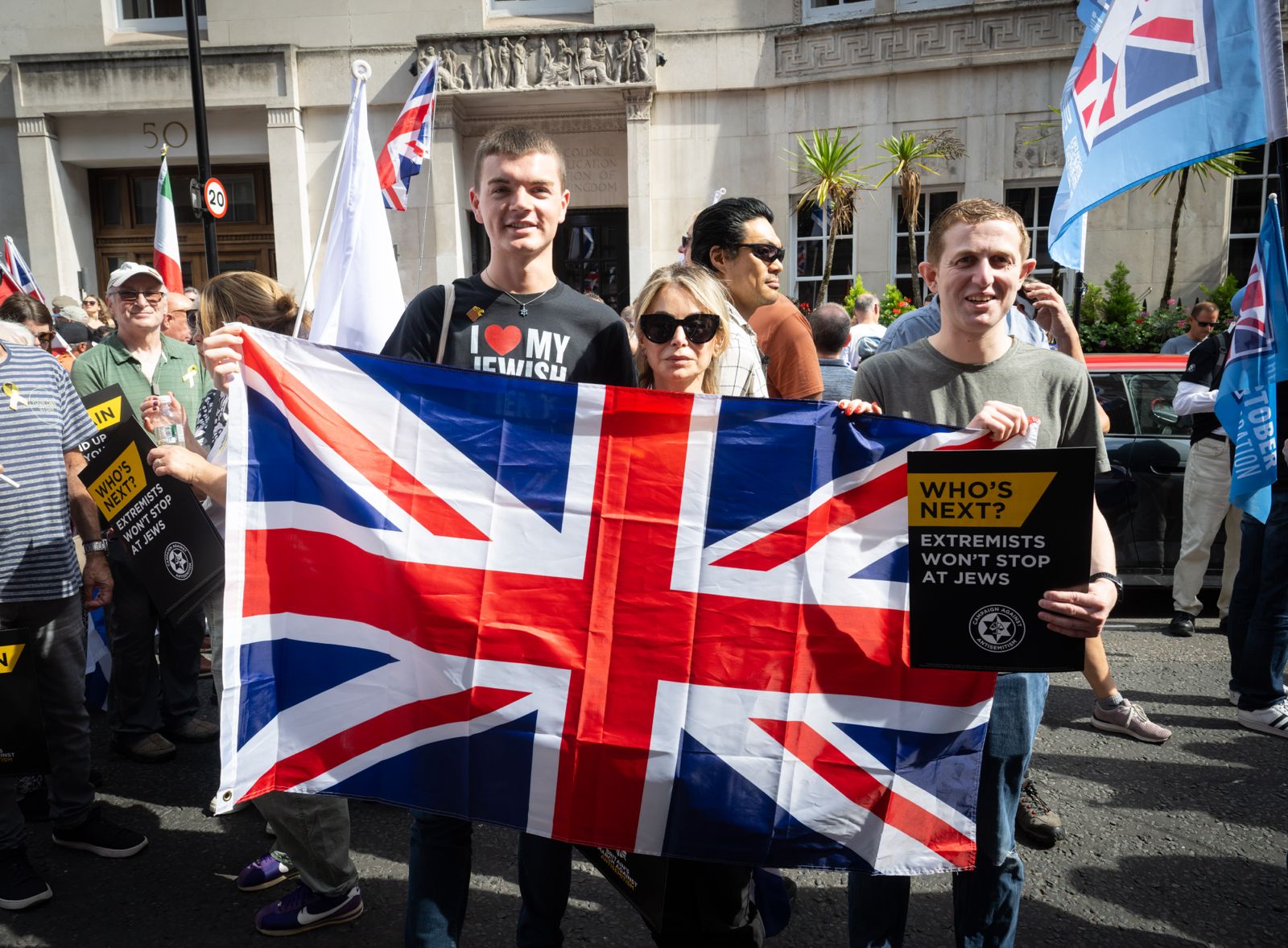
Standing with Britain's Jewish Community at a protest organised by Campaign Against Antisemitism in London. Credits: Elliott Franks
“You’re obsessed with Jews” I was told over the phone by a Pro-Palestine student harassing me via private calls at Royal Holloway, University of London.
But it did make me question myself.
Why do I care about antisemitism and the Jewish community? Instead of backing down, I doubled down on my support, and now some call me an activist, and here’s why.
I’m a non-Jew. Born and raised in the North of England, attending Christian, Catholic, and secular places of education in semi-rural villages, it was never diverse. I had no Jewish friends, no Jewish family, no Jewish connections. The first time I ever saw Jewish people was when I was about 10 years old, traveling through Manchester with my family, and I’d be confused by the men passing by with big furry hats on. We learnt about Judaism in Religious Education lessons in secondary school, but I only remember watching an outdated documentary. I’d never been to or even seen a synagogue. Realistically, I had no reason to care. But since moving to a London-Based University, I’ve seen what antisemitism looks like, and trust me when I say this: Antisemitism is not just a Jewish problem.
I didn’t find antisemitism. It found me.
I chose to study Politics, International Relations, and Law at University, and so, rightly, I expected to have my politics challenged. But before lessons had even begun, the confrontations had already started. It was Freshers Week, a time for socializing and getting to know people in your year group. But something stood out to me: the confrontations had gone from “Brodie, are you a Tory?” “Well, what do you think about immigrants?” “Are you racist?” to “What’s your opinion on Palestine?”

I’ll be honest, I had no clue. I wasn’t educated one bit on the conflict; I had only seen devastating headlines from Sky News, and I knew that my Political Party at the time, the Conservative Party, had always supported Israel. I used to answer, “Both sides are bad; it’s really upsetting what’s happening in the region”. It wasn’t long before I realized that that wasn’t good enough. You were either fiercely Pro- Palestine, or if you appeared neutral, you supported a genocide.
As I started to learn, watching documentaries and reading the history, as well as looking at the atrocities that broke out on October 7th 2023, I knew where I stood. I stood against Islamist extremism and terrorism. But this had a new name: antisemitism. In my second week of being at the University, I reposted a statistic about the record rates of antisemitism on my Instagram story. Only to be told I’m a ‘genocide supporter’ by a fellow student who later in the conversation suggested she supports Hamas. The terror group responsible for launching the deadliest massacre of Jews since the Holocaust. I was stunned, to say the least.
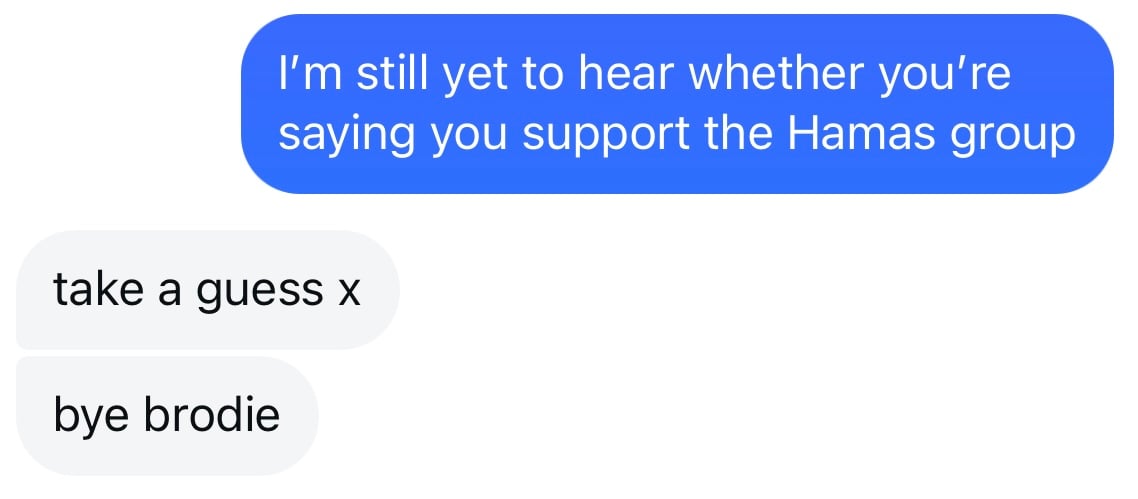
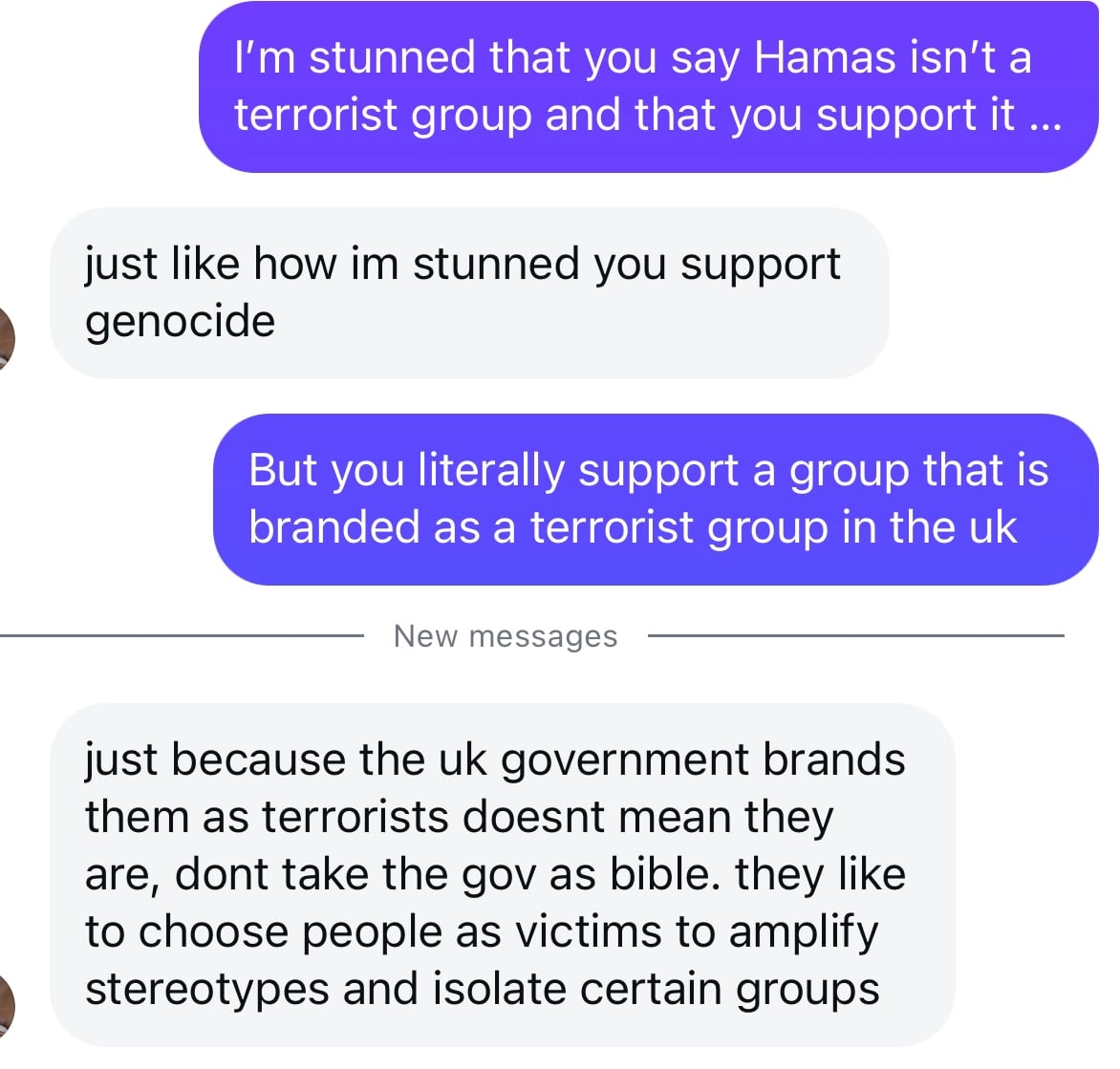
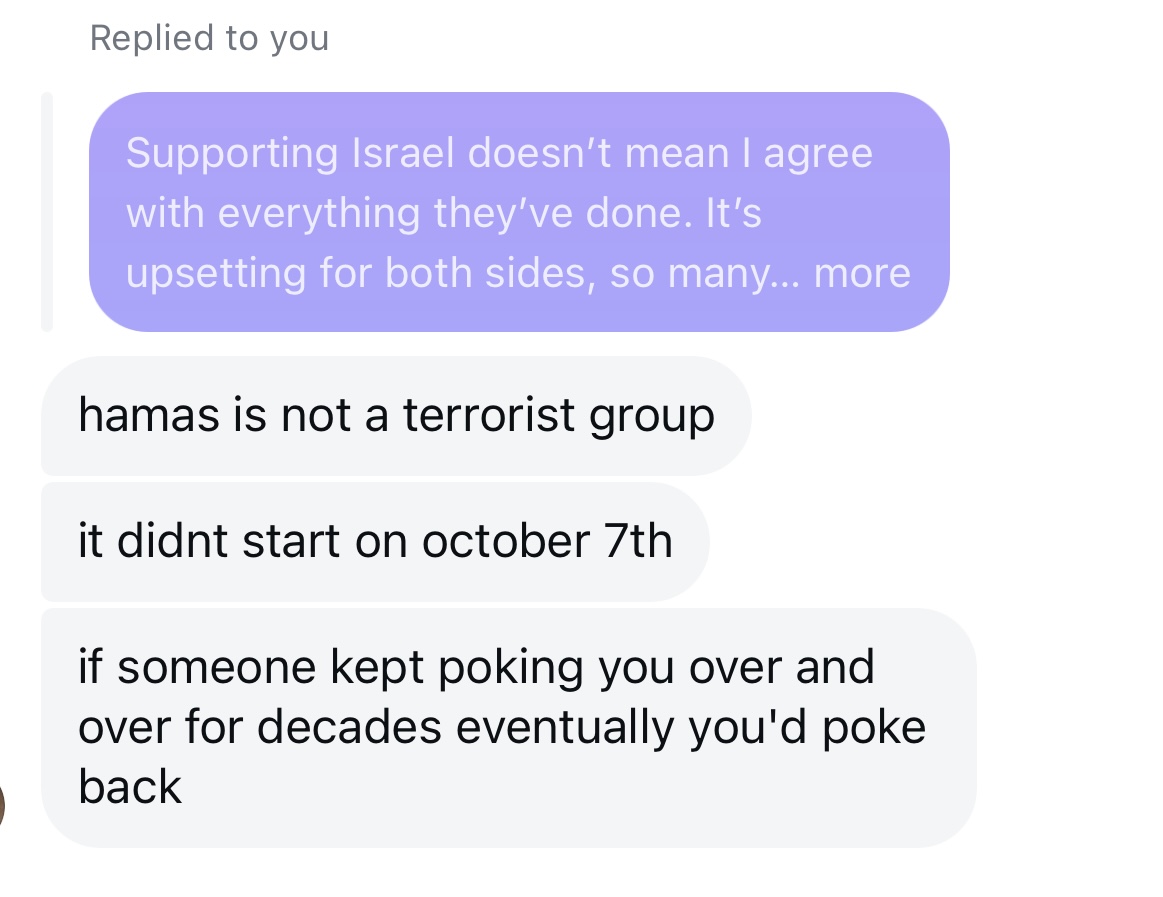
Messages from students started with things like the denial that Hamas is a terror group. Then ending with messages that, by my assumption, were an endorsement of a terror group.
Arriving at University, I expected debate and with debate comes criticism and disagreement – both of which are healthy. But instead I was met with open hate against Israel and the Jews, intimidation, justification of terror groups, and vile 1930s-like ideology. The sort of comments I had only previously heard in my GCSE History classes about Nazi Germany. I didn’t go searching for antisemitism; it found me!
Antisemitism – the new campus trend
When I met new friends during first term in 2024, there was a series of occasions when students, who were fully aware of my opinions and politics, would openly start the conversation about ‘the Jews’. That’s when I realized that Jew-hate wasn’t only aligned with Islamists and the far left; it’s also prevalent on the right. I recall one student, a friend at the time, walking with me to the shop, and when he was asking why I care so much and what have the Jews ever done for me etc, he said “You know what I think? All the Jews are leaving Europe and going to Israel, so we should just get a giant bomb and kill them all”, I was disgusted. I felt quite sick and couldn’t look at him the same again. Other conversations included, “the Jews run the banks, they run the media, the world’s richest man is a Jew”. And so it was like that; I quickly learned the hard way that you can’t ignore such hatred and turn a blind eye.
I started asking questions:
The hatred was mainly prevalent within the Pro-Palestine activist circles, and so most of the student population. I noticed a couple of things. Antisemitism was mainly driven by those of ethnic minorities and young women from Islamic backgrounds but who don’t call themselves religious muslims. Secondly, it seemed that almost all of these students would refer to themselves as Human Rights activists who care about global injustice. And this is where I questioned: why don’t these people speak about other incredibly challenging environments across the globe? The Uyghurs in China, locked away in camps – clearly religious discrimination. The women and girls in Afghanistan who aren’t even allowed to speak in public or have an education. These same “free Palestine” mouthpieces only ever seemed to mention Gaza. There were no posts from feminists about the report on sexual violence against women and girls on October 7th and beyond. No mention of the situation in African countries where Christians are being slaughtered.
I quickly arrived at the conclusion that these useful idiots were Gaza-obsessed, and most of them were not interested for humanitarian reasons, but were interested because it allows for greater promotion of their antisemitic, blood-libel, genocide accusatory language; it furthers their narrative. After all, the Jewish community have faced thousands of years of hatred; a few chants of ‘Free Palestine’ aren’t going to break them.
The Realisation:
In May 2025, I met the fantastic ‘Stop The Hate’ group in London, who were holding a vigil for victims of Islamist terrorism – mainly October 7th, but also the anniversary of the Manchester Arena attack, where young girls were targeted by an Islamist at an Ariana Grande concert. Meeting these people outside of King’s College London has forever changed me. I had gone from feeling alone about my experiences on campus to joining a huge Jewish community who had all faced the same experiences, if not worse. It was when I heard from the likes of Jonathan Sacredoti, Iranian speakers, and a Hindu from India that I realized we all share the same enemy. The Jewish people’s battle is our battle – a common one.

I soon realized that antisemitism is dangerous because of what it exposes about the people who are spreading it. The truth is, the hatred, the extremism comes from a collective that is, quite frankly, Anti-British. Antisemites are no friends of the UK; rather, they’d prefer to see the downfall of Western civilization. This is the point at which I think about the kind of person who hates Jews. If we picture, for a moment, our general stereotype of an antisemite, forget about the odd looks for a second; the hatred from these people never ends at Jews. It’s often the case that they hate freedom, strong women, democracy, the LGBT community, Christianity, British history and colonialism, and, quite frankly, anyone who dares to question the status quo. Anyone who isn’t the default herd-following, gutless coward.
If we take a glance at the real ‘far-right’, I can find a series of people, Neo-Nazis, should I say, on social media who are plain and simple racist. I’ve had accounts calling me a traitor, a Jew, and questioning why I have the Star of David on a British flag. They genuinely hate Jews and Muslims, and want Britain to be solely white and Christian. These people pose a serious threat; we mustn’t turn a blind eye. They are the same people who are racist towards leaders like Rishi Sunak, Kemi Badenoch, Suella Braverman, and David Lammy. This is also reflected in data provided by MI5 that show, between the years ending March 2023 and 2024, the Extreme Right Wing made up 1,314 cases of Prevent Referrals, compared to 913 Islamist referrals.
But along with this, we must also take a serious approach to Islamist extremism when assessing antisemitism. Whether it’s Imams spreading dangerous rhetoric in mosques, Islamic University groups mourning Iran’s Ayatollah, or Arabic chants on London streets against the Jews. We also musn’t forget the data on UK terror attacks and which ideologies are the most prevalent.
While the recent terror attacks may have only targeted Jews in Manchester and London, have you forgotten about the deadly attacks on ordinary non-Jewish Brits? Whether it’s the 7/7 attacks – before my time, the Westminster attacks, the London Bridge attacks, the Manchester Arena Ariana Grande attack, the beheading of soldier Lee Rigby– the hatred never ends at Jews.
Manchester tells us I am right:
If we take a look at security and make this something a bit wider than Israel and antisemitism, let’s look at the recently foiled attack, dubbed what would’ve been the deadliest terror attack in British history. The target was a synagogue, so most of you non-Jews probably didn’t even bother to read about this. The typical British ignorance of “well, I’m not Jewish, so it doesn’t matter to me”. Well, this next bit shows us that while jews may be at the top of the list, you’re next.
While Saadaoui and Hussein, the main perpetrators in this case, expressed their deep hatred for Jews, and said this was retaliation for what’s happening in Gaza, Saadaoui exposed something much deeper. He told an undercover officer that the attack would, of course, begin with the jews, but more telling, he mentioned that any Christian victims would be a bonus. Referring to Christians as the crusaders.
So I guess my point is this – these Islamists weren’t just targeting Jews. They targeted Britain. As Home Secretary, Shabana Mahmood said, “An attack on our Jewish community is an attack on this entire nation”.
What Antisemites actually hate:
Antisemites don’t hate Jews because Jews are ‘unique’; instead, they hate them because Jews and the World’s only Jewish state represent everything they hate – an open society, freedom of religion and expression, democracy, the ability to debate, and tolerance and respect. All of which are British values too.
Heading back to the original question I continue to face, “Why do you care so much about the Jews?”
Well, it’s simple. While antisemitism is seen as a Jewish issue, it often isn’t the case that us non-Jews link jJw hate to hatred towards our nation, to our people, not stopping at Jews, rather, continuing the persecution to their next ‘easy targets’. So you might disagree, but antisemitism isn’t just about hating jews. It’s about hating Britain, hating the West; it’s associated with our domestic security, and of course democracy and freedom.
I am not Jewish, and I will not stop talking about this. My fellow students on campus can continue to call me obsessed, harass me, continue the death threats and the institutions can continue the two-tier justice and accusations of Islamophobia. Because I will continue to say it how it is. That is, when I hear people- students at my University or just the general public- attacking Jews, celebrating Islamist terrorism, spreading hate on the streets of Britain, attacking people based on their race, ethnicity, religion – I do not see a Jewish problem. Quite frankly, I see a British problem. And unfortunately, by the time everyone else recognizes this, it may already be too late.
Related Topics
Related Posts