Documenting Hidden Jewish Histories and Legacies
In 1841, an American Jew called America “our Palestine”
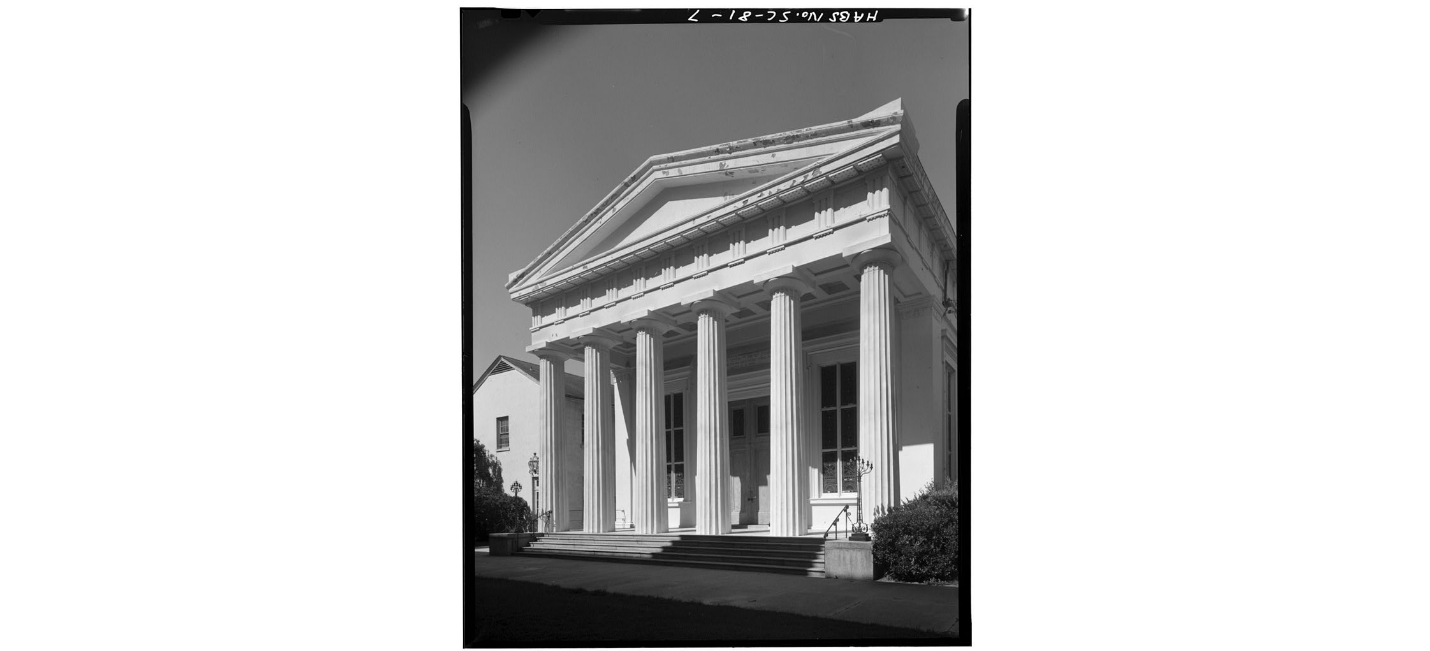
Kahal Kadosh Beth Elohim Synagogue in Charleston, South Carolina. (Historic American Buildings Survey/Library of Congress)
In 1822, Jews in Philadelphia placed the Constitution of the United States inside the cornerstone of their new synagogue. Mikveh Israel, one of the country’s oldest Jewish congregations, was building on Cherry Street near Third. Alongside American coins and an engraved plate went a volume containing the federal Constitution and the constitutions of the states.
The inscription on the plate marked the occasion according to two different reckonings of time. The cornerstone had been laid on the 11th day of Tishrei in the year 5583 of the Jewish calendar and on Sept. 26 “in the 47th year of the Independence of the United States of America.”
“This happy country,” the inscription declared, was one “in which religious and civil liberty is secured to its inhabitants.” The congregation prayed that the peace of the country, the integrity of its government, and the reign of “Virtue, Liberty and Independence” would endure.
When the building was consecrated in 1825, Christians and Jews gathered in the sanctuary. Among those present were Episcopal Bishop William White, other Christian clergy, the chief justice and associate justices of the Pennsylvania Supreme Court, and other prominent citizens.
The newspaper reporting on the ceremony saw in that gathering evidence of “the happy equality of our religious rights” and “the prevailing harmony among our religious sects.” Europeans, it suggested, should take notice: In Pennsylvania, Jews possessed political rights alongside Christians and were eligible for public office.
Around the same time, more than 70 clergymen representing different denominations assembled to meet the Marquis de Lafayette during his Philadelphia stop on his Farewell Tour of the United States. According to the newspaper, Lafayette was struck by the sight. Such an “assembly of brothers,” he observed, could be witnessed “in no other part of the world.”
For many of America’s earliest Jews, there was something exceptional about their new country.
In 1805, the Jewish congregation in Charleston, South Carolina, wrote to Jews in London while searching for a new religious leader. Its members described life “in a free and independent country like America, where civil and religious freedom go hand in hand.”
Here, they wrote, Jews were “incorporated and known in law” and enjoyed the blessings of freedom “in common with our fellow-citizens.”
When Charleston’s new synagogue was consecrated in 1841, the governor, judges, members of Congress and the state legislature, the mayor and aldermen, Christian clergy, and the general public were invited. A local newspaper praised the congregation’s contribution to the city and described its members as “our Hebrew fellow-citizens.”
During the dedication, the congregation’s hazzan Gustavus Poznanski spoke about the civil and religious privileges Jews enjoyed in the United States. Then he turned to what America had become.
“This synagogue is our temple,” he declared, “this city our Jerusalem, this happy land our Palestine.”
As their ancestors had defended their land, he continued, American Jews would defend “this temple, this city and this land” until “the last drop of our blood shall be shed on the shrine of our religion and our country.”
Nor did belonging require declaring that they had always been here.
In 1847, in Richmond, Virginia, a small congregation of German Jews appealed to their neighbors for help building a synagogue and school. The congregation had grown to 36 members and could no longer fit comfortably in its existing place of worship.
Its appeal acknowledged that many members had come from somewhere else. Yet it expressed confidence about their place in their new home.
“Although foreigners,” they wrote, “they are not strangers among them.”
There was a reason for that confidence. Only months earlier, Richmond’s Jews had organized a ball to raise money for the Hebrew school. So many of their “Gentile friends” subscribed that organizers expected them to outnumber the Jewish participants. Several prominent non-Jewish Richmonders agreed to help manage the event, while others contributed directly to the school fund. The organizers thanked their “Gentile neighbors” for the assistance.
In Cincinnati in 1834, 52 Christians each contributed $25 toward construction of a synagogue. When the building was dedicated two years later, so many “Christian friends” wanted to attend that the congregation could not accommodate them all. Its members gave preference to local clergy and the families of those who had helped pay for the building.
America was hardly free from antisemitism in these years, nor did religious liberty erase the other injustices of the early republic. But another tradition was taking root too.
What makes someone an American? The question is as old as the country itself. These early Jewish communities offer one answer.
That history remains worth remembering as Americans again ask who gets to be American.
Mikveh Israel, the Philadelphia congregation that placed the Constitution in its cornerstone, still exists today. So do the congregations described in Charleston, Richmond, and Cincinnati. More than two centuries after some of these stories began, they remain among their neighbors.
Related Topics