Documenting Hidden Jewish Histories and Legacies
In 1874 Buffalo, a Synagogue Spoke of Judaism’s Global Mission
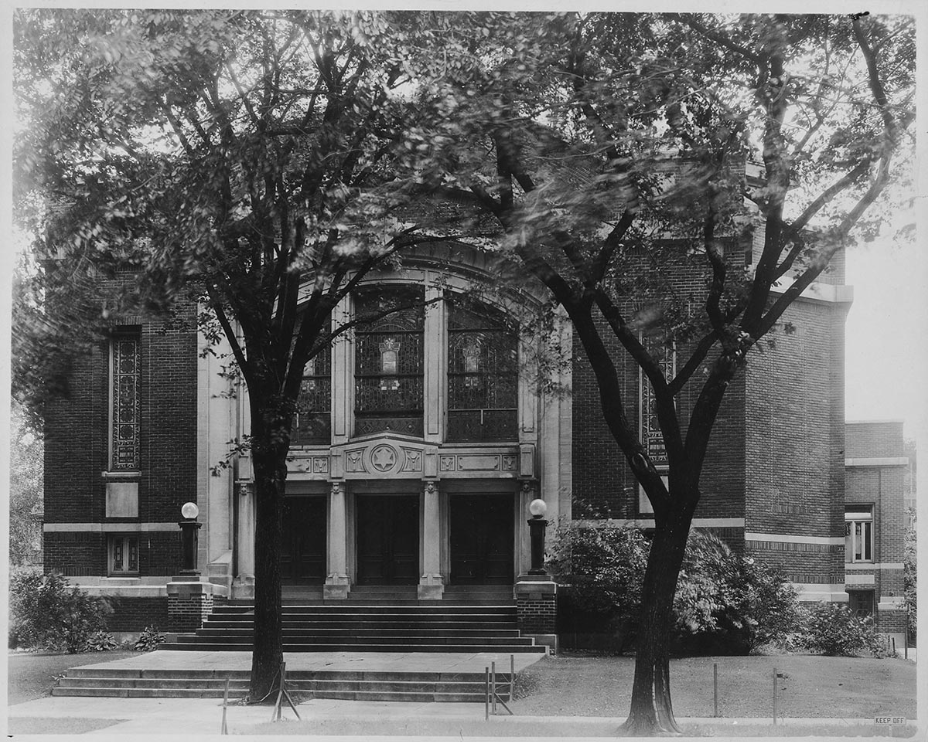
Temple Beth El on Richmond Avenue, c.1920s. This was the congregation’s second home, dedicated in 1911, decades after the events featured in this essay. Source: Jewish Buffalo History Center, Temple Beth El, Richmond Avenue, c.1920s. https://jewishbuffalohistory.org/temple-beth-el-photos/temple-beth-el-richmond-avenue-c-1920s/
In August 1874, Buffalo’s Jewish community gathered to dedicate a new red-brick synagogue on Elm Street. Beth El was the city’s first purpose-built synagogue, a Romanesque-style building that could seat 500—an ambitious space for a congregation of just 35 families. Inside, a choir from the Reform congregation Beth Zion sang in German as Torah scrolls were carried under a canopy. Two young women presented the ceremonial key to open the sanctuary.
Then the congregation’s president, A. F. Cohen, rose to speak.
“Though few in numbers,” Cohen said, “they have been successful in their efforts by great sacrifices on their part, and the aid and assistance of friends and neighbors, whom I also now take the opportunity to thank for the helping hand they extended to us.”
So far, the tone was what you’d expect—gratitude, pride, civic goodwill. But then Cohen went further. His words leapt beyond Buffalo, beyond the 19th century, beyond even the walls of his new synagogue:
“By this building they have done their share towards fulfilling the divine mission of Israel, as prophesied on Mount Sinai… For it is Israel’s mission to carry its truths unto the world at large.”
I was struck.
How often do we speak of the Diaspora today like this? A “divine mission”? A responsibility to carry Judaism’s truths “unto the world at large”? As a convert to Judaism, and someone who has been active in the Jewish community for over ten years, I can say I rarely, if ever, hear these stories — stories that resonate deeply with my understanding of Judaism. They are the same Jewish teachings that first inspired me and led me to embrace Judaism in 2015. In many synagogues I’ve attended over the years, I hear a great deal of talk about engagement strategies, demographic outlooks, and the next generation’s tenuous connection to Jewish life. The United States is home to the world’s largest Diaspora community; nearly three-quarters of Diaspora Jews live here. American Judaism is shaping, and will continue to shape, the future of Jewish life. Yet too often it seems younger Jews, particularly those around my post-college young professional age, are searching for meaning. What is the goal of Jewish life in America? What is Judaism’s purpose in the world?
In 1874 Buffalo one leader offered a vision. Before the congregation a vision was declared of a confident, outward-looking, and universal Judaism. A Judaism that existed not only for itself but for the sake of the world.
It wasn’t a call for conversion campaigns. It was a theology of ethical witness. The Judaism of Cohen’s imagination was expansive—meant to shape civic life, to inspire neighbors, to add what the prophets called tzedek (justice) and chesed (mercy) to the fabric of society.
That idea once pulsed through Reform platforms and American Orthodox sermons alike. Isaiah’s words—“My house shall be a house of prayer for all peoples”. In Buffalo, the 1874 dedication was itself an exercise in pluralism: non-Jewish neighbors packed the sanctuary, and a Reform choir sang in an Orthodox synagogue. The local press noticed, remarking that the cooperation of “orthodox and reformed societies” showed “how little apart the two divisions really are.”
Even Buffalo’s first synagogue dedication in 1850 had drawn a crowd “principally of residents not of Jewish origin,” according to reports at the time. Clergy, judges, and business leaders came to celebrate. A collection was taken up on the spot, raising $560—a remarkable sum in that era.
Buffalonians imagined something hopeful together: that religious difference could be a bridge, not a barrier. And Jewish leaders like Cohen spoke in a voice that centered Judaism’s spiritual ambition.
But over time, that universalist voice grew quieter. In the 20th century persecution and genocide reshaped community priorities. At the same time, political Zionism increasingly shaped Jewish identity, centering a nationalist conception of Judaism. Then came the Holocaust, which destroyed so much — including Jewish communities that had spoken in the same universalist voice heard at Beth El in Buffalo. Today, I wonder: has that vision been recovered?
The shift in vision was shaped by extraordinary circumstances unlike anything in the history of the Jewish people. I wonder what we’ve lost.
As a historian, who first encountered these moments while writing about small towns in Ohio, I’m drawn to moments like Buffalo’s 1874 dedication because they remind me why I was drawn to Judaism in the first place.
So many Jews are asking: what is the point of Judaism? What does it mean to be Jewish today? I find myself asking: what can we learn from Buffalo in 1874?
We don’t need to proselytize to reclaim that vision. We only need to remember our tradition still carries truths worth sharing; truths about justice, dignity, Shabbat rest in an age of exhaustion, and community in an era of isolation. These are universal values to which Judaism has something unique to contribute.
What would it look like to recover that vision? To speak again as A. F. Cohen spoke, believing that Judaism exists to bless the world?
Maybe it begins by radical welcome. A welcome modeled on Abraham who had all four sides of his tent open to others. Welcoming the stranger, and also welcoming the seekers. Telling them there may be something here you would like to hear.
The vision spoken in Buffalo nearly 150 years ago is still alive. The question is whether we will claim it; sharing Judaism with those who are searching for meaning. Judaism unto the world at large. Buffalo once shared this. Will we?
Related Topics
Related Posts