
In conversation with rock legend John Illsley – My Life In Dire Straits

“We were lucky we weren’t teenagers – that would certainly have been fatal” writes Mark Knopfler in his forward to John Illsley’s autobiography, reflecting on the band’s meteoric rise and an ever-changing landscape.
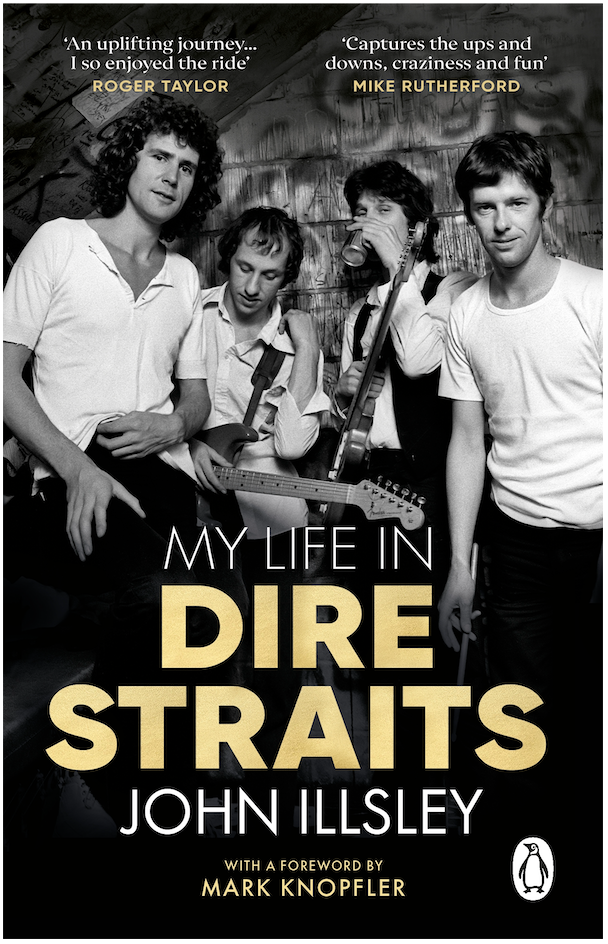 “The ride is not for everyone” Knopfler concludes, “not for those who can’t take the pressures and the pace, for whatever reasons. It was a different world. And John has remembered a pretty big chunk of it.”
From his thoroughly British Leicester 50’s childhood, to sharing a Deptford flat with David Knopfler, and founding one of Rock’s biggest bands with David’s brother Mark – My Life In Dire Straits is John Illsley’s striking account of the legend’s musical journey. Here Illsley reflects on his childhood, Dire Straits’ phenomenal ascend, Knopfler’s timeless tunes, their lifelong friendship, why context matters and the serendipity that guides our destinies.
HG My Life In Dire Straits is an awesome read – it is intelligent, insightful and honest.
JI It is really just a story. When I was revisiting it I found it interesting how all of these things come together in your life, and that’s one thing that I was trying to get across in the book, the idea that some things you do unconsciously and consciously – all these change the course of your life quite significantly, maybe not straight away but certainly down the track. So you should always go with your gut feeling and not worry about what others think, do what you feel is right – everything you do in life is an experience and adds to the rest of your life.
HG I definitely got that vibe from the book – the choices you made and the people you have encountered. You observe the actions of people around you and reflect on their impact, from girlfriends to your brother’s self constructed, life changing little radio.
JI That little crystal radio which my brother built was a very significant moment because we could tune in to pirate radio stations like Radio Luxembourg and Radio Caroline that were playing music that the BBC weren’t playing. This was the early 60s , and the BBC had a very conservative view of what was played, you wouldn’t hear Bob Dylan or the Stones. We also started getting records from America, this was a vital source of inspiration to all of us looking back this was a unique time to be growing up.
HG You embraced change and made courageous decisions throughout the band’s journey
JI Mark and I often spoke about how our age played a part, if we’d been 18 at the time when everything started getting a bit hectic, we’d probably be dead now, or on drugs, burnt ourselves out, you don’t have much common sense when you’re 18 years old, we were 26, 27 which to get started in the rock world was quite late.
Neil Young, Frank Zappa, The Temptations, Bob Marley, Van Morrison, Bruce Springsteen, Chuck Berry, Lou Reed, Jimmy Cliff, The Ramones, Patti Smith, Etta James, Jerry Lewis, B.B. King … and ‘Tonight, ladies and gentlemen, all the way from London, England, yes, please give it up for … Dire Straits!’ Or, in my head at least, please give it up for four lads from the borough of Lewisham.
HG You remember things in great detail – your council flat, meeting Mark Knopfler for the first time, uni days – you even remember moving things from one side of the room to another when trying to record or soundproof the room..this is golden information for fans and for musicians.
JI If you look at the lives of the bands in the early and mid 60s, you’ll find that they were all struggling, having to beg, borrow, and steal – changing the strings on your guitar was a luxury. We were very fortunate to have a fine songwriter, a great observer of the world we live in, quite a few other people recognised that as well. Sultans of Swing for instance a story about, a little jazz band in a grubby pub in Greenwich in South London, reminiscing about his first girlfriend on the steps of the banks of the Tyne, moments that everybody can relate to. Mark was able to put a dialogue down in a way that people could understand and relate to, that was the backbone of Dire Straits, this ability is everything because as I said before, a good song like a good painting will last a long time.
HG This is very true, these works are eternal in a way.
JI We would all love to paint pictures that everybody wants to look at forever or write a song that everybody wants to listen to forever, but it is not that easy.
HG There is also the element of luck, where you are, the people you meet, the fact that you you were roommates with Mark Knopfler’s brother for example, the fact that Charlie Gillett played your song.
JI Yes, but I have a little bit of a problem with the word luck. I wouldn’t have been in that council flat in South London if I hadn’t decided to drop my job at the age of 23, and go back to university. That decision to go to university at Goldsmith’s College and do sociology meant that I was able to get a cheap council flat from Greenwich Council; it was cheap but I still needed help with the rent. So I had to get somebody in and it just so happened it was David Knopfler. It could have been anybody off the street and maybe none of this would have happened. Now you can call that luck or you can call it coincidences. I believe that you make your own coincidences in life by making certain moves. If I’d chosen to stay with that company that I was working for, we wouldn’t be having a conversation now. These are significant decisions you make in your life that move things forward.
HG Also the fact that you’re such an accommodating, welcoming person, the fact that you and Mark are both musicians who got on well and created together.
JI Absolutely, if we hadn’t got on I would have carried on playing with the blues band at university and Mark would have kept playing with his rockabilly band in Essex. The amazing thing about it was when he brought his record collection to the flat when he moved in, it was pretty much the same as mine. So we ended up having two copies of quite a few records in the flat.

HG This is such a beautiful part in the book. The first encounters with fellow musicians, most notably with Mark where there was instant chemistry, where it was all about the music from the start
He plucked a few strings and twisted the tuning pegs. Then he really started playing, messing around with riffs and snatches of tunes. He had a curious finger-picking style. I had never seen anyone play a guitar like that, but even just fooling around, it was a great sound – a bit country, a bit rock – but fresh and original. Dave was right – his brother could play.
JI Up to this point he and I both had played with lots of different bands and musicians but as soon as we sat down together, it felt good. I joined the band he was playing with a couple of times as the bass player couldn’t do the gigs. After one of the shows we were sitting at a bar somewhere and decided we should try and put a band together, our own band.
HG It is like you and Mark were meant to be
JI That sounds slightly spiritual, ultimately it comes to actions and decisions – going back to Charlie Gilllet for example, the radio DJ who played Sultans for the first time, I could contact him because when I was at university, I started a record shop with my then girlfriend, which didn’t last very long, and I asked for Gilllet’s help because I used to listen to his radio show called Honky Tonk Music on a Sunday morning. I called my record shop Honky Tonk Records and I wrote to him, and said, “Charlie, I love your show, can you give me some advice on what records I should have in my record shop because I want to emulate what you’re doing on the radio. He sent back a huge list of albums to have in the store. So we got a reputation for having that kind of music, so I knew Charlie a little bit, so when we made the demo tape, I asked if I could send it to him, he kindly obliged. As you can see one thing leads to another , follow your gut then things might happen.
HG I agree. There was this famous golfer who said ‘it’s funny, the more I practice, the luckier I get’
JI That’s Gary Player – the more I practice funny enough, the better I get. Someone said, “you’re lucky, Gary”, and he says, “actually, no, I actually practice eight hours a day doing this.” I take it he still plays now, he’s over 90.
 HG The book starts with your parents who seem like the epitome of decency, charm, and kindness. How they supported you throughout your life – you describe being skint at uni and getting a cheque from your Dad,
JI Yes, he sent me £20 once and I asked him why and he said ‘your brother needed £20 so you’re all getting the same.’ I use the word old-fashioned, but that was a the way of bringing children up then, thank God we didn’t have the distractions that today’s children have and thank God my parents didn’t have to deal with that. It was a very playful existence. My brother Will and I, spent so much time outside just roaming the countryside on bicycles and building rafts and just having a kids life, people don’t do that kind of stuff anymore. Well, some do, but most kids are staring at a screen most of the day. We got into trouble, of course we did, but it was always pretty fair, that’s one thing that I remember very much with fondness about them that they were very fair and honest people. You’ve got to remember that they’ve just been through the war with the horrors of it all. They just wanted us all to be safe.
HG This is important – where they were coming from. You need to consider the time and see the context of things. This is something that you do really well in the book, from your childhood to Dire Straits fame, you put things in context.
JI Context is everything, Hannah, I mean, the way you write – everything’s in context, that’s the way it should be.
HG This comes across in the book, how these were different times. You wonder how much music you would have made had the internet been around, Paul McCartney too, has said that he doesn’t know how much music he and John would have made.
JI Yes if you wanted to make music you made it yourself
HG I love that you include throughout the book insight into society, family, and culture. Key transformative moments like your brother’s radio, uni days, Dire Straits becoming a global phenomenon, the band wrapping up, the notion of fame.
JI Fame is a tricky one. I would rather just enjoy the idea that we’ve been successful and both enjoyed the success. The fame bit is something quite different. In fact, most of the time to be avoided if possible. Mark got the brunt of it and he didn’t enjoy it at all. I got a certain amount of it, but not like Mark; he likened it to having a nice car but with something nasty coming out of the exhaust pipe. I don’t think Dylan particularly likes being seen the way people see him, on some kind of pedestal. He’s an entertainer who writes rather good songs.
HG A poet even.
JI He’s a poet, the Picasso of music. So great that he can still make an album like Rough and Rowdy Ways, just blew me away. I listened to McCartney’s new album recently, I liked it, quite reflective, the production is great.
HG He reminds me a bit of you in that respect – you do the same as in your coming Italy tour, you got on with the guitarist and a tour came into being, McCartney’s approach reminds me of you. You refer to Bob Dylan in the book. At a recent Dylan Camden tribute gig, the audience was made of teenagers, early 20s, they knew all the lyrics, sang along, it was incredible. How do teens come to know Dylan?
JI Once the young start listening to music they tend to go back to see what happened earlier and they discover that it touches them in some way, possibly in the way it touched us at the time. Apparently Dire Straits are having a renaissance on Tik Tok. It’s surprisingly but pleasing to hear that. My wife Steph spotted this in the newspaper, there was a whole article on Dire Straits becoming a Tik Tok sensation, and I thought to myself wonderful but probably for about five minutes and that’ll be it.
HG So apparently they’re all dancing to Walk of Life or something. Everyone loves the Walk of Life. It is sweeping.
JI Yes. Walk of life. And why not? The song has a certain universality about it
 HG I think the way Spotify’s algorithm works exposes people to a massive variety, it suggests things and apparently hits the mark, introducing people to music before their time that they love.
JI You’re talking to somebody who’s completely naive as far as technology is concerned. So, I have no idea how it works or why but fact of the matter is it’s obviously very efficient.
HG It introduces to people music that they would never have heard and that they find inspiring and moving.
JI There is nothing wrong with that.
HG Speaking of eternal tunes – many millions out there wishing for a Dire Straits reunion. It’ll be sold out in seconds.
JI There won’t be a reunion.
HG Was writing the book a positive experience for you?
JI Very much so. I found that I really enjoyed it and it was also something to do during lockdown. I did an album in lockdown too.
HG What did your fellow Dire Straiters make of your recollection of events?
JI I think they thought I got most of it right. In the forward Mark says that it was a different world and that I remembered “a pretty big chunk of it” – I think that’s about right.