
In Praise of Ambivalence
Today is October Eighth, 2025. Yesterday was two years since the Hamas attack on Israel. There was a book launch I wanted to go to but couldn’t. To sit in a literary event on this day seemed distasteful to me. But how did I want to spend the day? Two years ago, on the days just after the October Seven attack, I felt grief, nausea, pain. Literally, my heart ached. Everything I did—if it was taking a stroll in the crisp fall air, or eating breakfast, taking a shower or drinking coffee—every little thing reminded me of the 251 Israeli hostages and the life that was abruptly taken from them. I identified deeply with the hostages and their families. I felt it could’ve been me. I knew one of the hostages, a sister of a family friend. I read the people’s stories. I made sure my front door was locked at night, even though I lived in a suburb of Toronto, far away from the border with Gaza.
I couldn’t feel this way yesterday. The world has changed too much. Zionism became a swear word—closer to Nazism than a movement whose purpose was to build a land for the Jewish people. Antisemitism has risen, and the fear of antisemitism has risen even more. War became the new norm. Unavoidable, people might say. Not just war with Hamas, but also with Lebanon, Iran, Yemen and Qatar.
But most of all, what changed for me in the last two years is the killing in Gaza and the war crimes Israel has committed. Some call it genocide. I don’t want to throw this word off-handedly, but what happened in Gaza in the last couple of years burdens me.
Yesterday, when I asked an Israeli friend how he felt, my friend replied that it was a difficult day. Of course, it was. He lost a friend in the attack, the filmmaker Yahav Winner from Kfar Aza, who was killed saving the life of his wife and baby. And yet. How could he say that when every day civilians are getting killed in Gaza? I want to grieve the death of more than 1,200 Israelis who were killed on October Seven, but I can’t. I can’t because more than 67,000 Palestinians were killed in Gaza since October Seven. Some were starved to death. Many of them were children. I can’t because I feel ashamed. I feel wrong to think that only the death of my tribe is important, rather than the death of every individual.
On the other hand, I felt mad to the bones when I saw on Instagram a link to an article by a former professor and author. The article was published to promote his new fiction book and represented him as a hero fighting against evil powers because he demonstrated outside the Giller Prize ceremony last year. How dare he ride on the tragedy of my country and of the Palestinians to promote his book? How dare he pretend to be a social justice warrior because he protested along with many others against Israel—one of the most hated countries in the world nowadays.
My anger toward both my Israeli friend and my professor is the rage I feel constantly toward everyone who wants to say something. Who just has to say something! As if everything hasn’t already been said. As if there is something to say that would comfort us after the loss of so many individuals.
Thinking about not wanting to say anything, yet finding myself saying something, I was reminded of a book I finished reading a couple of months ago, Ambivalence: Crossing the Israel/Palestine Divide by Jonathan Garfinkel. I’ve been wanting to write about it since I finished reading it, but I couldn’t find the drive to do so until today.
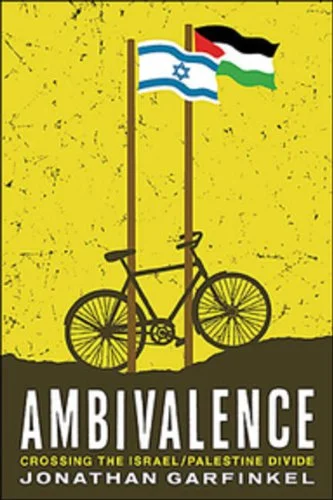
Ambivalence is a memoir by the Canadian poet and playwright Jonathan Garfinkel, which was published in 2007. After a meeting with an Israeli-Palestinian woman in Toronto, Garfinkel travels to Israel to confront the Zionist myths he grew up on. He searches for a house in West Jerusalem, which his friend told him about. A house in which a Jewish Israeli and a Palestinian live together in peace. But Garfinkel finds out the reality is more complicated. He confronts the silenced history of the foundation of Israel but also searches for people on both sides of the conflict who work toward reconciliation. He asks questions more than he makes judgments, letting the readers come to their own conclusions. But ultimately, he feels ambivalent, as the title suggests. Ambivalent because, after everything that he has found out in his trip to Israel, he still believes it should exist as a country for the Jewish people, though in a different and more just way than it exists today.
I am very curious to know what Garfinkel thinks about Israel today and whether he has changed his mind after the crimes that happened in Gaza recently. As for me, if there is anything I would like to say about this already too-much-said-about day, it is that I wish more people would stop using the war and the conflict to validate themselves and their own already made up minds, and could hold more curiosity and compassion for both sides.