
In Wehrmacht’s Footsteps? What is behind Trump’s Interest in Intel and Lockheed
Donald Trump’s recent flirtation with America’s defense and technology giants—first with Intel, and rumors about Lockheed Martin next—has raised alarm bells. On the surface, it might look like a business-minded politician investing in industries of “national importance.” But beneath the surface lies something darker: a playbook uncomfortably reminiscent of Adolf Hitler’s strategy to turn private industry into a war machine under the control of the Reich.
The Wehrmacht’s Model: Industry as a War Engine
When Hitler rose to power, he quickly recognized that military conquest required total industrial mobilization. The Wehrmacht couldn’t fight without a steady stream of weapons, tanks, aircraft, and vehicles. To make that happen, Hitler turned key industries into cogs of the Nazi state. He appointed Albert Speer, his Minister of Armaments and War Production, to coordinate this vast machine.
Speer consolidated Germany’s steel, automotive, and chemical sectors into a single war engine. Volkswagen shifted from people’s cars to military transport. Junkers and Messerschmitt churned out warplanes. Krupp became synonymous with artillery and tanks. These weren’t isolated corporations anymore; they were extensions of a militarized dictatorship.
Fast-forward to Trump. He is no intellectual mastermind, but he has instincts for power—and more importantly, he has advisors who understand history. His push toward Intel signals more than economic nationalism. Semiconductors are the backbone of modern warfare, powering everything from drones to satellites. Controlling that supply chain is essential for any authoritarian bent on projecting military dominance.
And if Intel is step one, Lockheed Martin could be step two. Lockheed is the crown jewel of America’s defense sector—the maker of fighter jets, missile systems, and space weapons. If Trump, or those guiding him, tether political power directly to the defense-industrial complex, the echoes of Hitler’s model become impossible to ignore.
The warning signs are not just corporate. Trump already tested deploying the U.S. military domestically during the 2020 George Floyd protests, most notably in Washington, D.C. Now, he openly discusses using federal forces in major cities like Chicago and New York. He’s building a loyalist paramilitary wing through ICE and recruiting fervent MAGA supporters into “law-and-order” militias. Many are under-trained, but they are armed and loyal.
The prospect is chilling: a president embedding soldiers and private police forces inside American cities while consolidating control over industries crucial for war. That’s not democratic governance—it’s authoritarian state-building.
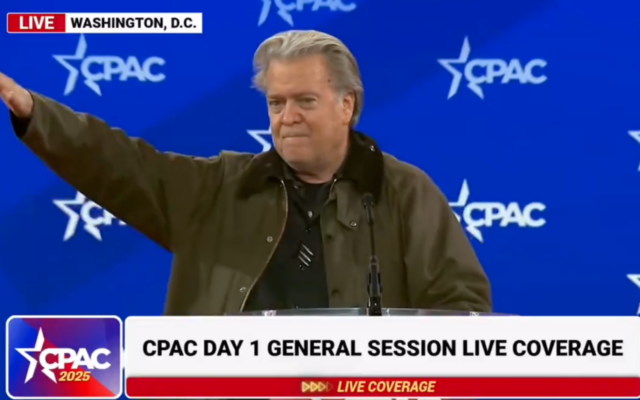
Trump’s grasp of history and economics is notoriously shallow. He is not the architect of such a strategy. The real question is: who is? Steve Bannon looms as the most likely suspect. Bannon has openly spoken about “the Fourth Turning,” a belief in civilizational crises that birth strongmen leaders. He understands propaganda, economic leverage, and how to weaponize chaos.Recently on his “War Room” he even referred to the German army in WWII as “The greatest war machine in history”. If anyone is whispering in Trump’s ear about building a modern Speer-like apparatus, Bannon is the prime candidate, as he is also pushing for military action against “Drug Cartels” in Mexico and Venezuela. A classic excuse.
From Intel to Lockheed, from Washington deployments to MAGA militias, all signs point in one direction: a march toward authoritarianism built on control of industry and armed force. Trump may not be smart enough to design this strategy, but he doesn’t need to be. He craves the role of dictator, and there are people around him who think they see an open road to making it happen.