
Urban sociologist and geopolitical commentator
India’s Power Grid and the AI-Era Sovereignty Problem
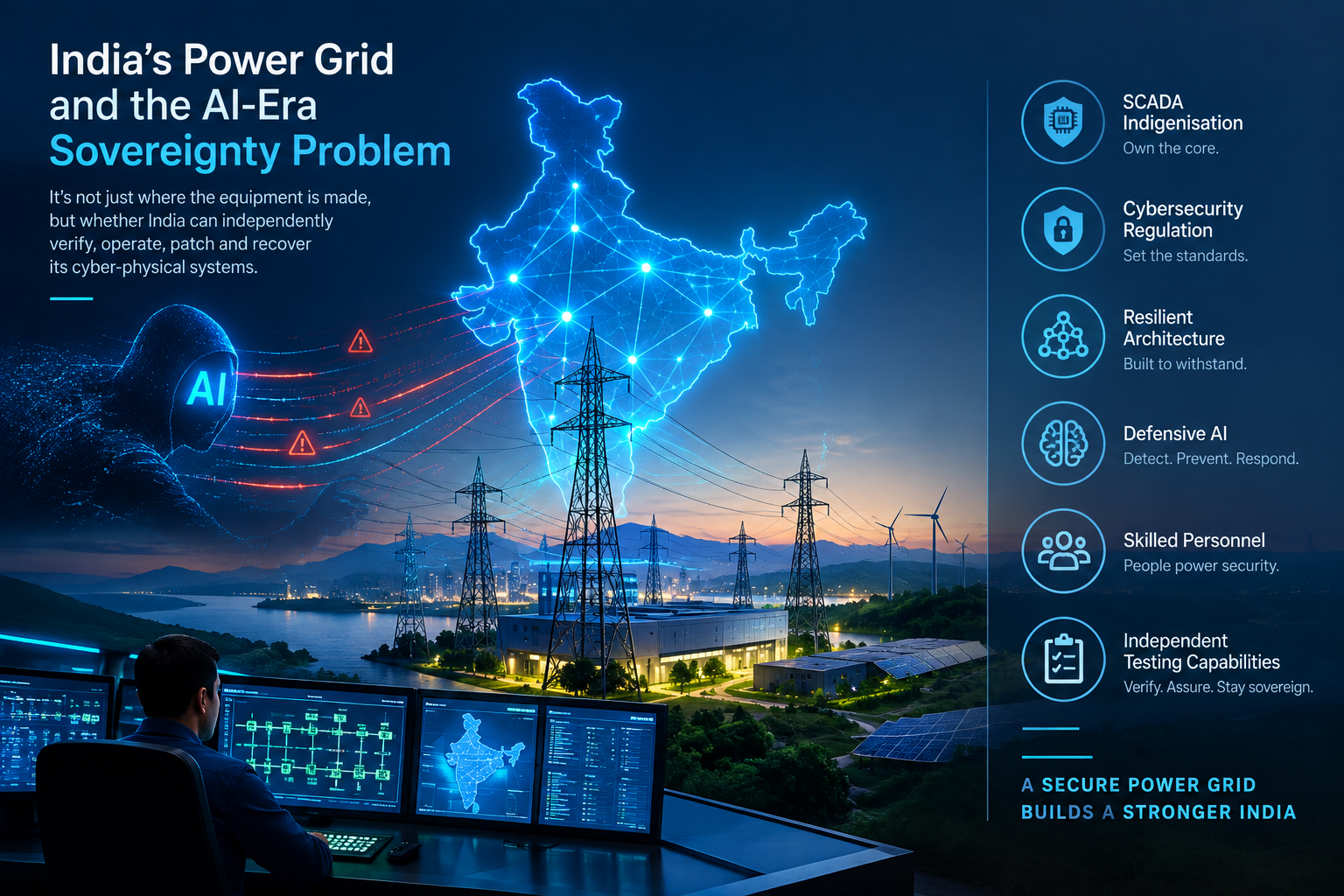
India's Power Grid in the AI-Era. An AI Illustration.
As AI lowers the cost of sophisticated cyberattacks, India’s power-grid sovereignty increasingly depends not on where equipment is made, but on whether India can independently verify, operate, patch, and recover its cyber-physical systems. India must pair SCADA indigenisation and cybersecurity regulation with resilient architecture, defensive AI, skilled personnel, and independent testing capabilities.
On August 26, 2026, the United States declared a national emergency over the security of its bulk-power system, citing foreign-sourced equipment, cyber vulnerabilities, and supply-chain dependence. Read narrowly, this looks like an American trade and security measure. Read carefully, it identifies a structural problem that applies with even greater force to India: the electricity grid has become a cyber-physical system, and control over its digital layer is now as strategically significant as control over its physical assets. Artificial intelligence does not create this vulnerability, but it collapses the cost, time, and expertise required to exploit it, turning a slow-moving industrial-security problem into an urgent one.
This essay argues that India’s exposure should be assessed not by asking whether grid equipment is foreign-made, but by asking who controls the failure modes of critical systems: who can inspect, patch, operate, and replace them without dependence on an external party. On that standard, India has begun building the right institutions but is racing against an adversarial capability, AI-enabled cyberattack, that is advancing faster than the underlying infrastructure transition.
From Electrical Machine to Cyber-Physical System
A modern grid is layered. Beneath the visible hardware (transformers, breakers, transmission towers) sits a control stack: sensors and intelligent electronic devices feed remote terminal units and programmable logic controllers (PLCs), which report to substation automation and supervisory control and data acquisition (SCADA) systems, which in turn feed energy-management systems, state estimation, protection logic, and dispatch. The US emergency order is instructive precisely because its definition of “covered equipment” spans this entire stack, not just generators and switchgear but protective relays, control systems, firmware, remote-access tools, and lifecycle maintenance arrangements. That breadth reflects a correct diagnosis: the boundary between electrical engineering and information technology has effectively dissolved, and the two must now be governed as a single security domain.
Why AI Changes the Economics, Not the Category, of Attack
The vulnerabilities in industrial control systems (legacy devices, weak segmentation, excessive remote-access privileges, opaque firmware) are not new. What is new is how cheaply they can be found and exploited. A conventional attack against energy infrastructure traditionally required a rare combination of network expertise, industrial-protocol knowledge, and electrical-systems understanding, assembled through a long reconnaissance-to-exploitation pipeline. Generative and agentic AI can now assist at nearly every stage of that pipeline: interpreting vendor documentation and engineering manuals, mapping likely targets from public tender and procurement data, drafting protocol-aware exploit code, and generating convincing social-engineering content. Industry reporting on the energy sector has already described adversaries using AI-assisted tooling against operational-technology assets such as programmable controllers and substation systems, and international-agency analysis similarly frames AI as simultaneously a powerful defensive tool and a force multiplier for attackers. The resulting asymmetry is structural: an attacker needs one workable path through a complex system, while a defender must secure the entire system. AI narrows the gap in specialist knowledge that used to protect defenders by default.
The Insufficiency of “Foreign Equipment = Insecure Equipment”
It would be a mistake to translate this threat into a blanket suspicion of foreign vendors. Firms such as Siemens, ABB, and Hitachi Energy generally maintain mature security engineering and global threat-intelligence capacity; foreign origin is not itself evidence of a backdoor, and domestic origin is not itself evidence of safety. The more precise concept is strategic dependency: a system can be physically located and even manufactured in India while remaining externally controlled if its firmware, signing keys, vulnerability disclosure, patch authority, and diagnostic access all reside with an outside party. In that case, sovereignty over the asset’s failure modes, not its ownership, sits abroad.
This suggests a five-level hierarchy of technological sovereignty, rising from mere assembly, through domestic manufacturing and design authority, to the two levels that matter most for security: the capacity to independently verify a system (audit its code, firmware, and supply chain) and the capacity to operate it indefinitely without the original supplier: patching, replacing, and recovering it unassisted. The American order is fundamentally concerned with these top two levels. India’s policy should be too.
India’s Institutional Response
India is not starting from zero. The Central Electricity Authority notified new Cyber Security in Power Sector Regulations in July 2026 (effective April 2027) covering asset inventories, supply-chain risk management, remote-access controls, vendor obligations for bills of materials and end-of-life disclosure, and incident-response and audit requirements. On the institutional side, CSIRT-Power was established within CEA in 2023 as an arm of CERT-In, complemented by six sector-specific CERTs and a POWERGRID-IISc cybersecurity research centre. Operationally, the Ministry of Power has reported repeated IT/OT assessments of the National Load Despatch Centre and no confirmed successful attack on its operational systems over the preceding five years, a reassuring but not conclusive data point, since a clean record does not prove the absence of exploitable weakness.
The most strategically significant move, however, is the drive toward SCADA indigenisation. CEA’s 2026 report on the subject and the draft National Electricity Policy both target a transition to domestically developed SCADA/EMS systems by 2030. This matters because SCADA and its associated control systems function as the grid’s nervous system; indigenising them is a fundamentally different order of undertaking than indigenising a category of hardware, since it concerns the layer that decides what the hardware does.
Three Underappreciated Dimensions
Software, not hardware, is the deeper exposure. A transformer or generator may carry little inherent cyber risk (smart power transformers carry significant risks), but the digital ecosystem around it (protection relays, engineering workstations, remote diagnostic interfaces, firmware update channels) routinely is a dependency even when the physical asset is fully indigenous. Attackers need not compromise the transformer; they need only compromise the system that instructs the breaker.
Renewable and distributed energy expands the attack surface qualitatively. The shift toward solar, wind, and battery storage is simultaneously a shift toward millions of independently networked control points: inverters, battery-management systems, smart meters, EV chargers. CEA’s 2026 regulations already extend vendor obligations to these distributed assets, recognising that the future risk may not be a single compromised control centre but many minor compromises that become systemically significant when coordinated, a pattern well suited to AI-assisted orchestration.
The threat is not hypothetical. Cybersecurity researchers, including Recorded Future, have previously documented campaigns such as RedEcho targeting Indian electricity-sector organisations, with attribution debates aside, establishing that India’s grid is already regarded as a valuable target. AI does not create this motivation; it lowers the cost of acting on it.
What Should Follow: From Cybersecurity to Cyber-Physical Sovereignty
Several implications follow. First, India’s SCADA indigenisation programme should be treated as a national-security undertaking rather than a procurement exercise, with a “secure-by-design, not indigenous-by-decree” standard: a domestic platform should earn deployment through demonstrated security architecture (authenticated updates, strong identity management, independent code review, transparent vulnerability disclosure) rather than through nationality alone. A premature or under-engineered domestic system merely relocates the vulnerability.
Second, India should distinguish cybersecurity (preventing intrusion) from resilience (limiting the consequences of intrusion). Given that no defense is complete, the operative goal should be ensuring that a compromise at one layer, say, SCADA, communications, a single control centre, cannot cascade into a physically catastrophic event, through layered independence: functioning local protection if SCADA fails, manual control if communications fail, regional operation if a control centre fails. India’s large, interconnected “One Nation, One Grid” architecture is often treated purely as a vulnerability, but with proper digital segmentation (interconnected electrically, segmented digitally) its geographic scale can instead support containment.
Third, the notion of a “trusted vendor” needs to move beyond corporate nationality toward an assessment of the full technology supply chain: software and firmware provenance, remote-access architecture, update infrastructure, and the ability to operate independently of a foreign cloud dependency, since an Indian-incorporated company can be technologically dependent on a foreign parent, and an international firm can supply highly secure technology.
Fourth, defensive AI deserves equal emphasis to defensive regulation. AI-assisted asset discovery, behavioral anomaly detection, threat hunting across network and physical telemetry, and continuous supply-chain monitoring (tracking vendor advisories, firmware changes, and vulnerability disclosures) represent one of the few areas where India could convert a source of vulnerability into a genuine advantage, rather than responding to AI-enabled threats by restricting AI use in critical infrastructure.
Fifth, the human and institutional gap deserves as much attention as the technical one. Electrical engineers and cybersecurity engineers have traditionally been trained separately, yet the emerging threat operates precisely across that boundary. Building a professional category, the cyber-physical power engineer, through integrated approach to Operational Technology (OT) systems-cybersecurity, targeted education and R&D investment may be as important as any hardware or software initiative.
Finally, a dedicated national testing capability, a facility reproducing the full generation-to-distribution stack across multiple vendors and generations of equipment, would let India conduct adversarial and AI-generated attack simulations, verify supply chains, and rehearse recovery before an incident occurs rather than after.
The Sovereignty Question
The correct reading of the U.S. bulk-power emergency order is not that India should mimic American import restrictions, but that it should absorb the underlying conceptual shift: electricity infrastructure is now national-security technology, and sovereignty over it is measured by the ability to see, verify, operate, patch, and recover critical systems, not by where components are assembled. India’s 2026 cybersecurity regulations, its CSIRT-Power architecture, and its 2030 SCADA indigenisation target show that this problem has been recognized and that institution-building is underway. The open question is whether that transition converts into genuine technological sovereignty (verifiable software, independent recovery capacity, and defensible failure modes), or settles for domestic procurement dressed as self-reliance, at precisely the moment when AI is compressing the time and expertise an adversary needs to exploit whatever gaps remain. That is the narrow window in which India’s current policy choices will be judged.
Related Topics