London based entrepreneur, cybersecurity analyst doing a PhD in AI
Industrial Cleaner for Pride – 100% arguments gone

The Point at Which All Arguments Vanish
Every minute brings us closer to death. What are we preparing along the way?
Somewhere today, someone is composing the perfect reply. Someone is defending a flag, disputing a border, attacking a theology, recording a rap diss track, negotiating a contract, placing a trade, or calculating a retirement fund. Someone is refreshing a screen to see whether the world has applauded.
Meanwhile, a minute has passed.
For all their differences, every person involved has moved closer to the same certainty: death. The argument may continue tomorrow. The person making it has no guarantee of doing so.
We know this. Yet we organise much of our lives as though it applies mainly to other people.
Death remains an event in the news, a family memory, a distant possibility. Our own unfinished plans feel more immediate. There is always another meeting, another purchase, another grievance to settle before we consider what our lives are actually becoming.
But the clock does not wait for that consideration.
The Qur’an ends Sūrat al-Ḥijr with a striking instruction:
“And worship your Lord until the certainty comes to you.”
— Qur’an 15:99
The Arabic word is al-yaqīn: certainty. In his commentary, Ibn Kathīr explains that it refers here to death. The instruction is to continue worship throughout life, until death arrives.
There is something arresting about naming death this way. So much that occupies us is uncertain: whether we will succeed, whether others will admire us, whether our plans will survive contact with reality. Yet we repeatedly neglect the event whose arrival requires none of our agreement.
You can reject the Qur’an’s authority. You can dispute religion, revelation and resurrection. Mortality still confronts you. Agreement about what follows death is not necessary to recognise that your opportunity to act in this life is finite.
Your disbelief will not prevent death. Neither will my profession of faith.
That shared limit should introduce some humility into our disagreements.
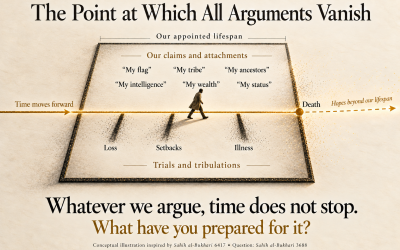
A second teaching gives this tension a visible form. In a narration from ʿAbdullāh ibn Masʿūd, the Prophet ﷺ drew a square, then a central line extending beyond it, with smaller lines coming towards the central line from the side.
He explained that the central figure represented the human being; the surrounding square represented the appointed lifespan enclosing him. The portion extending outside represented his hope. The smaller lines represented the troubles and calamities that encounter him: escaping one does not mean escaping them all. This is recorded in Ṣaḥīḥ al-Bukhārī 6417.
The image captures the mismatch between finite life and hopes that reach beyond it. The drawing is simple enough to remember long after a lengthy argument has been forgotten.
We recognise ourselves in that extending line.
After this qualification, I will settle down. After this promotion, I will be present for my family. After this dispute, I will find peace. After I have enough money, I will become generous. After life becomes easier, I will take my relationship with God seriously.
Each milestone produces another. The future becomes a place where we store the person we intend to become, while the present receives whatever is left over.
This is how a life can be spent preparing to live.
Our modern calendars make the illusion particularly convincing. They show next month as neatly as this afternoon. We enter appointments, renew subscriptions and forecast income. A date printed on a screen begins to feel like time already in our possession.
But a scheduled appointment is a statement of intention. It is not a promise that we will attend.
We have all seen how quickly ordinary plans become irrelevant. A telephone call arrives. A diagnosis interrupts a working week. A bereavement changes the meaning of a room. The things that seemed urgent an hour earlier remain on the desk, suddenly unable to command the same attention.
We need not wait for such an interruption before examining our priorities.
Ambition can still be worthwhile. A person can hope to build a school, raise a family, complete research or relieve poverty. Projects that outlast their founders can serve people for generations. The question is whether our ambitions produce worthwhile conduct today, or merely supply excuses for postponing it.
If the project remains unfinished, were we honest while building it? If recognition never arrives, did the work help anyone? If our lives end earlier than expected, have we already begun to live by the values we claim?
You may believe your tribe is superior, your nation indispensable, your suffering uniquely important. You may experience the world so intensely through your own perspective that other people seem like supporting characters. But they have inward lives too: fears, attachments, memories and hopes that feel as immediate to them as yours feel to you.
Death gives none of us an exemption for being the centre of our own story.
Consider everything we clutch: flags, land, children, wealth, status, applause, fame.
A flag may cover a coffin. It cannot keep its occupant alive. Land may bear your name for generations. You will no longer walk across it. Your children may love you deeply and remember you faithfully. They cannot accompany you through your death.
The applause belongs to those still listening. The estate passes into other hands.
This does not make family, belonging or provision meaningless. It makes our relationship with them more serious. Children are people entrusted to our care, not extensions of our importance. Wealth offers opportunities to relieve hardship. Land can shelter others. Influence can protect someone who has none.
What matters is what we do with what we temporarily hold.
Another narration makes that distinction explicit. In Ṣaḥīḥ al-Bukhārī 6514, the Prophet Muhammad ﷺ describes family, wealth and deeds accompanying the deceased. Family and wealth return; deeds remain.
The point is not that nothing matters because we die. Our conduct matters even when our possessions cease to be ours.
And this brings us to a question the Prophet ﷺ was once asked.
A man wanted to know when the Hour—the Day of Judgement—would come. The Prophet ﷺ replied:
“What have you prepared for it?”
The man answered by expressing his love for Allah and His Messenger. The Prophet ﷺ told him:
“You will be with those whom you love.”
— Ṣaḥīḥ al-Bukhārī 3688
The exchange moves attention from the timing of the event to the condition of the person awaiting it. It also contains hope. The answer is not simply a threat or a countdown. Love belongs within the discussion of preparation.
The Hour and an individual’s death are distinct. But the question cuts through our habit of postponement: what are we doing with the time available to us?
We can spend years debating theological propositions while neglecting prayer, honesty or mercy. We can demand justice in political discourse while treating someone within our own household unjustly. We can denounce another person’s arrogance while carefully cultivating our own.
Even the argument about goodness can become a way of avoiding its practice.
Remembering death should make us more attentive to that contradiction.
The same examination belongs in our public arguments. A theological disagreement can be sincere and necessary. Political debate can expose injustice. Refusing to challenge a falsehood may leave vulnerable people unprotected. Remembering death should never become an excuse for telling the oppressed to accept oppression quietly.
But we should notice when defending a principle turns into defending our own importance.
The question changes from whether a claim is true to whether our side can be seen to lose. We excuse conduct in an ally that we condemn in an opponent. We treat an admission of error as humiliation, even when correcting the error would prevent harm.
A person aware of their limited time has reason to resist this waste. There is too little life available to spend it knowingly maintaining a lie.
Even the spectacle of a rap feud illustrates something recognisable beyond music: the hunger to have the final word. One insult demands another, each audience rewards escalation, and backing down becomes unthinkable. Versions of that contest unfold in offices, families, political movements and online religious discussions.
Death interrupts the contest without asking who was ahead.
The unfinished reply stays unfinished. The audience moves on. Whatever harm we caused to win its approval remains with other people.
It should not make us abandon work, stop saving for retirement, or withdraw from public responsibility. Planning for old age is sensible. So is recognising that old age is not promised. Providing for dependants can itself be part of living responsibly.
The trouble begins when preparation for a possible future consumes every thought, while preparation for our certain mortality receives none.
A retirement statement can estimate what we may have at seventy. It cannot tell us whether we have become someone our family feels safe around at forty. An impressive professional biography can record appointments without mentioning the people we belittled to obtain them.
These are different kinds of accounting. Both deserve attention, but only one is routinely placed before us. Institutions send reminders about payments and deadlines. Our character rarely receives such organised scrutiny.
We therefore have to make room for it deliberately.
What might preparation look like today?
For a Muslim, it includes worship, repentance and the effort to fulfil obligations towards Allah and other people. It may also mean a very ordinary action: returning money, correcting a lie, offering an apology, keeping a promise, or giving a child undivided attention.
For someone who does not share that faith, the practical question still deserves an answer: what are you leaving others to live with?
Begin with something specific enough to do. Identify one obligation you have been avoiding. Examine one resentment that is consuming more life than it deserves. Ask whether the people closest to you experience the kindness you display in public.
There may be relationships that cannot safely be restored, or wrongs that require firm boundaries. Preparation does not demand pretending harm never happened. It asks us to act with integrity in the circumstances we actually face, rather than waiting for circumstances in which goodness would become effortless.
There is tenderness in this perspective too. A meal with someone you love becomes an occasion to attend to them. A familiar voice deserves more than distracted answers. An ordinary afternoon carries possibilities that neither wealth nor regret can retrieve once it has passed.
Remembering our limits can deepen our participation in life. It can make us more generous with attention, less eager to humiliate, and quicker to recognise when pride is making a decision for us.
Death will not erase the consequences of cruelty. Nor does it settle every philosophical dispute for those who remain. What ends is our ability to keep defending ourselves, revising our choices and assuming there will always be another chance.
That is the point at which our arguments fall silent.
The world may continue arguing about us. We will no longer control the conversation.
We also confuse being remembered with being present. Fame promises that our name will survive us, and perhaps it will. But a name circulating among strangers cannot return an evening we refused to spend with someone who needed us. A monument cannot make an apology on our behalf.
Legacy deserves care because other people will inherit the consequences of our choices. It becomes a distraction when we imagine that admiration after death can compensate for neglect during life.
The useful question is therefore close at hand: what would change this week if we took our mortality seriously without becoming paralysed by it? Perhaps we would still go to work, pay the bills and pursue the project. But we might do those things with less vanity, more fairness, and a clearer sense of whom they are meant to serve, while we still have the opportunity.
While we still can, we should examine what lies beneath our insistence on winning. Is it truth we serve? Is it justice? Or is it the desperate wish to feel important for a little longer?
Another minute has passed.
There is still an opportunity to do something worthwhile with the next one.
What have you prepared?
Selected References :-
- “Worship your Lord until the certainty comes to you.” Qur’an, Sūrat al-Ḥijr 15:99. The Arabic term al-yaqīn (“certainty”) refers here to death, as explained in Tafsīr Ibn Kathīr on 15:99. The verse directs continued worship throughout life.
- Family and wealth return; deeds remain. Narrated by Anas ibn Mālik: the Prophet Muhammad ﷺ explained that family, wealth and deeds accompany the deceased; the first two return, while deeds remain. Ṣaḥīḥ al-Bukhārī 6514.
- “What have you prepared for it?” When a man asked when the Hour would come, the Prophet ﷺ asked what he had prepared. The man expressed his love for Allah and His Messenger, and the Prophet ﷺ replied: “You will be with those whom you love.” Narrated by Anas ibn Mālik. Ṣaḥīḥ al-Bukhārī 3688.
- The square, the human being, hopes and trials. Narrated by ʿAbdullāh ibn Masʿūd: the Prophet ﷺ drew a square enclosing a central line that extended beyond it, with smaller lines approaching it from the side. He explained the enclosing boundary as the person’s appointed lifespan, the extension as hope, and the smaller lines as calamities and troubles. Ṣaḥīḥ al-Bukhārī 6417. The article’s illustration is a conceptual interpretation of this narration.
- “Remember often the destroyer of pleasures.” Narrated by Abū Hurayrah: the Prophet ﷺ encouraged frequent remembrance of death. The linked translation reads: “Increase in remembrance of the severer of pleasures.” Jāmiʿ al-Tirmidhī 2307, graded ḥasan on the linked page.
- “Nothing fills his mouth except dust.” Narrated by Anas ibn Mālik: the Prophet ﷺ described a person who, despite possessing a valley of gold, would desire another. The narration states that only dust fills his mouth and concludes with Allah accepting the repentance of those who repent. Ṣaḥīḥ al-Bukhārī 6439. “Of his grave” is an explanatory addition, not part of the wording of this narration.
Related Topics
Related Posts