
Greek Jewish roots. New York voice. Unfiltered perspective.
ISRAEL VOTES, PART III: THE BALLOTS ARE IN. THE ANSWERS AREN’T.
Israel’s first election since October 7 has produced remarkable turnout, a divided Knesset, and an extraordinary question: Could Arab voters help determine who leads the Jewish state?
Election-night reporting cutoff: Tuesday, October 27, 2026, at 8:00 p.m. New York time (Wednesday, October 28, at 2:00 a.m. Israel time). All seat figures cited are television exit-poll projections, not official results.
REMEMBER THE SOCCER MOM IN NEBRASKA?
In Part I of this series, I asked why a soccer mom in Nebraska should care about an election taking place thousands of miles away.
After all, she has enough on her plate. Children to shuttle, groceries to buy, bills to pay, and perhaps a husband who still cannot locate the ketchup despite standing directly in front of the refrigerator.
Why add Israeli coalition politics to the list?
Because Israel’s elections do not remain Israel’s business alone.
The outcome affects American foreign policy, regional security, the U.S.-Israel relationship, and the wider Jewish world. Decisions made in Jerusalem have consequences far beyond Israel’s borders.
And unlike an American presidential election, where we generally know the winner before going to bed, or at least know whom everyone is arguing about, Israel’s election night can be only the beginning of the argument.
Tonight is a perfect example.
In Part I, I explained the rules: 120 seats in the Knesset, a parliamentary majority of 61, and a coalition system in which winning the most seats does not necessarily mean winning the government.
In Part II, I introduced the people behind those numbers.
A first-time voter trying to understand her political future. Young soldiers who fought for their country and now wonder whether they can afford to build lives there. Israelis demanding accountability for October 7. Others who believe Israel must focus on what comes next. Israelis abroad wrestling with whether they should have a say in decisions whose consequences they do not experience daily.
Their stories revealed something important.
October 7 was the common denominator.
The conclusion was not.
Today, those personal convictions became ballots.
And the first projections have given us something extraordinary to examine.
THE DEMOCRACY THAT SHOWED UP
Israelis went to the polls on October 27, 2026, in their first national election since the Hamas attacks of October 7, 2023.
And they showed up in remarkable numbers.
According to election-day reporting, by 2 p.m., turnout had reached 44.9%, compared with 38.9% at the same hour in 2022.
By 4 p.m., it reached 55.7%, compared with 47.5% in 2022.
By 8 p.m. Israel time, turnout had climbed to 74.3%.
And by the official 10 p.m. closing time, turnout had reached 77.7%, the highest closing-time figure in 25 years.
Whatever their political differences, Israelis were making one thing unmistakably clear: They intended to participate in deciding their country’s future.
And that brings me to an accusation repeated so frequently that many people have stopped questioning what it actually means.
Israel is an apartheid state.
I reject that characterization.
And rather than responding with another slogan, I want to show readers something concrete about Israel’s democracy – something unfolding in plain sight on election night.
Not a theoretical argument.
Not a public-relations campaign.
An election in which Arab citizens vote, elect representatives, and may help shape the next government of the Jewish state.
WHO GETS TO VOTE IN THE JEWISH STATE?
Israel is a Jewish state.
It is also a country in which eligible Arab citizens (Muslim, Christian and Druze), can vote, organize political parties, stand for election, and serve in the Knesset.
These are not theoretical rights.
They exercised them today.
And according to the major Israeli television exit polls, Arab-led parties were projected to win a combined 17 to 18 seats – a historic showing.
Let that sink in.
In an election to determine the next government of the world’s only Jewish state, Arab political parties may hold a substantial number of parliamentary seats at a moment when neither major Jewish-led bloc has secured a majority.
One of those parties is Ra’am, the United Arab List, an Islamist party led by Mansour Abbas. The Joint List brings together several Arab political factions.
These are not symbolic organizations permitted to exist merely for appearances.
They represent voters. They contest elections. Their members can influence legislation, parliamentary negotiations, and the political direction of the country.
Ra’am has already demonstrated that influence. In 2021, it became the first independent Arab party to formally join an Israeli governing coalition.
Now, in 2026, Arab-led parties may again play a consequential role in determining whether a government can be formed.
Consider the significance.
Arab citizens of Israel do not merely possess the right to vote. They exercise it, elect representatives, and can influence the formation of governments.
Muslim, Christian, Druze and Jewish citizens participate in the same national parliamentary elections.
No country is perfect. No democracy is free of disagreements, social inequalities or political controversies. But imperfection alone does not establish apartheid.
The electoral record directly contradicts any assertion that Arab citizens are categorically denied the vote or excluded from representation in Israel’s parliament.
They are not excluded.
The wider legal accusations concerning Israeli rule over Palestinians in the occupied territories are disputed and involve questions beyond citizenship. But those disputes do not erase the parliamentary rights exercised by Arab citizens of Israel.
And tonight, their votes may be among the most consequential in the country.
BUT WHAT ABOUT GAZA AND THE WEST BANK?
Here comes the question I can almost hear someone typing.
If Israel is a democracy, why can’t Palestinians living in Gaza or the West Bank vote in Israeli national elections?
Very plainly put: because they are not Israeli citizens.
Citizenship ordinarily determines eligibility to vote in national elections.
I cannot vote in Canada, Greece, Israel, or any other country simply because I care deeply about what happens there. I would need the legal right to participate.
Israel is no different in that basic respect.
There are different legal arrangements across the territories, including a distinct status for many Palestinian residents of East Jerusalem. Questions about political rights under Israeli control in the West Bank are separate from the voting rights of Arab citizens inside Israel.
But here is another question that deserves far more attention.
When was the last time Palestinians were able to elect their own national leadership?
The last Palestinian Authority presidential election was held in 2005.
The last Palestinian legislative election was held in 2006.
Hamas won the 2006 legislative election and took control of Gaza in 2007 following violent conflict with Fatah. The Palestinian Authority continued governing parts of the West Bank.
Palestinian national elections have not been held since.
Twenty years.
An entire generation has grown up without the opportunity to choose new national representatives through a Palestinian general election.
The Palestinian Central Elections Commission documents the electoral process, including the postponement of elections scheduled for 2021.
And what about Hamas?
Hamas is not merely an armed terror organization operating in Gaza. It has exercised governing authority there while suppressing political opponents and restricting dissent.
So where is the sustained international outrage over those violations of Palestinian rights?
Where are the American campus demonstrations demanding that Hamas stop suppressing Palestinian dissent?
Where are the mass university protests calling for Palestinians to be allowed to choose new national leaders after two decades without a general election?
We have witnessed enormous campus mobilizations accusing Israel of denying Palestinians freedom and political rights.
But where is a comparable American campus movement, with the same visibility, urgency and intensity, demanding democratic accountability from Hamas and the Palestinian Authority?
Palestinian activists have criticized their own leaders, sometimes at considerable personal risk. Their efforts deserve recognition.
My question is specifically about the priorities of the international protest movement.
If Palestinian freedom matters, why shouldn’t freedom from repression by Palestinian leaders matter just as much?
And if the right to vote is fundamental, why isn’t the absence of Palestinian national elections a central demand of those who claim to be marching for Palestinian rights?
Those are not distractions from the question of democracy.
They are questions about democracy.
Meanwhile, millions of Israeli citizens, Jewish and Arab alike, have just participated in a national parliamentary election.
And the resulting political arithmetic may give Arab representatives an important role in determining what happens next.
THE NUMBERS THAT HAVE EVERYONE TALKING
As of 8 p.m. Tuesday evening in New York (2 a.m. Wednesday in Israel) Israel’s polling stations have closed, television networks have released their exit polls, and the vote count is underway.
And there is no clear winner.
According to Ynet’s reporting on updated exit polls from Kan 11, Channel 12 and Channel 13, the following projection emerged:
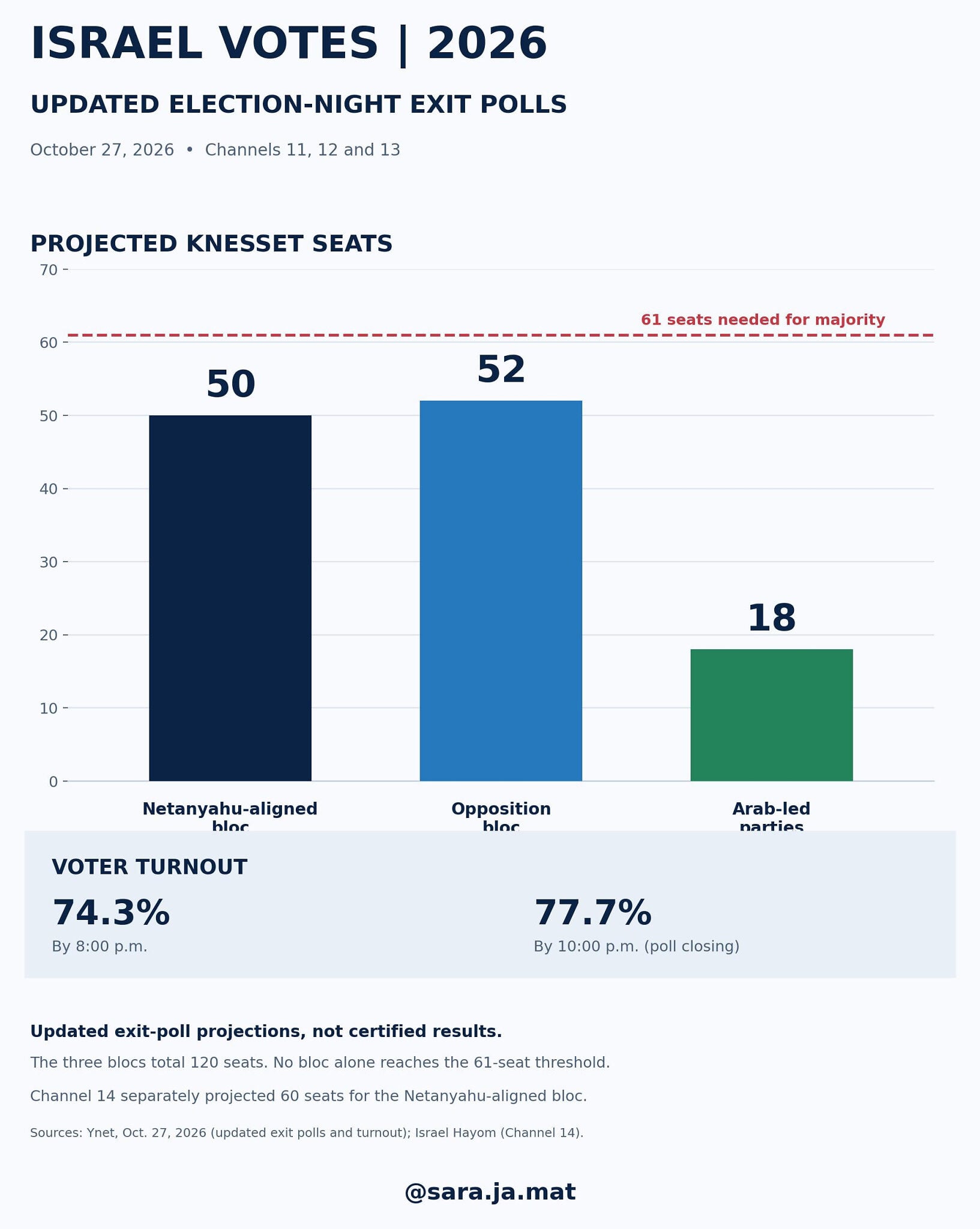 These are updated television exit-poll projections, not certified election results.
Other networks have published different estimates, and the final allocation of seats may change as ballots are counted.
Benjamin Netanyahu’s Likud is projected to remain the largest individual party, with approximately 24 to 25 seats.
His principal challenger, former IDF chief of staff Gadi Eisenkot, leads Yashar, projected at approximately 21 to 23 seats.
Former Prime Minister Naftali Bennett’s B’Yachad, Yair Golan’s Democrats,
Avigdor Liberman’s Yisrael Beytenu, and the religious and right-wing parties will also shape what happens next.
Yet neither major Jewish-led bloc appears able to govern alone.
And the Arab-led parties?
A projected 18 seats.
Not enough to govern independently, of course. But potentially enough to influence the political arithmetic that determines who can.
There is one complication, and it is an important one.
Several Jewish-led opposition parties have rejected governing with Arab parties. Their projected seats therefore do not automatically translate into a workable coalition.
Having enough seats on paper is not the same as having enough political partners willing to sit around the same cabinet table.
Which brings us back to that soccer mom in Nebraska.
If she thought American politics involved difficult negotiations, she should try assembling a government from parties that agree the current prime minister should go but disagree about practically everything else.
WHY WE DON’T KNOW THE WINNER TONIGHT
In America, voters elect a president through the Electoral College, and the outcome generally becomes clear once the necessary states have been called, subject to certification and any disputes
Israelis do not vote directly for prime minister.
They vote for political party lists.
Those votes determine how the 120 Knesset seats are distributed among parties that cross the electoral threshold.
Then comes the next contest.
President Isaac Herzog will consult the parliamentary factions and assign a Knesset member the task of trying to form a government.
That person does not automatically have to lead the largest party.
What matters is who has the best prospect of assembling sufficient parliamentary support.
Under Israel’s Basic Law: The Government, the designated candidate ordinarily receives 28 days, with a possible extension of up to 14 additional days. If that effort fails, further procedures can give another candidate an opportunity.
So even when the final vote count becomes clear, the identity of Israel’s next prime minister may remain uncertain for weeks.
And if nobody can form a government?
Israel could face another election.
For Americans who find the Electoral College confusing, consider this the parliamentary version of putting together a wedding seating chart in which half the guests refuse to sit beside one another.
Except the consequences are considerably greater.
WHAT HAPPENS AFTER THE BALLOTS?
In Part II, I asked Israelis what they believed they were voting for.
Some spoke about security.
Some about accountability.
Some about economic opportunity, military service, national identity, or the future of democratic institutions.
Tonight’s projections suggest that none of those questions has produced one universally accepted answer.
And perhaps that is the most revealing result of all.
A democracy is not defined by everyone agreeing.
It is tested by whether people who disagree can participate, be represented, accept legitimate results, and find a way to govern.
The coming days will test those principles in Israel.
We will learn whether Netanyahu can find a path to another term, whether Eisenkot and the opposition can assemble an alternative, and whether Arab-led parties can translate their projected parliamentary strength into meaningful political influence.
We will also learn whether the commitments parties made during the campaign survive their first serious encounter with coalition arithmetic.
Because campaigning is about what politicians promise.
Governing is about what they are willing—and unwilling—to do to fulfill those promises.
And for the Israelis I introduced in Part II, this is not an abstract exercise.
They will live with the consequences.
The soldiers hoping to build futures in the country they defended. The young voters seeking a government they can trust. The families demanding security. The citizens asking whether responsibility, accountability and shared sacrifice will mean something beyond election slogans.
The ballots have been cast.
The seats are not yet final.
The coalition negotiations have barely begun.
And the question is no longer simply who received the most votes.
If Israel’s voters have delivered a divided Knesset, can its political leaders find a way to govern a divided country?
That is the question I will return to in Part IV of Israel Votes, which I plan to publish in the coming weeks, once the final election results are known and the outcome of the coalition negotiations becomes clear.
For now, the voters have spoken.
The question is whether Israel’s political leaders can turn those votes into a government.
Related Topics