
Middle East Analyst
Featured Post
Intervention without control: Why Iran remains a strategic trap
Protest movements succeed when participants believe they are shaping their own future, not when foreign militaries become the decisive actors
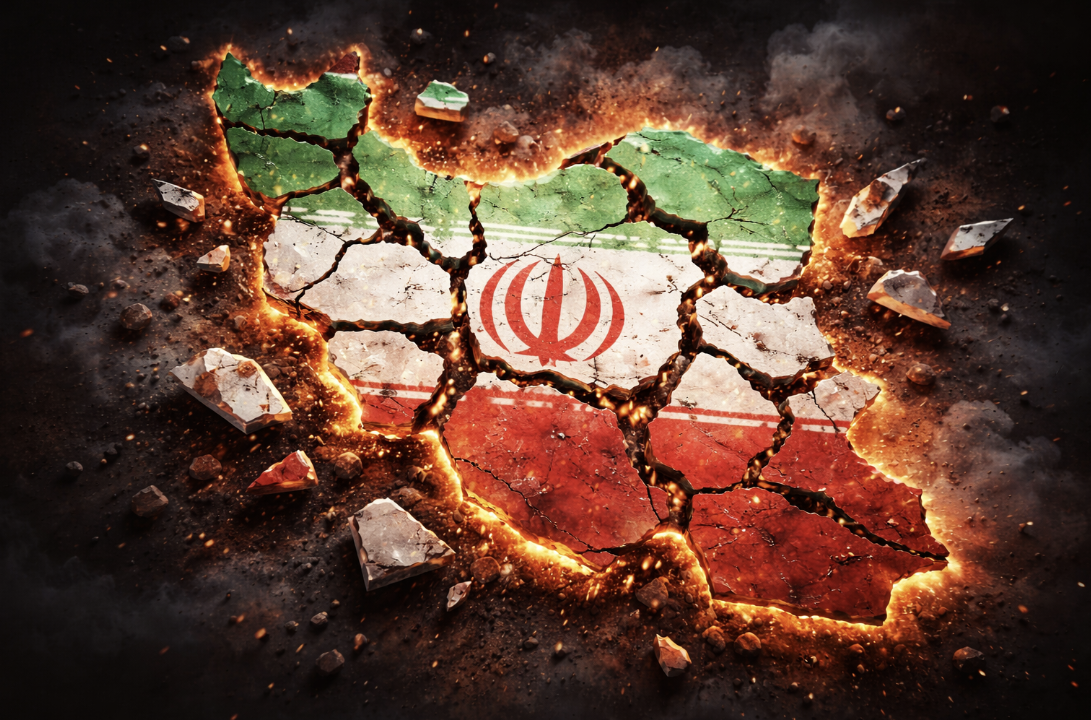
graphic by author
Any assessment of potential US intervention in Iran must begin with a recognition of hard constraints rather than policy preferences. The United States is highly unlikely – politically, militarily, or socially – to deploy ground forces into Iran under current or foreseeable conditions. Geography, force posture, alliance politics, and the enduring legacy of Iraq sharply limit Washington’s options to standoff measures: cyber operations, covert action, targeted strikes, sanctions enforcement, and, at the outer edge, leadership decapitation. Yet the absence of occupation does not equate to the absence of risk. On the contrary, intervention without control carries a distinct set of dangers that are more diffuse, less predictable, and potentially more destabilizing.
The central strategic question is therefore not whether the United States can impose costs on the Islamic Republic (it can) but whether such costs, applied from afar, can produce outcomes aligned with US interests and regional stability. In Iran’s case, the answer remains deeply uncertain.
The most immediate danger is escalation without dominance. Iran’s security doctrine is built around the assumption that external pressure during periods of internal unrest signals an existential threat. Even limited US actions, whether cyber sabotage, strikes on IRGC assets, or covert leadership targeting, would almost certainly be interpreted in Tehran as the opening phase of regime change. Under those conditions, retaliation becomes not optional but obligatory. Iran retains credible capabilities to strike Israel, US bases across the region, disrupt maritime traffic in the Strait of Hormuz, and activate proxy networks across Iraq, Syria, Lebanon, and Yemen. A narrowly conceived intervention could therefore widen rapidly into a regional confrontation that Washington neither intends nor controls.
Iran’s proxy architecture is designed precisely for such contingencies. IRGC-aligned Pakistani and Afghan Shia militias operating from Syria, Iraqi Shia armed groups, Lebanese Hezbollah, and the Houthis provide Tehran with a menu of deniable and scalable responses. These actors need not deliver decisive military effects to be strategically consequential. Their value lies in creating multi-front pressure, forcing the United States and Israel into repeated tactical responses, and blurring escalation thresholds. The dilemma is persistent: respond and risk widening the conflict, or absorb attacks and risk deterrence erosion.
Energy markets amplify this risk. Iran does not need to close the Strait of Hormuz to impose global costs; it merely needs to make transit unpredictable. Even symbolic disruptions – mining incidents, drone harassment, or insurance shocks – can spike prices and undermine market confidence. In an already fragile global economy, such volatility would translate quickly into domestic political pressure inside the United States and strain alliance cohesion. This leverage is asymmetric but powerful, and it sits largely outside the reach of precision military solutions.
The intervention calculus is further complicated by great power dynamics. Iran today is not an isolated actor but part of a looser Russia-China strategic ecosystem. Moscow has incentives to prevent another US-backed regime collapse that reinforces Western primacy, particularly as it manages confrontations elsewhere. Beijing, while cautious, has strong interests in energy security and sanctions erosion. Neither power needs to intervene overtly to raise US costs. Intelligence support, air defense transfers, cyber operations, diplomatic obstruction, and economic lifelines are sufficient to transform a “limited” intervention into a prolonged proxy contest with no clear escalation ceiling.
Beyond these external dynamics lies the most misunderstood risk: the effect of intervention on Iran’s internal protest movement. There is no question that elements of the opposition would welcome external pressure on the regime. During recent Israeli strikes, there were visible expressions of approval in some urban areas, reflecting a view – held by a minority but real constituency – that any blow to the regime advances the cause of change. However, this sentiment is neither uniform nor dominant.
Most protests inside Iran remain driven by economic collapse, corruption, repression, and demands for dignity rather than by geopolitical alignment. Even among deeply anti-regime Iranians, nationalism remains a powerful moderating force. Many protesters simultaneously believe the Islamic Republic must fall and that foreign military intervention carries profound risks. This duality is critical because intervention would not simply weaken the protest movement; it would reconfigure it.
External military action would fracture opposition constituencies along multiple axes. Ideologically, intervention would become a litmus test, dividing those who view foreign strikes as liberation from those who see them as humiliation or existential danger. Socioeconomically, energy disruptions and sanctions shocks would fall unevenly, straining working-class and provincial protesters whose grievances are already material and immediate. Tactically, expectations would diverge: some groups would escalate, believing collapse imminent; others would disengage to avoid association with foreign actors; still others would radicalize or retreat underground. Over time, even initial supporters of intervention would splinter as civilian costs accumulate and nationalist backlash grows.
Perhaps most damaging, intervention would shift agency away from Iranian society and toward external powers. Protest movements succeed when participants believe they are shaping their own future. When foreign militaries become the decisive actors, protesters are reduced to spectators of events they do not control. This erosion of agency undermines legitimacy, coordination, and endurance – the very qualities required to sustain pressure on an entrenched authoritarian system.
Leadership decapitation, often proposed as the most aggressive feasible option short of war, does not resolve these dilemmas. Removing senior figures without the ability to impose order creates a power vacuum rather than a transition. Iran’s political system is not a personalist dictatorship held together by a single individual; it is a complex web of clerical institutions, security organs, economic conglomerates, and regional power centers. Decapitation would likely trigger competition among IRGC factions, clerical networks, and provincial commanders, while external actors maneuver to shape outcomes. Without an occupying force to stabilize the transition – a step the United States will not take – the result is more likely fragmentation or renewed authoritarianism than democratic consolidation.
Mission creep compounds these risks. Once intervention begins, pressure to escalate rarely recedes. If limited strikes fail to alter regime behavior, calls for broader action intensify. If chaos follows decapitation, humanitarian or stabilization imperatives emerge. If allies – particularly Israel, whose threat perceptions and timelines differ from Washington’s – act unilaterally, the United States may be pulled into a conflict it did not design. Strategic ambiguity, in this context, becomes a liability rather than a hedge.
The cumulative picture is stark. The risks of US intervention in Iran are systemic, interconnected, and difficult to contain. Escalation dynamics, proxy activation, energy shocks, great power counter-moves, regime hardening, and the reconfiguration of the protest movement all point in the same direction. Because the United States is unwilling to occupy Iran, it lacks the principal tool historically required to shape post-collapse outcomes.
The strategic question, therefore, is not whether the United States can intervene, but whether intervention under these constraints can plausibly deliver outcomes aligned with US interests. The weight of evidence suggests that it cannot. Limited intervention promises visible action but uncertain payoff, while reliably increasing the probability of unintended consequences. In Iran, pressure without control does not produce order; it produces volatility. And volatility, at this scale, is itself a strategic hazard.
Related Topics
Related Posts