The views expressed herein are solely mine.
Inviting the ‘Arsonists’ to the “Fire Brigade”
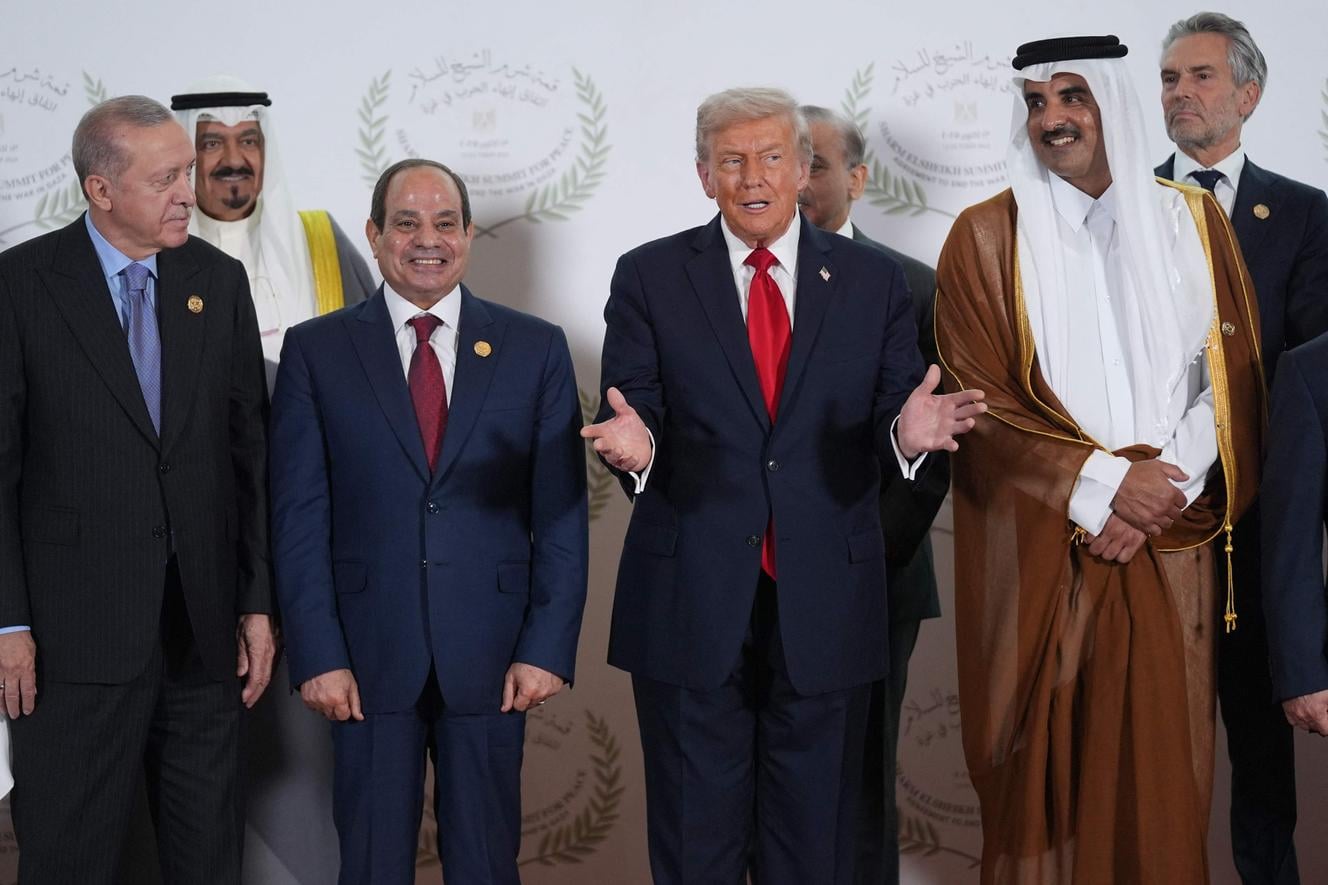
(Front L-R) Turkish President Recep Tayyip Erdogan, Egyptian President Abdel Fattah al-Sisi, US President Donald Trump and Emir of Qatar Cheikh Tamim ben Hamad al-Thani and other leaders at the Gaza summit in Sharm el-Sheikh on October 13, 2025. EVAN VUCCI / AFP.
History has a cruel sense of irony, and sometimes policy walks straight into it with eyes wide open. Inviting Qatar and Turkey into a so-called “peace board” for Gaza is not realistic. It is strategic amnesia dressed up as diplomacy.
Let’s be clear, without slogans and without hysteria. Qatar is not a neutral mediator. It has been the single most important financial lifeline for Hamas for years, funneling hundreds of millions of dollars into Gaza with full knowledge that Hamas controlled the territory, its ministries, its security apparatus, and its military wing. Money is fungible. Every dollar that “paid salaries” freed another dollar for tunnels, rockets, and command bunkers. That is not conjecture; it is how insurgent economies work.
Turkey’s record is no better. Under Recep Tayyip Erdoğan, Ankara provided political cover, diplomatic legitimacy, and operational space for Hamas leadership.
On the other hand, Erdoğan has not merely criticized Israel; he has openly praised Hamas as a “resistance movement.”
And that matters because States that legitimize jihadist actors do not suddenly become architects of the post-war order. They become spoilers with veto power.
To bring these actors into a Gaza governance framework is to confuse access with alignment. Yes, Qatar talks to Hamas. So do hostage negotiators talk to kidnappers. That does not mean you hand the kidnapper a seat at the table to redesign the neighborhood after the crime.
From a geopolitical standpoint, this move collapses deterrence logic. Post-conflict governance is not charity; it is enforcement. It is the phase in which consequences are locked in and incentives are reshaped.
Thus, allowing Qatar and Turkey inside that structure signals to every proxy network in the region that underwriting terror carries no long-term penalty. Fund the war, mediate the ceasefire, manage the aftermath. That is not peacebuilding. That is laundering influence.
Strategically, it also undercuts Israel’s core security doctrine. The State of Israel and the IDF dismantled Hamas at enormous cost, militarily and morally, to ensure Gaza would never again be a forward base for Iranian-aligned jihad.
Now imagine the absurdity: the smoke has not cleared, and two states that empowered Hamas are asked to help “stabilize” the ruins. That is how wars lose meaning after they are won.
Sociologically, this tells a darker story. Radical movements survive not just on weapons but on narratives of inevitability. When their patrons are rewarded with diplomatic prestige, the lesson to terrorists is simple: endure long enough, kill enough, and your sponsors will be indispensable partners in the peace. Without a doubt, violence becomes a down payment.
Nonetheless, this is not an anti-Trump reflex. It is strategic consistency. President Trump understood leverage better than most presidents. He knew that pressure works, that incentives shape behavior, and that alliances must be conditional. Thence, inviting Qatar and Turkey into Gaza governance contradicts that logic. It trades leverage for illusion.
Cinematically, the image is stark. Gaza is a burned-out city still warm from battle, tunnels collapsed, arsenals exposed, and graves still fresh. And into that landscape walk the very financiers and apologists of the arson, now wearing suits, now speaking of “reconstruction” and “stability.” The matchsticks are still in their pockets.
In my opinion, peace is not built by confusing proximity to power with moral authority. It is built by drawing hard lines and enforcing them. Therefore, if the architects of terror are allowed to supervise the cleanup, the next fire is not a question of if—but when.
Related Topics
Related Posts