
Lawyer & Law Professor
Iran After the Ring of Fire
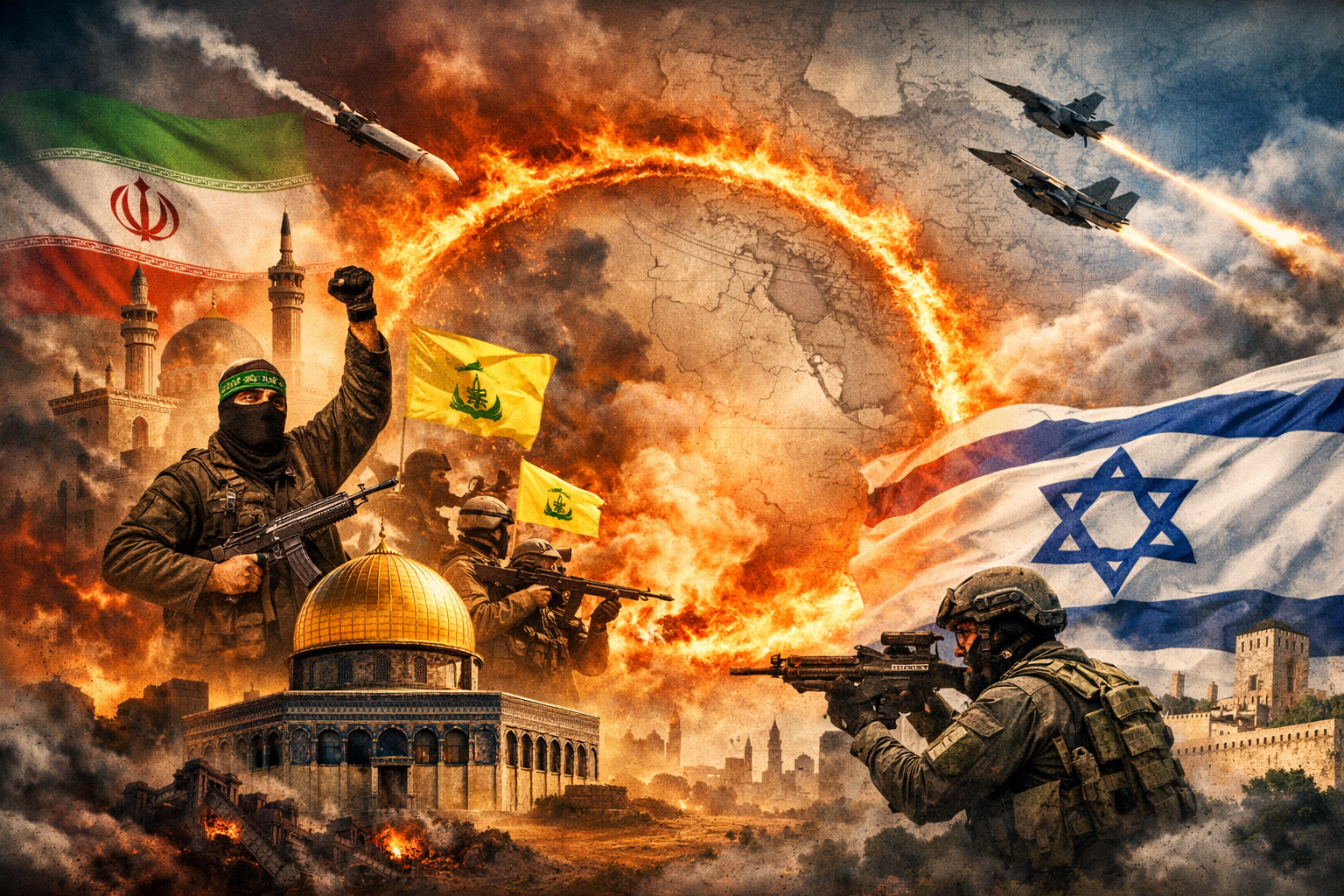
Image Created by ChatGPT with DALL-E, 2026.
For over forty years, analyses of Israel’s security have often framed it as a sequence of isolated conflicts involving peripheral armed actors, treating each front as independent and contingent. This framework is inadequate for understanding current developments, especially following the twelve-day war and the ongoing process, initiated in 2023, in which Israel’s security forces have systematically undermined a regional architecture orchestrated by Tehran.
To grasp what is at stake, it is necessary to clarify a central concept: the so-called “ring of fire”, an Iranian strategic construct whose objective has been to encircle the State of Israel with simultaneous armed fronts, capable of coordinated activation, in order to deter, erode and, if necessary, overwhelm the defensive capacity of the Middle East’s only democracy. This ring did not arise from spontaneous local dynamics, but rather from a conscious military tactic aimed at shifting the conflict away from Iranian territory and turning third parties into executors of a violent, radical, Islamist, and, troublingly, expansionist ideology.
The Islamic Regime of Iran conceives its foreign policy as a direct extension of the so-called “export of the Islamic revolution”, a principle embedded since 1979 in the very DNA of its organizational structure. This exportation materializes through a network of unofficial military embassies, composed of armed actors ideologically subordinated to the Iranian leadership.
Examples of this include Hezbollah in Lebanon, the Popular Mobilization Forces in Iraq, Shiite militias in Syria, and the Houthis in Yemen, all of which form part of a single interconnected framework conceived to project hard power through weapons while simultaneously exercising soft power through religious propaganda, indoctrination, ideological legitimization, and a disturbing use of mass media. Iran trains, disciplines, and doctrinally aligns these actors under a shared worldview centered on a global Islamic caliphate.
It is worth noting that Syria has played a pivotal role in this architecture, particularly since 2011. The Syrian civil war presented Tehran with a strategic opportunity to transform that country into an advanced logistical base for the Iranian axis. Through land corridors linking Iran to Iraq, crossing Syria, and terminating in Lebanon, the Iranian regime consolidated territorial continuity that enabled the transfer of weapons, fighters, technology, and resources without relying exclusively on air routes. As this dynamic developed, Damascus became a central link in the ring of fire, serving as an operational platform that facilitated Hezbollah’s force buildup and Iran’s projection toward Israel’s northern border. This design, however, began to deteriorate as Israel intensified its systematic interdiction of these corridors, disrupting the regularity and security of the ayatollah’s logistical flows.
In parallel, Lebanon itself has become an increasingly unstable theater that constrains Hezbollah’s operational capacity as an Iranian proxy. Economic collapse, institutional paralysis, the disintegration of basic services, and the loss of legitimacy of Lebanon’s political system have eroded the environment in which Hezbollah once operated with relative ease. While the organization retains significant military capability, its room for maneuver is conditioned by an exhausted society, a failed state, and a degree of international pressure that limits its freedom to escalate without political cost.
This regional project must be understood through a fundamental conceptual distinction: Iran represents the principal exponent of political Shiism, a modern and militant reinterpretation of classical Islamic religious tradition. Unlike historical Shiism, which for centuries was largely quietist and detached from temporal power, the Iranian regime is founded upon the doctrine of Wilayat al-Faqih, under which the supreme cleric exercises absolute political authority in the name of purported moral infallibility. The fusion of religion and power eliminates all forms of checks and balances, sacralizes political decision-making, and transforms ideological expansion into a religious duty. The ring of fire is therefore not a conventional aggressive foreign policy, but rather the manifestation of a claimed religious obligation that legitimizes violence beyond the borders of an oppressive regime.
In response to this architecture, Israel has developed and refined in recent years a specific doctrine known as the “campaign between wars”, Me’aracha Bein HaMilchamot (MABAM, by its Hebrew acronym). This strategy does not seek immediate total war, but rather the continuous and preventive degradation of the adversary’s operational capacity through covert missions, targeted strikes, tactical intelligence, and technological disruption. Since 2023, this doctrine has been applied with greater intensity against the nodes of the ring of fire, reducing the operational coherence of the enemy’s strategy and, more recently, exposing its structural dependence on Tehran. The twelve-day war, situated within the context of the escalations of May 2023, constituted the visible manifestation of a broader process of strategic erosion of the ring of fire.
During that confrontation, Israel demonstrated defensive capability and a substantial improvement in intelligence, multi-front coordination, and operational precision. The result was the tangible weakening of the ring of fire. Hezbollah, in turn, began operating with greater caution, aware that its Lebanese environment had become far more fragile. Simultaneously, Hamas became increasingly isolated financially and politically. Pro-Iranian militias in Syria and Iraq began to exhibit fractures and diminished coordination capacity. Added to this was growing pressure on the Yemeni front, where the Houthis, also aligned with Tehran, have projected power toward the Red Sea and Saudi Arabia, threatening strategic maritime routes and expanding the regional scope of the conflict.
Iranian power, however, is not confined to the military domain. As previously noted, alongside hard power, Tehran has deployed an ideological form of soft power that combines religious rhetoric, geopolitical victimhood, and identity-based mobilization. This dimension explains why Iran stands as an exceptional actor compared to other regional powers. Turkey, despite neo-Ottoman ambitions, operates within a pragmatic nation-state framework. Saudi Arabia, notwithstanding its religious conservatism, has opted for a logic of stability and gradual modernization.
In this context, theorizing about a potential post-theocratic transition is more rigorous than proclaiming imminent collapse. Internal indicators are concrete and verifiable, including persistent inflation, currency devaluation, water scarcity, recurrent protests, intensified repression, and a state apparatus increasingly disconnected from a young population.
The regime’s external margin has also narrowed. Russia and China, while cooperating with Tehran for strategic convenience, display clear limits to their willingness to sustain it in the face of a broader regional confrontation. At the same time, Iran’s weakening has contributed to new regional configurations, visible following the Abraham Accords, which openly aligned Israel with the United Arab Emirates, Bahrain, and Morocco, and laid the groundwork for broader strategic cooperation with other Arab actors confronting a shared threat.
Prospects for internal change, whether through a secular opposition, the diaspora, or symbolic figures such as Reza Pahlavi, remain uncertain, yet they reveal a significant fact: there is growing convergence around the need to move beyond the theocratic model. What matters most is the erosion of the ideological consensus that sustained the Iranian regime since the revolution that brought it to power.
The decay of the ring of fire marks the beginning of the end of a regional architecture designed for permanent confrontation. A post-theocratic transition in Iran would not resolve all of the Middle East’s problems, but it would bring to a close an era in which the ideological export of violence constituted state policy, and that shift, given its strategic and human implications, matters profoundly.
Related Topics
Related Posts