
Clear analysis of Israel's politics, security and history
Iran and the Myth of Diplomatic Restraint
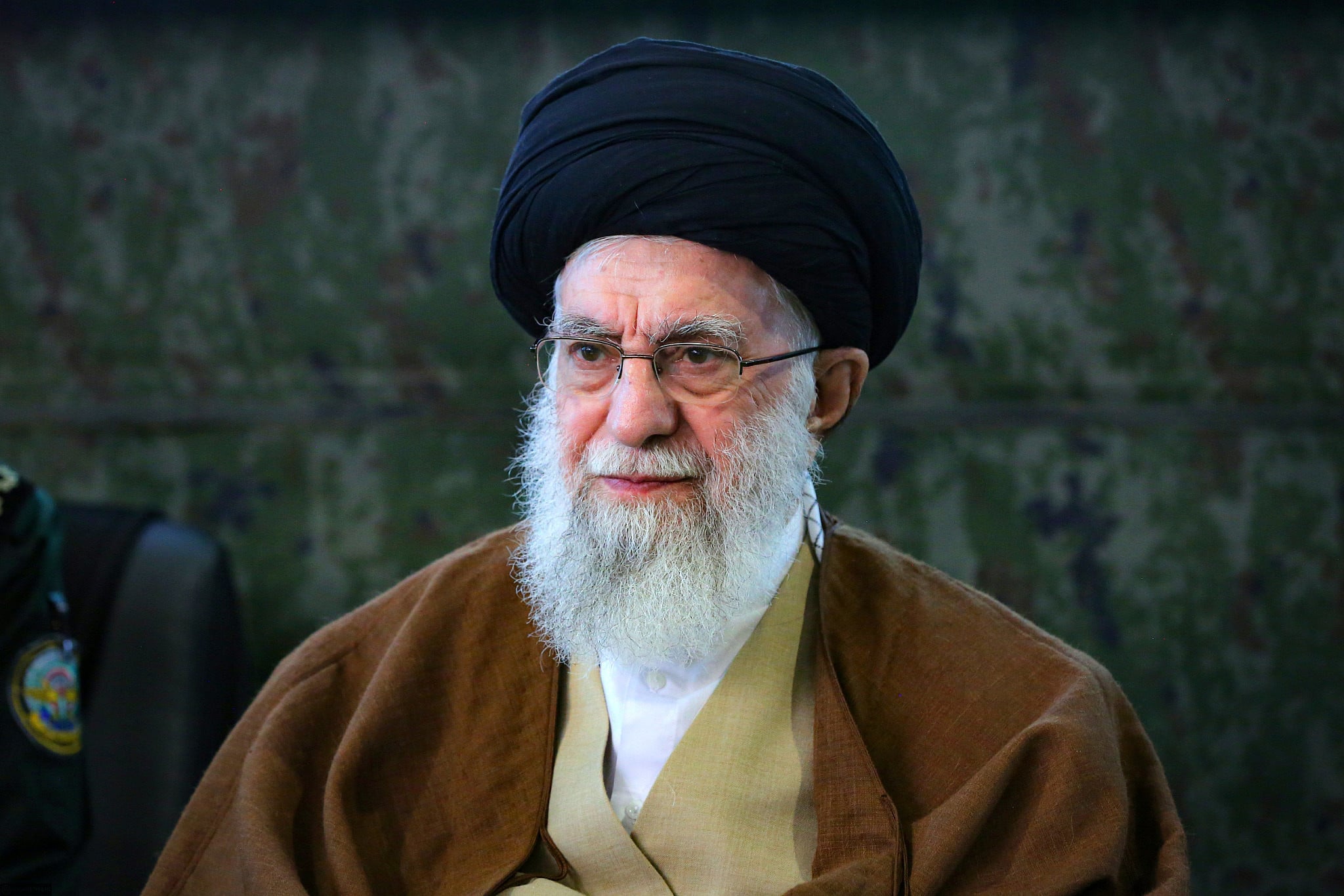
Ali Khamenei, Supreme Leader of Iran (photo: Khamenei.ir / CC BY 4.0)
On the final day of the 12-day war, after Iran had broken the ceasefire, Israel prepared a follow-up strike against Iran that would have been its most extensive operation. According to media reports and security sources, the planned operation was aimed at targeting multiple regime sites. It was halted following direct American intervention to bring the confrontation to a controlled close on Washington’s terms.
By striking Iran’s nuclear infrastructure and then stopping further escalation at a moment of choice, Donald Trump sought to show that the United States could neutralize the core threat and end the conflict swiftly, disproving critics who warned of a prolonged and costly war.
Among the decisions taken was sparing the life of Ali Khamenei, the central pillar of regime survival. Those opposing regime change got their wish, but at what cost?
‘Restraint’ From An Iranian Perspective
Iran does not interpret restraint the way Western policymakers often assume. Silence is not read as caution. It is read as permission.
The Islamic Republic has survived by absorbing pressure until it passes. It trades escalation for time, knowing that attention fades and priorities shift. Each crisis ends the same way: Tehran remains standing, its enemies debate the risks of doing more, and the regime consolidates again.
By halting the strike and deciding against taking out Khamenei when the regime itself felt exposed, the message received in Tehran was not deterrence. It was survivability. It was that the West did not have the will to go all the way, and that, ultimately, the regime could not be stopped.
Negotiations As Strategy, Not Solution
Periods of heightened pressure on Iran are consistently followed by renewed calls for diplomacy and de-escalation. Calls for talks, de-escalation, and “off-ramps” are presented as responsible alternatives to confrontation. Regional actors such as Qatar and Turkey reliably amplify this framing. Today’s report by the French News Agency quoting a Saudi source reported that Saudi Arabia, Qatar and Oman had persuaded Trump to give Iran another chance after US strikes once again appeared imminent.
For Iran, this is the ideal outcome. Negotiations do not restrain the regime, they buy it time. Every diplomatic process creates space to crush internal revolt, rebuild military capabilities, and re-entrench control over society. Protest movements do not fail because grievances disappear. They fail because repression becomes easier once international attention moves on, compounded by internet blackouts imposed to conceal the regime’s brutal killing of protesters.
The logic mirrors the mindset that prevailed in Israel before October 7. The belief that ideologically driven regimes can be managed through incentives and dialogue assumes a shared interest in stability. That assumption failed catastrophically, and repeating it with Iran would not be cautious; it would be a denial of reality.
There is no durable negotiation with a regime whose ideology treats compromise as weakness and delay as a tool of survival.
The “Day After” Fallacy – From Gaza To Iran
The same flawed reasoning has appeared before. During Israel’s war in Gaza, critics argued that defeating Hamas was pointless without a fully formed plan for what would follow. The implication was that military action itself lacked legitimacy absent a detailed post-war governance model.
The logic was backwards, because no credible “day after” scenario was possible while Hamas remained in control. Removing it was not the final step of a political process; it was the prerequisite for one.
The same applies to Iran: demanding a perfect transition plan before challenging the regime assumes the status quo is a tolerable baseline, when in reality it is the central obstacle to any meaningful change.
Planning for the day after matters. But the absence of a finalised blueprint is not more dangerous than inaction that allows a violent regime to persist. The argument that restraint is preferable because the alternative might be worse rests on the assumption that the status quo represents a tolerable baseline. In Iran’s case, it does not.
The current regime has killed thousands of its own citizens, continues to repress dissent through imprisonment and execution, and is widely regarded as the most destabilising state actor in the Middle East.
The Iran/Iraq Comparison
The comparison to the Iraq War is routinely used to argue against any serious challenge to the Iranian regime. It is also fundamentally flawed.
In Iraq, regime change meant trying to invent a political culture that had never existed; in Iran, regime change means restoring one that was violently interrupted.
The assumption that in Iraq, democratic institutions and civic norms could emerge in a society with no living memory of them and no unified mass movement demanding them proved wrong. The project required invention.
Iran is the opposite case. Iranians are not asking the outside world to introduce democracy. They are demanding the removal of a regime that violently interrupted an existing social and political trajectory. Before the Islamic Republic seized power in the Iranian Revolution, Iran was a globally integrated, modernised society with significant cultural freedoms. Those conditions were not erased. They were suppressed.
The distinction matters. Iraq required construction of an entire new way of life. Iran requires removal of a regressive dictatorship. The persistence of nationwide protests, the explicit rejection of clerical rule, and a long history of social progress make comparisons between Iran and Iraq a straw man argument.
Selective Outrage And The Erasure Of Iranian Voices
A consistent feature of this period has been the silence and selective outrage of certain media figures and commentators. Many of the same voices that accepted casualty figures from Hamas without hesitation suddenly demand extraordinary levels of proof when Iranian deaths are reported. Commentators who speak confidently about Iranian society routinely dismiss Iranians themselves when they call for outside intervention, regime change, or express support for Reza Pahlavi. Non-Iranians insist on explaining to Iranians what they supposedly want.
What is revealing is how consistently these positions come from the same ideological camp. Almost without exception, the commentators and media figures minimizing Iranian demands for change are those who are highly critical of Israel, openly pro-Palestinian, or explicitly anti-Zionist. Because the fall of the Iranian regime would also serve Israel’s security, it is opposed almost on principle. In this framing, Iranian voices are taken seriously only until their demands align with Israel’s interests – at which point they are dismissed as merely individual Iranian voices, no longer representative of their own people.
Conclusion
Debate now centers on whether there will or will not be an American strike on Iran. On the one hand, Donald Trump has publicly encouraged Iranian patriots to continue protesting, warning that the killing of demonstrators would trigger a harsh US response. Thousands have been killed. Yet after Iranian airspace was effectively cleared, American naval assets repositioned, and US troops departed from Qatar, Trump pointed to reports claiming the violence had subsided, and the language of de-escalation once again took centre stage.
With Trump, mixed signals, pauses, and contradictory messaging are tools rather than signs of indecision. The same pattern appeared before the 12-day war, when he seemed to favor diplomacy while simultaneously giving Israel the green light to act. Ambiguity over timing is deliberate. The outcome itself is not in doubt.
The Iranian regime uses negotiations to buy time, repression to crush revolt, and delay to rebuild its military and nuclear capabilities. But the strategic environment has changed. In the post-October 7 reality, with Benjamin Netanyahu no longer willing to gamble on restraint, Iran’s familiar delay tactics are losing their effectiveness.
Whether the next strike comes from the United States or from Israel remains to be seen. But one fact is undeniable: Iran will be hit. The only questions are when, and by whom. If the task falls to Israel, the next confrontation will not resemble the last. Israel cannot sustain endless cycles of war while ballistic missiles rain down on its cities. The next campaign would be aimed at the regime itself.
On October 9, 2023, Netanyahu declared that Israel’s response to the Hamas attack “will change the Middle East,” a statement many at the time ridiculed as hyperbole. As things stand today, that picture is already far clearer, with Iran’s proxies weakened, exposed, and increasingly constrained. Yet the region cannot truly transform while the head of the octopus remains intact. The collapse of the Iranian regime will usher in a new Middle East – and it is now widely understood that this moment is fast approaching.
Related Topics
Related Posts