The views expressed herein are solely mine.
Iran: Disarm Hezbollah Before Israel Leaves. Deal?
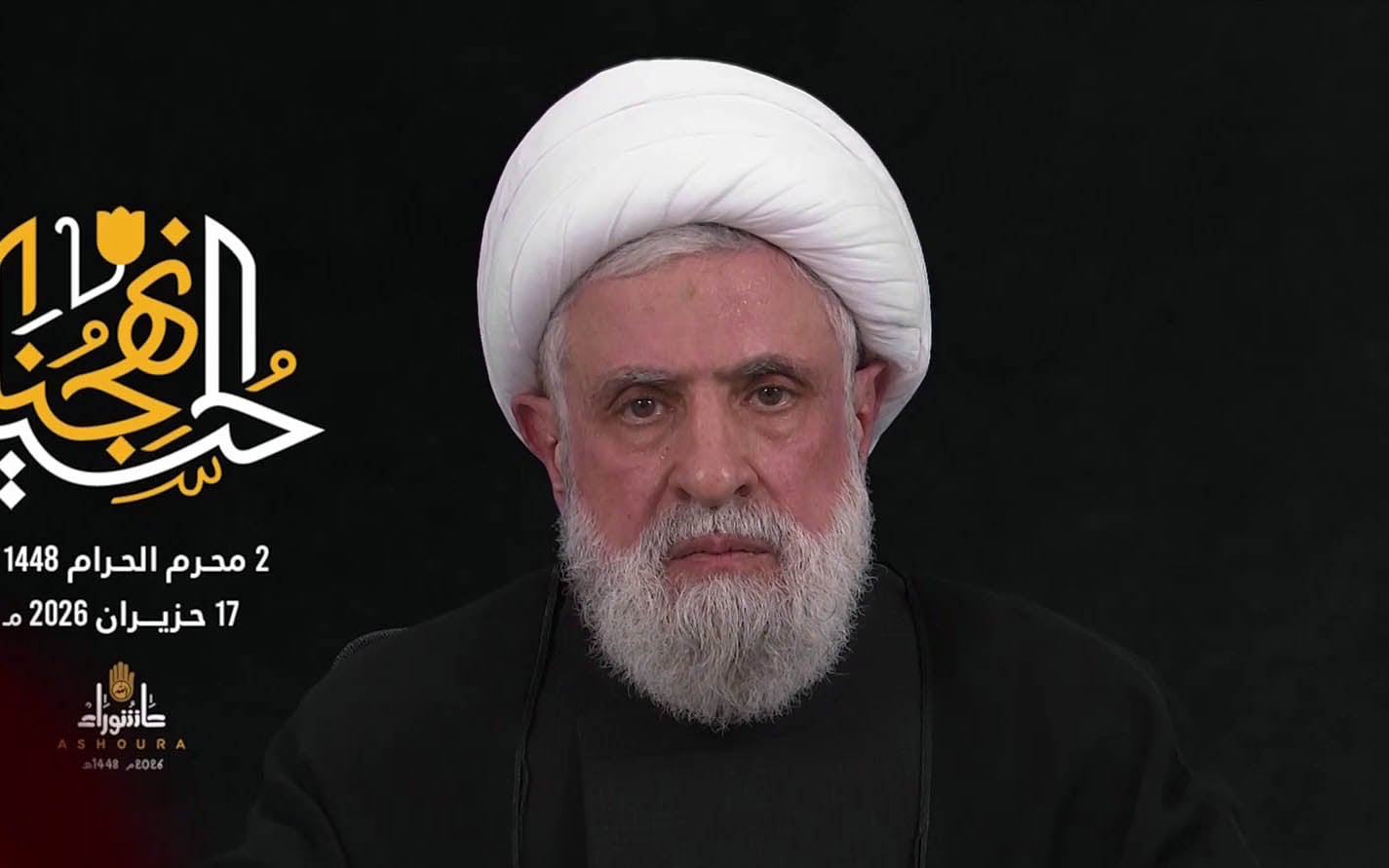
Hezbollah leader Naim Qassem delivers a speech broadcast on June 17, 2026. (Screenshot/Al Manar via X).
Western capitals and influential segments of the international media are now urging Israel to withdraw from southern Lebanon without first disarming Hezbollah. They claim recent Israeli operations have weakened the Iranian-funded terrorist group “enough” and that it is time for a “diplomatic resolution” that will restore “normalcy” along the border. Indisputably, this argument reverses cause and effect, treats the symptom as the disease, and ignores the structural reality that has driven this conflict for a generation.
History provides the clearest test. Israel completed a full withdrawal from southern Lebanon in 2000 and was even praised by the United Nations. However, Hezbollah did not disarm, and instead, it rearmed on an industrial scale. Its rocket and missile inventory grew from roughly 12,000 on the eve of the 2006 war to an estimated 150,000 by October 2023.
Over the same period, the group built hundreds of kilometers of tunnels — many multi-level and hardened — for command, storage, and cross-border raids such as ‘Operation Conquer the Galilee’, which they planned to launch right after October 7. With direct Iranian assistance, Hezbollah acquired precision-guided munitions, anti-ship missiles, and advanced drone systems. UN Security Council Resolution 1701, passed after the 2006 war, explicitly required Hezbollah’s disarmament and the Lebanese state’s exclusive military authority south of the Litani River. UNIFIL documented the opposite: systematic fortification, unauthorized armed presence, and the transformation of the area into a forward Iranian base.
Hezbollah functions as Iran’s premier proxy in the Levant. Tehran provides approximately $700 million annually, along with training, advanced weaponry, and strategic direction through the Islamic Revolutionary Guard Corps’ Quds Force. Hezbollah’s decision to open sustained attacks on northern Israel on October 8, 2023, was not an independent Lebanese initiative; it was a calculated Iranian move to open a second front in support of Hamas and to derail regional normalization.
Israeli operations in 2024 and 2025 produced major tactical gains. The IDF destroyed between 70 and 80 percent of Hezbollah’s pre-war rocket arsenal. Key tunnel networks, including complexes over two kilometers long that could house thousands of terrorists, were exposed and dismantled.
Open-source and military assessments now place Hezbollah’s remaining effective projectile inventory at roughly 20,000 to 30,000 rockets, increasingly concentrated north of the Litani. These are real operational achievements. They do not, however, sever Hezbollah’s command relationship with Tehran or eliminate its capacity for rapid reconstitution as long as Iranian supply lines remain open. That is the decisive constraint.
Current diplomatic efforts that fold Israeli withdrawal into broader U.S.-Iran negotiations or treat withdrawal as a goodwill gesture recreate the very conditions that brought us here. They hand Hezbollah—and therefore Hamas—political breathing room and time to recover while casting Israel’s defensive operations as the main obstacle to calm. Much international media coverage reinforces this distortion by emphasizing Lebanese humanitarian suffering while giving far less weight to Hezbollah’s deliberate embedding inside civilian infrastructure and its role as an Iranian terror instrument. The pattern is familiar: pressure from Washington and European capitals that prioritizes procedural diplomacy over verifiable security outcomes. After October 7 and the multi-front war that followed, Israeli public tolerance for concessions without ironclad guarantees has collapsed.
Some will argue that demanding verifiable disarmament before withdrawal is unrealistic. They will point to Lebanon’s humanitarian crisis, the Lebanese Armed Forces’ limited capacity, and the political dominance Hezbollah already exercises inside the Lebanese state. Yet these objections miss the central lesson of the last 25 years.
The Lebanese state has repeatedly proven unable or unwilling to confront Hezbollah. Past reliance on UNIFIL produced documented impotence rather than enforcement. A withdrawal that leaves Hezbollah’s offensive infrastructure and Iranian resupply routes intact resets the clock for the next military battle.
Humanitarian costs in Lebanon are real, but they stem primarily from Hezbollah’s decision to turn civilian areas into military zones and from Iran’s choice to use Lebanon as a battlefield. Framing Israel as the primary obstacle to calm inverts responsibility.
A realistic framework should appeal to reverse the sequence. Any change in Israel’s military posture in southern Lebanon must rest on demonstrable Iranian steps to halt the flow of weapons, funding, and operational guidance to Hezbollah, coupled with the verified dismantlement of the group’s offensive infrastructure south of the Litani River. Given Hezbollah’s political entrenchment and the Lebanese Armed Forces’ weakness, effective Lebanese state control requires binding monitoring arrangements with automatic enforcement mechanisms — including the credible prospect of renewed Israeli action if violations occur. Without enforcement teeth, any agreement will eventually repeat past failures.
Since 2000, the record is unambiguous. Withdrawals that do not first neutralize the Iranian-backed threat will only foster rearmament and renewed war. Sustainable Israeli departure from southern Lebanon, therefore, requires the verifiable neutralization of Hezbollah’s offensive capabilities. If a serious deal is the goal between Israel and Lebanon, but also between America and Iran, this is the only sequence that could yield one worth signing. The alternative is to accept the next, more destructive conflict on Iran’s timeline.
Related Topics
Related Posts