
Iran Faces Its Defining Deadline
There are moments in geopolitics when time itself becomes a pressure point. For Iran’s ruling establishment, that moment has arrived. As February 2026 begins, Tehran is facing a convergence of forces it can no longer manage through delay, deflection, or denial. The message from Washington is blunt, the mood in the streets is restless, and the patience of the international community—long stretched thin—is rapidly evaporating.
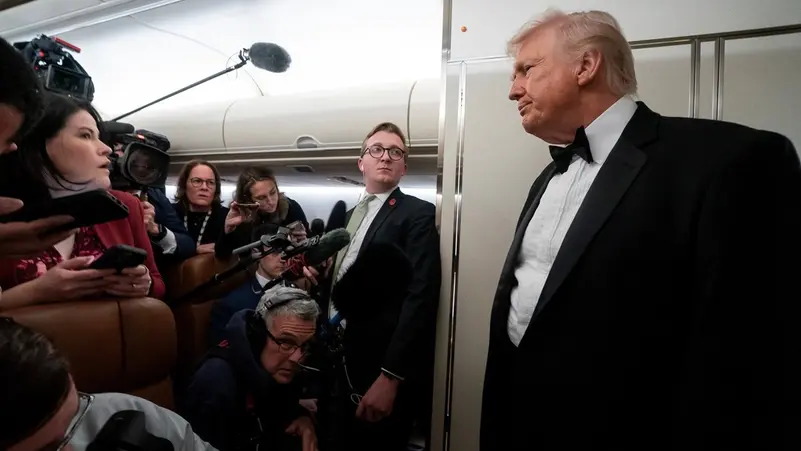
President Trump has repeatedly stated that Iran is actively engaging with the US, describing the talks as “serious” and expressing hope for a deal that would see Iran abandon its nuclear ambitions. In a January 31 interview with Fox News, Trump said:
“[Iran is] talking to us, and we’ll see if we can do something, otherwise we’ll see what happens … We have a big fleet heading out there. They are negotiating.” He emphasized that the US cannot disclose military plans to regional allies for security reasons, noting, “Well, we can’t tell them the plan. If I told them the plan, it would be almost as bad as telling you the plan – it could be worse, actually.”
Trump has also highlighted the scale of the US naval presence, calling it an “armada” larger than deployments used in past operations, such as in Venezuela.
US President Donald Trump says that Tehran is “seriously talking” to his administration and that he hopes that an “acceptable” deal will be reached.#Iran #Trump pic.twitter.com/j77qMRdmFV
— Al Arabiya English (@AlArabiya_Eng) February 1, 2026
President Donald Trump’s approach to Iran in his second term has stripped away ambiguity. He has signaled openness to negotiations while simultaneously deploying a powerful U.S. naval presence to the region. Critics bristle at the optics. Supporters argue that this is precisely the clarity missing from years of diplomacy that rewarded stalling rather than compromise. The underlying calculation is simple: Iran only negotiates seriously when the alternative is demonstrably worse.
For the Iranian people, this is not an abstract strategic debate. It is lived reality. Years of sanctions mismanagement, corruption, and ideological adventurism have hollowed out the economy. Inflation has crushed savings. Jobs have disappeared. Young Iranians—educated, connected, and increasingly fearless—have taken to the streets demanding dignity and a future. The state’s response has been brutally familiar: live fire, mass arrests, internet shutdowns, and executions meant to terrify a population into silence.
These are not the actions of a confident government. They are the reflexes of a regime that knows its grip is slipping.
For too long, Western diplomacy separated Iran’s nuclear file from its domestic repression and regional violence, as if these were unrelated problems. They are not. The same Islamic Revolutionary Guard Corps that fires on protesters in Tehran also bankrolls militias in Lebanon, Gaza, Yemen, and Syria. The same system that jails women for refusing to comply with dress codes uses proxy wars to project power abroad while insulating itself from direct accountability.
The Trump administration’s demands—ending high-level uranium enrichment, allowing intrusive inspections, limiting long-range missiles, and halting support for armed proxies—are not radical. They are the minimum conditions required to prevent a regime under internal pressure from externalizing its crisis through aggression. Framed another way, they are demands that align with the interests of ordinary Iranians far more than those of the clerical elite.
Recent U.S. military strikes on sensitive Iranian facilities sent a message Tehran understood instantly: American warnings are no longer hypothetical. Deterrence only works when it is credible, and credibility requires action. Trump’s warning that future attacks would be “far worse” is meant not to provoke war, but to prevent it—by forcing a choice before miscalculation makes escalation inevitable.
What has changed most dramatically is that Washington is no longer alone. Europe’s decision to designate the IRGC as a terrorist organization marks a historic break with years of hesitation. For Iranian protesters, this move matters. It signals that the world is finally connecting the dots between internal repression and external terror. The IRGC is not a normal military institution; it is the regime’s shield and sword, controlling vast economic empires while enforcing obedience at gunpoint.
By blacklisting it, Europe has stripped away a layer of legitimacy the regime relied on. Asset freezes, travel bans, and legal consequences are important, but the symbolism is even stronger: those who terrorize their own population will no longer be treated as respectable state actors abroad.
Inside Iran, this international pressure intersects with a society that has already crossed a psychological threshold. Fear remains, but so does defiance. Each crackdown produces more anger, not submission. Each funeral becomes a protest. The regime’s attempts to project strength—military drills, threats in the Strait of Hormuz, fiery speeches—ring hollow against the reality of unpaid wages and empty refrigerators.
From Israel’s perspective, this moment carries obvious stakes. A nuclear-armed Iran would embolden its proxies and destabilize the entire region. Yet there is also a quieter truth: the Iranian people chanting for freedom are not Israel’s enemies. They are victims of the same system that funds rockets and repression. A strategy that pressures the regime while keeping the door open to genuine negotiations is not anti-Iranian—it is aligned with the aspirations of those risking their lives for change.
None of this makes war inevitable. Regional actors are still urging restraint. Mediation channels remain open. But avoiding conflict does not mean pretending the problem will resolve itself. The era of strategic patience has ended because patience became permission.
Iran’s leadership now faces a narrowing window. It can choose serious negotiations that curb its nuclear ambitions and end its reliance on proxy violence, opening the door—however gradually—to reintegration with the world. Or it can continue to double down on repression at home and defiance abroad, accelerating its isolation and deepening the suffering of its own people.
Time is no longer on the side of Tehran’s clerical regime. The streets are restless. The alliances against it are hardening. And for once, the international community appears willing to match words with resolve.
Iran’s clock is ticking—not because the world seeks confrontation, but because delay has become the most dangerous option of all.