
Iran is running out of water – and time
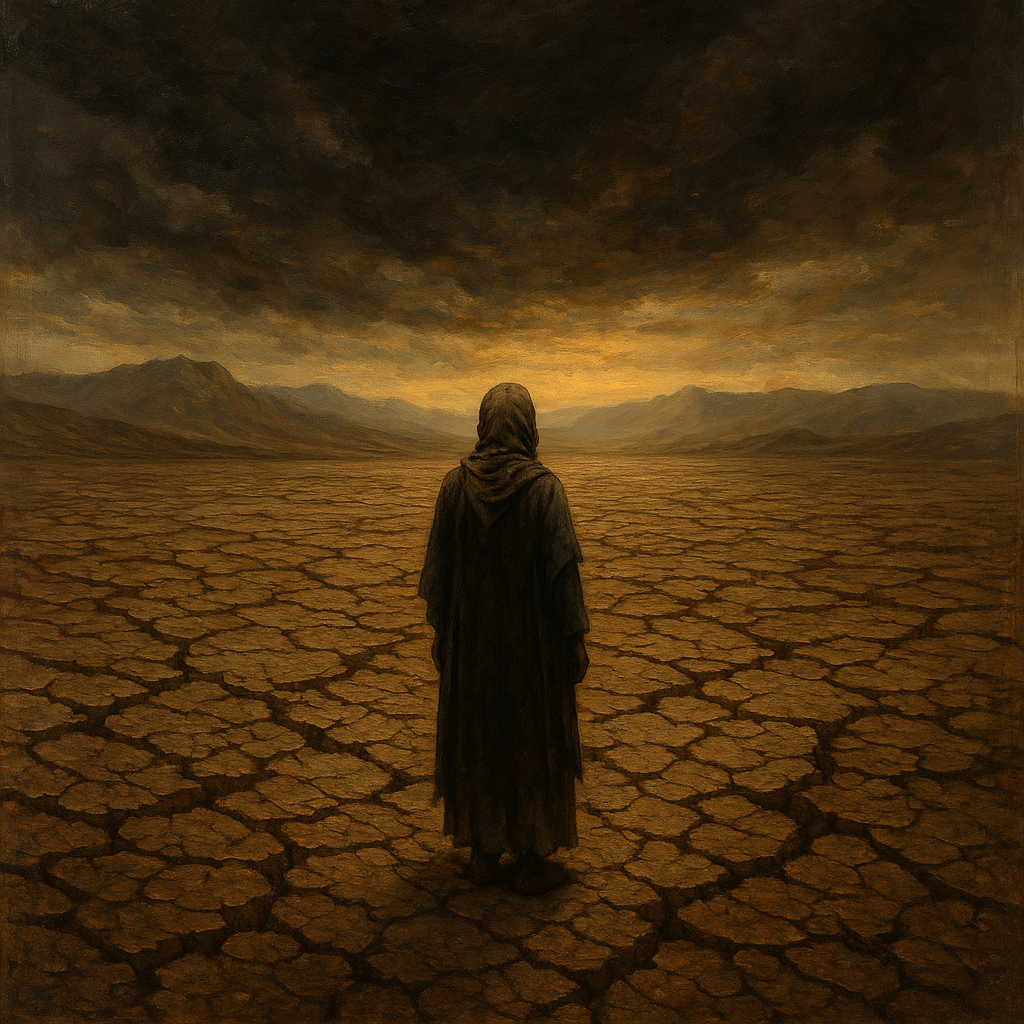
Picture, if you will, a country that is quite literally lowering itself into the ground. Fields once green now fissured and grey, lakes reduced to chalk outlines on satellite images, roads creased like old parchment. This is Iran in the 2020s: not merely an authoritarian state with a taste for proxy warfare, but a civilization quietly dying of thirst and, in places, sinking under the weight of its own mismanagement.
We have become so accustomed to thinking of Iran in the cramped vocabulary of uranium enrichment and missile ranges that we have missed the larger drama: the story of a great nation drifting into what its own experts call water bankruptcy. Iran is using more water than it has, more water than it can reasonably hope to have, and it is doing so under a political order structurally ill-suited to course correction.
And nowhere is this more symbolically charged than in Tehran.
Let us address the question head-on, because it has become almost folkloric: is Tehran actually sinking? The answer, stripped of hyperbole, is this: yes, in substantial parts of the capital region the ground is subsiding at a rate that would terrify any engineer, even if it is not quite the cinematic vision of a city vanishing into a sinkhole.
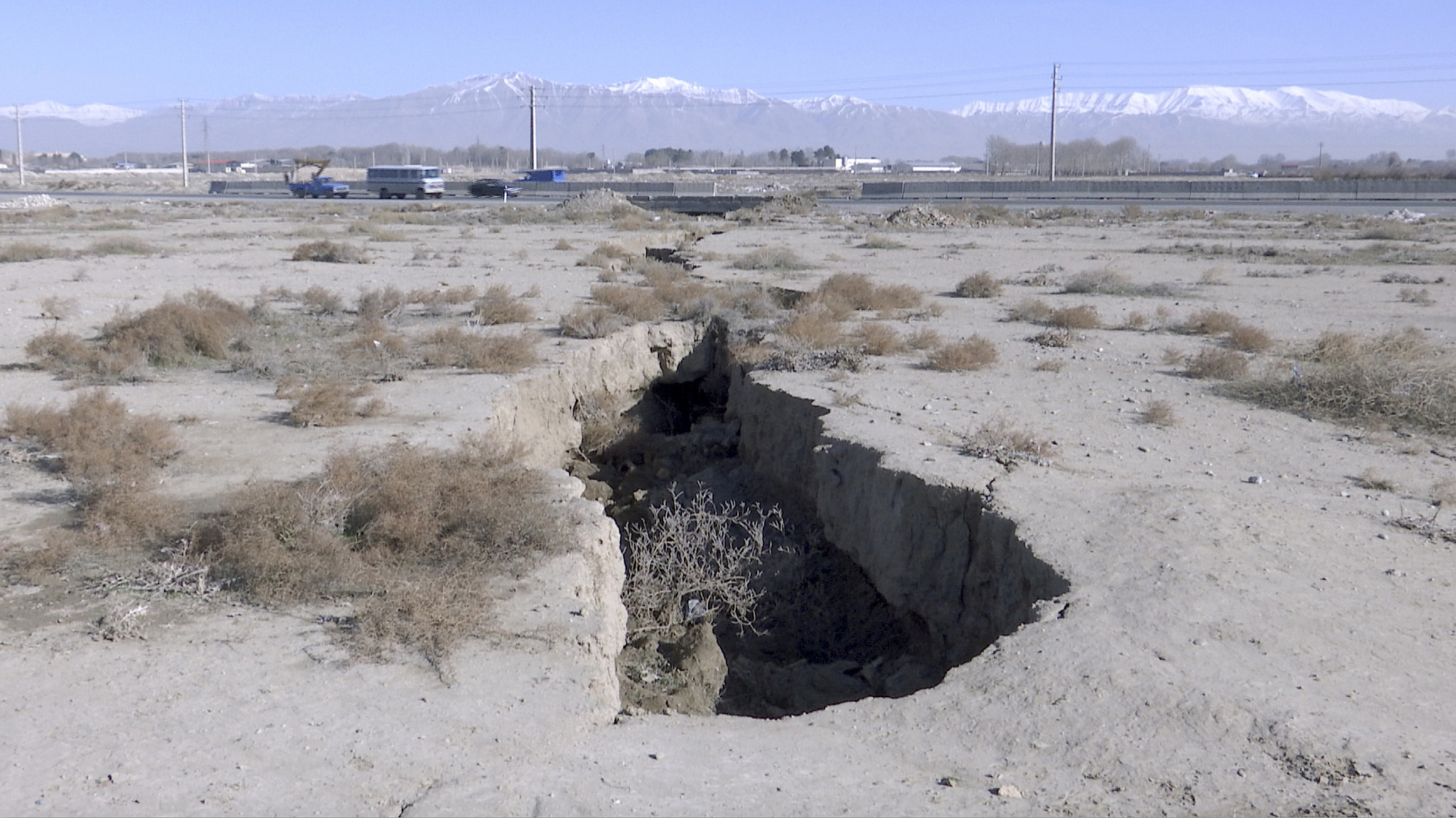
Using satellite radar, geoscientists have tracked the Tehran plain over the past two decades. Their measurements show that in several western and southern districts the land is dropping by up to a foot – roughly 25 to 30 centimeters – each year. That may sound modest to the human ear, but in geological terms it is a stampede. A few millimeters a year is enough to set alarm bells ringing in civil-engineering departments; Tehran in places is sinking dozens of times faster.
Other parts of the city move far less; the centre is not uniformly collapsing like a failed soufflé. The subsidence is patchy and uneven, which is precisely what makes it so dangerous. One building moves a little, the ground under its neighbor moves a lot, and between them pipes shear, walls crack, roads ripple. Once compressed, the fine sediment layers that used to hold groundwater do not spring back; the aquifer is like a mattress whose springs have been crushed flat. The storage that sustained the capital for generations is, in some areas, gone for good.
So yes, Tehran is sinking – not everywhere, not all at once, but enough to threaten housing, heritage, and the physical skeleton of a metropolis that holds well over ten million people.
An unraveling social contract
Subsidence is only the most visible expression of a deeper unravelling: the loosening of the social contract every time a tap runs dry.
Iran’s villages have been emptying at an astonishing rate. Tens of thousands of them have already been abandoned as wells fail and crops no longer justify the effort of sowing. Those who can move do so, joining the annual tide towards cities that are already overburdened. The swollen outskirts of Tehran, Isfahan and other major urban centers now bristle with informal settlements: cinderblock warrens where water arrives, if it does, in blue plastic tanks and people live at the mercy of tanker schedules and power cuts.

Inside the cities, the middle classes have discovered that the state they fear is also a state that cannot reliably keep them supplied with something as prosaic as running water. Reservoirs are scraped down to historic lows; nightly rationing and sudden cuts become part of the urban soundscape. When the electricity grid buckles under the combined load of pumps and air-conditioners during forty-odd-degree heatwaves, flats go dark and lifts stall. A government that cannot keep water in the pipes and power in the wires looks faintly ridiculous when it boasts about centrifuge cascades.
Water scarcity is not simply a putative engineering problem. It corrodes trust. Farmers watch their rivers diverted to distant industrial plants or funneled via pipelines to inland cities and ask, with some justice, why their children must leave ancestral land so that well-connected steelworks may continue to gulp water in the middle of a desert. Upstream and downstream communities quarrel over whose fields live and whose die. Add to this a security apparatus that answers complaints with batons and bullets, and environmental crisis becomes a standing invitation to unrest.
Beyond the human geography, Iran’s physical geography increasingly resembles an act of protest.
Lakes that once served as climatic shock absorbers and economic anchors have shrunk to sad, saline remnants. Lake Urmia in the north-west, once among the largest salt lakes on earth, has lost the bulk of its surface area. What lies exposed is not some picturesque white playa but a source of salt-laden dust that burns crops, irritates lungs and shortens lives. In the east, the Hamoun wetlands have largely vanished, replaced by dust bowls that send choking storms across the border into Afghanistan and Pakistan.
Beneath all this, the aquifers that nourished Iranian civilization for millennia are being drained like someone sucking the last drop through a straw. For years, as rivers dwindled, the country responded by drilling deeper: more wells, drilled further down, powered by subsidized electricity and cheap fuel. It worked until it didn’t. Once enough water is removed, the clay and silt layers compact. The ground lowers. Buildings tilt. Bridges warp.
To say that the land is rebelling is no longer metaphorical indulgence. Tehran’s own predicament – reservoirs near empty above, aquifers compressed below – is simply the most vivid expression of a nationwide pattern.
Policy failures with global consequences
It would be comforting, in a perverse way, to blame all this on capricious weather or an unkind God. Climate change has certainly turned the heat up and fiddled malevolently with rainfall patterns, but Iran’s predicament is not an act of heaven. It is the outcome of policy.
After 1979, the new Islamic Republic wove water into its founding promises. Food self-sufficiency became a totem; water and electricity were talked about as rights to be handed down, gratis, from the revolutionary state. Agriculture now swallows the overwhelming majority of Iran’s water, much of it poured into thirsty crops in regions where they never made sense, irrigated by techniques that would embarrass a Victorian. At the same time, heavy industry – steel among them – was planted squarely in some of the country’s driest basins, as if daring geography to object.
Layered on top of this were prestige projects: hundreds of dams and water-transfer schemes, rammed through in the 1990s and 2000s with more enthusiasm than prudence. Many were championed less by hydrologists than by the engineering arm of the Revolutionary Guards and a constellation of favored contractors. Some were built on salt formations, duly salting rivers downstream; others diverted water from minority provinces to religious and political capitals.
When experts protested, they were brushed aside. Some environmentalists found themselves not in advisory councils but in prison cells. This is not mere miscalculation; it veers into malpractice.
If the consequences stopped at Iran’s borders, the story would already be bleak enough. But environmental systems are not so courteous.
Dust storms from Iranian lake beds and dried farms routinely roll across Iraq, Kuwait and the Gulf states, shrouding cities in a noxious haze that closes airports and fills hospital wards. Shared rivers with Afghanistan and Iraq have become increasingly contentious, as dams and diversions upstream leave less for downstream farmers and marshlands. Skirmishes on the Helmand and rising tempers over the Mesopotamian marshes are early warning shots in what could, if mismanaged, become a far more volatile hydropolitical landscape.
The specter that ought to give European policymakers sleepless nights, however, is not merely dust or river spats. It is people. Iran is home to nearly ninety million citizens. If enough of its countryside becomes unviable – through lack of water, collapsing infrastructure and the impossibility of making a living from exhausted land – then internal migration will, in time, overflow borders.
We know what a million Syrian refugees did to Europe’s political equilibrium. Now envisage several million Iranians, many from minority regions, moving through Turkey and the Caucasus towards the EU, or seeking refuge in already fragile neighbors. To describe this as destabilizing would be a masterpiece of understatement.
A regime that cannot or will not protect its own population from thirst, dust and subsiding ground does not merely fail domestically; it exports risk.
Lost opportunities – and the path forward
There is a sting of irony in all this. Half a century ago, under the monarchy, Iran quietly recognized that it needed help to manage its water. It turned, of all places, to Israel – another small, arid country wrestling with similar constraints. Israeli engineers and Iranian colleagues together designed systems, built pipelines, experimented with early desalination, and nudged agriculture towards more efficient practices. It was hardly paradise, but it was recognizably technocratic and forward-looking.
The revolution ended that chapter. Israeli experts were expelled, many Iranian specialists tainted by association were sidelined, and water policy became the turf of revolutionary organs and the Guards. While Israel went on to turn scarcity into a kind of perverse abundance – desalination on a grand scale, near-universal wastewater reuse, world-leading drip irrigation – Iran marched in the opposite direction: subsidized waste, politicized engineering and the steady vandalism of its own natural capital.
Today, as Tehran contemplates the once fantastical idea of moving its capital because it may simply no longer be viable where it stands, hardliners still indulge the fantasy that their woes are the product of foreigners “stealing clouds” rather than their own decades-long misrule. One is tempted to say that what has truly been stolen is opportunity – the forty-odd years in which the country might have adopted the very methods that have allowed others to live reasonably well in similar climates.
Here is the most maddening part of the tale: Iran’s water crisis is technically solvable. No, not easily; no, not quickly; but solvable. Other countries with less forgiving climates have shown that it can be done.
The tool-kit is well known: serious demand management; realistic pricing; modern irrigation; leakage reduction; large-scale desalination where appropriate; re-use of treated wastewater; smarter crop choices; restoration of at least some strategic lakes and wetlands. Iran has the engineers and scientists to design such a transformation.
What it lacks is the one ingredient no foreign consultant can supply: political will rooted in accountability. A system that treats data as subversive, criticism as treason and cooperation with technologically advanced neighbours as ideological pollution is not going to deliver the quiet revolution required. That will demand a different style of governance altogether – one that prizes competence above revolutionary pedigree, welcomes expertise rather than jails it, and sees neighbours as potential partners in shared basins rather than convenient villains.
Why, then, should those of us sitting in London, Paris or Berlin care about whether parts of Tehran are dropping by a few inches a year? Because in a world already rattled by climate, conflict and migration, a slowly failing state of ninety million people in one of the planet’s most strategic corridors is not a local curiosity; it is everyone’s problem.
We can, if we choose, continue to talk about Iran in the familiar language of nuclear thresholds and sanctions waivers. Or we can widen our focus and recognize that the deeper, longer-term threat lies in the slow violence being done to water, soil and air. The former may, in the worst case, produce a bomb. The latter may produce a rolling humanitarian and geopolitical shock for which our institutions are entirely unprepared.
An Iran that learns to live within the limits of its rivers and aquifers, governed by people who listen to hydrologists as closely as to generals, could be a pillar of regional stability and even of cooperative problem-solving. An Iran that continues to pump its aquifers to exhaustion, salinate its rivers and sink its capital – literally and metaphorically – will remain a source of chronic anxiety, not only to its own citizens but to all who share a sky, a sea lane or a migration route with it.
The choice, in the end, is stark. Either Iran becomes a cautionary parable of how to ruin a country by mismanaging water, or it becomes an example of how even the gravest ecological folly can be slowly reversed. For the sake of Iranians and their neighbors – and, yes, for our own – we would do well to hope for the latter, and to plan for both.