The views expressed herein are solely mine.
Iran Tightens the Noose: Kuwait Must Choose Israel
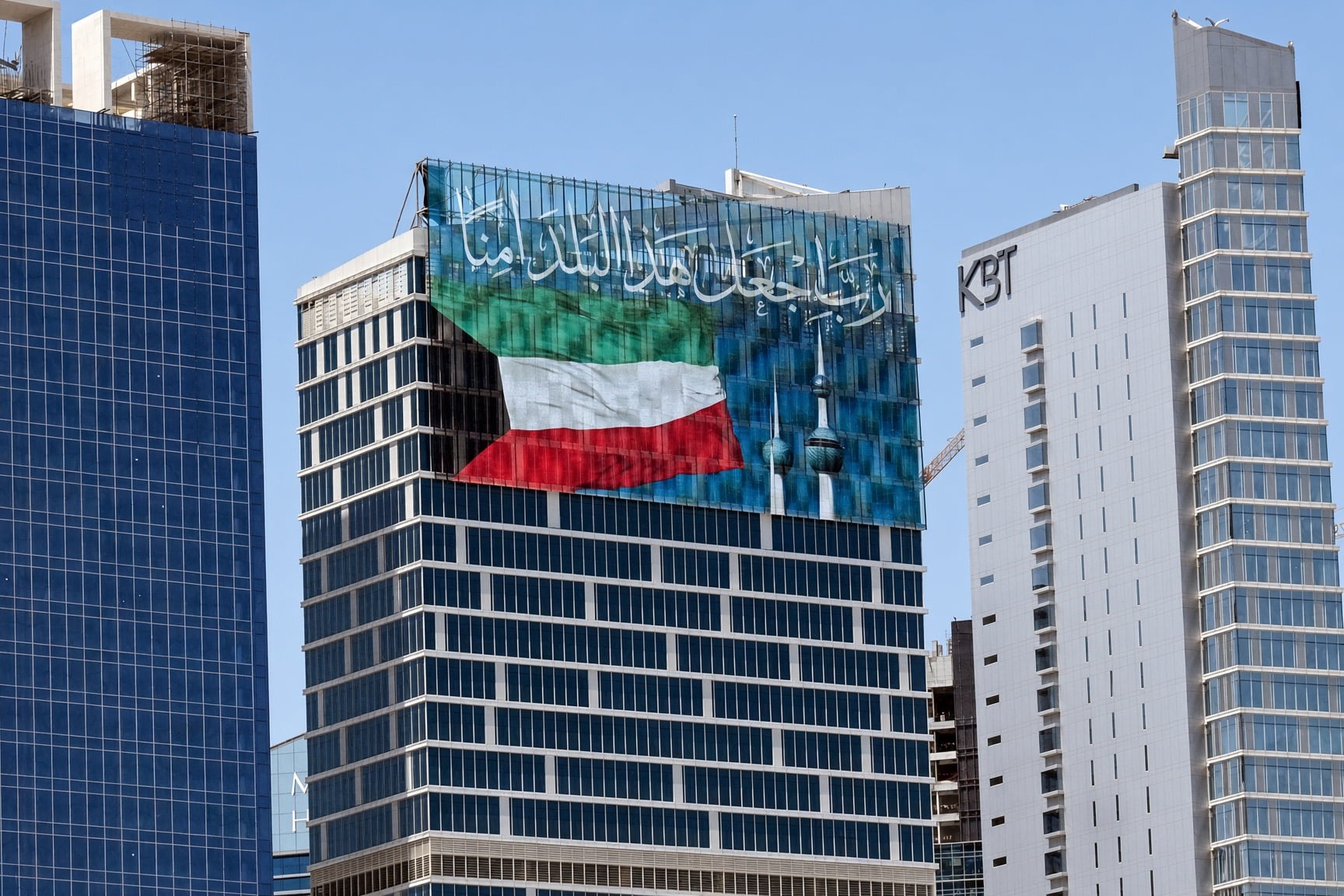
A large screen displays a verse from the Koran reading 'My Lord, make this city secure,' alongside the Kuwaiti flag and the landmark Kuwait Towers, on a skyscraper in Kuwait City on September 2, 2026. (AFP).
Kuwait stands on the precipice of an avoidable catastrophe that Western weapons cannot avert. For decades, bloated defense procurement has yielded an armed force optimized for twentieth-century desert tank warfare, leaving the nation blind to twenty-first-century gray-zone coercion. Squandering nearly six percent of national output on obsolete conventional armor will not deter the bloody Islamic Republic of Iran or its predatory Iraqi proxies. Instead, geography remains Kuwait’s existential curse, leaving its primary industrial centers exposed beneath the direct crosshairs of hostile launch batteries.
This vulnerability is compounded by a historical reality: regional brotherhood is a hollow illusion. Baghdad demonstrated this during the March 1973 Al-Samita border incursion, proving how swiftly Iraqi forces would violate Kuwaiti territory while neighboring Arab capitals issued toothless communiqués. Clinging to sterile Arab League resolutions today merely repeats the self-delusion that preceded both the 1973 aggression and the ruinous 1990 invasion. Today, Tehran views Kuwait City’s performative anti-Abrahamic normalization posturing not as principled steadfastness, but as paralytic weakness awaiting exploitation.
The operational timeline illustrates just how defenseless the emirate has become. A low-altitude Shahed-136 drone launched from the Faw Peninsula requires barely eighty-five seconds to incinerate the $27 billion Al-Zour refinery complex—yet firing a $4 million Patriot interceptor against that $20,000 composite-plastic drone represents fiscal suicide. This aerial vulnerability is mirrored at sea, where 78% of Kuwaiti maritime petroleum exports must transit the shallow littoral corridors surrounding the islands of Bubiyan and Warbah. In these muddy waters, Iranian Islamic Revolutionary Guard Corps naval vessels and acoustic limpet mines operate with absolute impunity. Facing a multi-domain stranglehold, survival requires the ruling Al-Sabah family to discard ideological posturing and construct an urgent, covert defense framework alongside Jerusalem.
To secure its sovereignty, Kuwait should consider launching three kinetic initiatives.
First, it must establish an uncrewed sub-surface surveillance perimeter across its northern littoral mudflats. By purchasing Israel Aerospace Industries’ BlueWhale autonomous underwater platforms and seabed acoustic sensor networks, Kuwaiti forces can track, intercept, and neutralize hostile minelaying units before they seal critical maritime arteries.
Second, sovereign investment entities must establish dual-use corporate fronts in neutral trade hubs like Singapore to procure advanced interception capabilities. Purchasing Elbit Systems’ Iron Beam directed-energy laser platforms will enable containerized, fiber-optic weapons to shield the Al-Zour and Mina Al-Ahmadi terminals directly. This concentrated optical energy can vaporize swarming kamikaze drones at a marginal operating cost of under $4 per shot, fully neutralizing Tehran’s asymmetric economic leverage.
Third, defense planners must wire Rafael’s AI-driven Fire Weaver sensor-to-shooter architecture directly into coastal defense batteries. This digitized target allocation ensures instantaneous electronic countermeasures against the guidance links of Iraqi terrorist groups before hostile warheads can even cross Kuwaiti airspace. The stark reality is that Western military contractors do not supply the nimble, theater-tested systems necessary to defeat this low-altitude swarm doctrine.
Ultimately, embracing Israeli technical dominance is no longer an optional diplomatic experiment; integration represents Kuwait’s sole path toward physical preservation. Realpolitik demands ruthless strategic calculation, not blind allegiance to an Arab boycott long discarded by pragmatic capitals. Both Abu Dhabi and Manama recognized years ago that deploying Israeli defensive hardware secures critical national infrastructure without provoking domestic instability. Kuwaiti indecision merely invites the Mullahs to tighten their deadly regional stranglehold.
Jerusalem provides the exact operational deterrent required to convert an undefended Gulf emirate into an impregnable littoral fortress. Choosing diplomatic complacency instead guarantees the destruction of Kuwait’s core energy assets and the ultimate surrender of national autonomy. The mandate for the Al-Sabah leadership is clear: they must shed outdated ideological dogma, recognize the stark limits of Western security umbrellas, and integrate Israeli technological shields immediately. Regional conflagration will not wait for Arab League consensus—and Kuwait’s time has officially run out.
Related Topics
Related Posts