
Iran Wants 60 Days to Build the Nuclear Bomb (Part 2)
On June 17, leaked drafts of the fourteen point memorandum of understanding between Washington and Tehran, reported by Bloomberg and obtained separately by CNN and The Times of Israel, finally committed to paper the question that had been kept deliberately blurry for weeks.
The fate of Iran’s enriched uranium stays unresolved, pushed into a sixty day negotiation that can be extended by mutual consent. The text asks Iran to reaffirm, in words, that it will never produce a nuclear weapon, and it leaves the material itself exactly where it has sat since the first bomb fell.
The war was fought over that uranium. The agreement that ends the war does not remove it. The formal signing is set for Friday in Switzerland, and Iran has already dismissed the leaked text as incomplete, which only thickens the fog around the single fact that matters most. The stockpile remains on Iranian soil.
A deal that defers the only thing that mattered
Strip the fourteen points to their core and the bargain reads plainly. There is an immediate and permanent ceasefire on all fronts, including Lebanon. There is the reopening of the Strait of Hormuz, the narrow channel through which roughly a fifth of the world’s traded oil and gas once moved. There is sanctions relief, with Treasury waivers issued almost the moment the ink dries, letting Iran sell its crude and petrochemicals again.
There is the release of frozen assets and, according to Reuters, a private investment vehicle of at least three hundred billion dollars, financed by companies rather than by the American treasury, meant to rehabilitate the Iranian economy. And there is a phased withdrawal of United States forces from the region within thirty days of a final accord. In return, Iran offers a single sentence of reassurance about a weapon it claims it never wanted.
The draft language makes the deferral almost explicit. It speaks of resolving Iran’s “nuclear needs” in the final agreement, and it asks Tehran to maintain what it calls the status quo on its program during the sixty days. A status quo, one should recall, in which Iran has spent years running ahead of the inspectors. To freeze that picture is to bless the lead Iran already holds.
President Trump himself has called the memorandum “not final,” promising to resume strikes if Tehran misbehaves. A promise to bomb again, though, leaves the four hundred and forty kilograms precisely where they are. Bombing can flatten a building. It cannot un-enrich uranium that has already been spun to sixty percent.
What Israel fears about the window
On June 16, Channel 12 reported, citing senior Israeli officials, that Israel fears Iran will use the sixty day window to fast-track its program and move closer to a nuclear weapon. Israeli defense officials reportedly warned their own government that Tehran will stretch the process until sixty days quietly becomes far more. One senior official said it would be surprising if Iran did not use every effort and trick to shorten its path to breakout under the cover of negotiations.
The same report carried an assessment that sits at the center of this article. Israel believes the Iranian regime has no intention of reaching a genuine nuclear agreement, and that it approved the memorandum mainly to reopen Hormuz and secure economic relief for itself. If that reading holds, the agreement functions as cover for a clock that never stopped running.
This matters because the breakout step that alarms Israel is the short one. Most of the separative work needed for a weapon is already done once uranium reaches sixty percent. Carrying the existing stockpile to weapons grade, the irreversible line, is a question of weeks under working cascades. A deliverable warhead is a slower and separate project, yet the fissile threshold is the one that sixty unwatched days can comfortably cross.
I argued this three weeks before
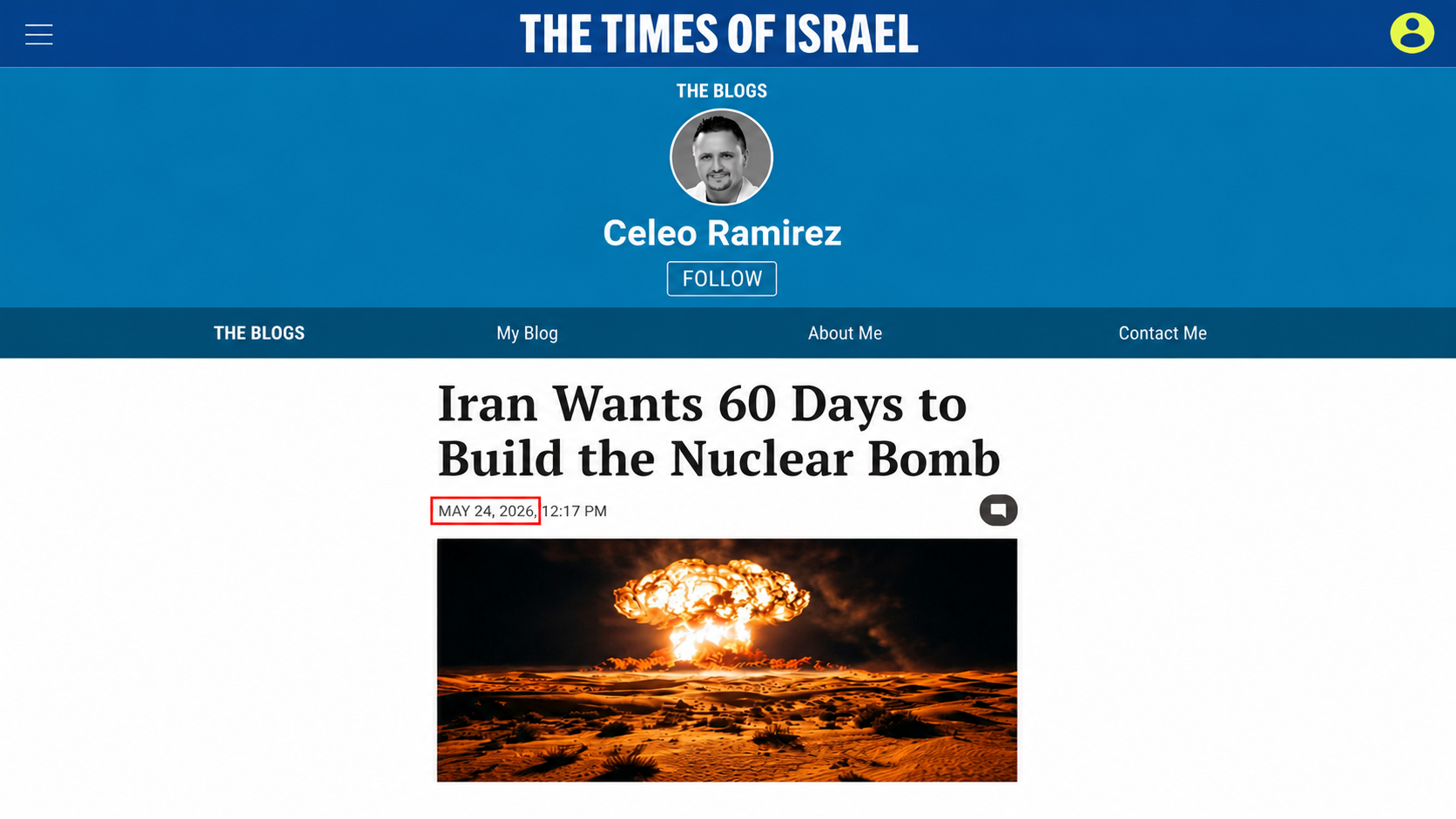
On May 24, in my article “Iran Wants 60 Days to Build the Nuclear Bomb,” I argued that Iran wanted the sixty days for a purpose, and that the purpose was time. The argument rested on the shape of the trade itself, on what Iran chose to keep when it could have given it away.
A state that truly wished to prove it had abandoned the bomb, and that wanted its sanctions lifted and its economy revived, would surrender its enriched uranium on the first morning, because that single concession would cost it the least and earn it the most. Iran has refused to do exactly that. Its preference is revealed in what it insists on guarding.
I reached that conclusion by deduction. Israel’s security establishment, looking at the same regime, now voices the same assessment. Two readings, the same door, three weeks apart.
I will not hide an honest uncertainty. No one can say for sure whether the stockpile lies buried under the rubble of the strikes, was moved beforehand, or sits intact. American intelligence has its theory, satellite analysts have theirs, and the IAEA lost its continuity of knowledge after the attacks. The uncertainty, though, changes nothing that counts. Buried or intact, those roughly four hundred and forty kilograms of highly enriched uranium never left Iranian soil.
Some will answer that the material is sealed for good, entombed under collapsed tunnels by the strikes or by Iran’s own hand, and therefore beyond reach. That comfort is thin. As I argued only days ago in my article “Persia Bred Top-Tier Diggers for Millennia: Why Leave Its Uranium Buried?” the civilization that built the qanat networks across the Iranian plateau over millennia does not treat buried material as a serious obstacle. Burial buys time at most. A nation of master excavators recovers what it chose to hide.
That material cost Tehran years of suffocating sanctions and billions of dollars to produce. A regime does not lightly surrender the very thing it bled for over two decades. The reversible cards prove their nature by the day.
Since the digital signing, by several reports, the Revolutionary Guard has launched drones at commercial ships in the strait night after night, intercepted by the American navy before they reach a hull. The waterway Iran agreed to reopen is being tested the same week the deal was signed. The card handed back can always be picked up again. The uranium is the card that, once kept, stays kept.
A record that speaks for itself
History is unkind to the notion that Iran’s word can serve as collateral. Natanz and Arak were never declared by Tehran; an opposition group exposed them in 2002. Fordow was carved in secret beneath a mountain and revealed only in 2009.
In 2018, Israeli agents carried an entire nuclear archive out of Tehran, documenting the Amad weapons program the regime had always denied. Time after time, international inspectors found undeclared material at undeclared sites. Every Iranian declaration, once it could finally be checked, proved incomplete.
So a signature promising no weapon carries little weight on its own. What would carry weight is conduct. Let Iran hand over the four hundred and forty kilograms, or dilute them to 3.6 percent in full view of the world.
With its enrichment halls knocked out of service, with renewed and intrusive IAEA monitoring, and with the material genuinely gone, Iran would stand a long way from any bomb. The deal now heading for Switzerland secures none of those three things for the uranium. It secures the ceasefire, it reopens the oil, it releases the money, and it files the material under later.
The question that remains
Strip away the ceremony in Switzerland and the arithmetic is plain. A regime that will not say in public that Israel has a right to exist has agreed to surrender every card it can later reclaim, while keeping the one card no one can force it to return. It asked for sixty days, with the blockade lifted, the Americans on their way out, and no inspector standing over the centrifuges. What it means to do with that time is the same thing I named on May 24, to carry its program toward the bomb, and nothing signed this week has moved it off that road.