Middle East Analyst
Iran’s Center of Gravity and the Limits of Decapitation Strategy
by author
Iran’s Assembly of Experts has named Mojtaba Khamenei to replace his father, Ayatollah Ali Khamenei, as the country’s new supreme leader, state media reports.
Mojtaba had been regarded as the frontrunner to succeed his father, who was killed on the first day of US-Israeli strikes on Iran, on February 28. But US President Donald Trump has called the younger Khamenei “unacceptable” and demanded to have input in choosing Iran’s next leader, a request Islamic Republic officials have rebuffed.
Earlier today, Trump said whoever was chosen to replace the late supreme leader would not “last long” without US approval.
What follows is an attempt to provide an analytic framework for one of the most consequential strategic questions now facing policymakers: where Iranian power actually resides after Ali Khamenei, and what that means for the conflict now unfolding.
At the center of that question lies a concept drawn from classical military theory. Carl von Clausewitz described the center of gravity as the source of power that holds an adversary’s system together — the hub upon which everything depends. In modern strategic analysis, a Center of Gravity (COG) refers to the critical node — political, military, economic, or psychological — whose disruption produces disproportionate effects across the system. Identify it correctly and pressure produces decisive effect. Misidentify it and you expend resources on targets that generate noise without structural consequence.
In hybrid ideological-security regimes, however, identifying the COG becomes considerably more difficult. The Islamic Republic of Iran presents precisely such a challenge.
What “Regime Change” Actually Means
Public discussion of Iran routinely invokes “regime change” as though it were a single clearly defined outcome. It is not. The phrase can describe at least four distinct scenarios, each implying a different center of gravity and a different strategic pathway:
Formal regime collapse — the clerical and constitutional apparatus of the Islamic Republic ceases to function. The most dramatic outcome, and historically the rarest following external military pressure alone.
Leadership decapitation — the Supreme Leader is removed while the broader institutional system survives. This is the scenario now unfolding in real time following the killing of Khamenei.
IRGC ascendancy — the Islamic Revolutionary Guard Corps becomes the effective governing authority while clerical institutions become ceremonial. A structural shift in who exercises power without formally toppling the system.
Regime 2.0 — a managed transition to a more pragmatic hybrid model, driven by IRGC-aligned pragmatists, that preserves the framework of the Islamic Republic while reducing clerical dominance. The post-Mao CCP consolidation and Iran’s own 1989 post-Khomeini succession offer partial historical analogues.
Conflating these scenarios — as much current commentary does — risks strategy directed at the wrong target at the wrong moment. Each requires a different analytical approach and implies different indicators of success or failure.
Hypothesis A: The Clerical-Constitutional Apparatus as Primary COG
The first analytical position holds that the Islamic Republic remains fundamentally a clerical-authoritarian system whose stability ultimately depends on the office of the Supreme Leader and the doctrine of velayat-e faqih — the guardianship of the Islamic jurist — that authorizes it.
Ali Khamenei sat at the apex of Iran’s constitutional structure. He commanded the armed forces, appointed key judicial and security officials, and arbitrated disputes among major political institutions. The IRGC, despite its enormous and growing influence, formally derived its authority from that structure. Its founding mandate was to protect the revolution and its clerical expression. Its oath of loyalty ran to the Supreme Leader, not to the Iranian nation-state in the conventional sense.
On this reading, the IRGC’s internal cohesion is not self-generating — it is authorized. When Ali Khamenei publicly endorsed the suppression of the 2009 Green Movement and framed it as defense of the revolution, he was not providing cosmetic cover for an operation the IRGC would have conducted regardless. He was providing the ideological authorization that maintained cohesion within an institution whose internal culture was built around revolutionary legitimacy. Remove that authorization and the IRGC does not automatically become a unified military government. It risks fragmenting into competing factions — regional commands, economic conglomerates, intelligence services — that share material interests but lack the ultimate arbiter that the Supreme Leader’s office has historically provided.
The succession mechanism reinforces this reading. Supreme Leadership does not pass through military command. It passes through the Assembly of Experts — a clerical body with constitutional authority to appoint and supervise the Supreme Leader. That the Assembly has managed to convene under wartime conditions — reportedly meeting virtually, with members reportedly describing the proceedings as “unnatural” and under explicit Israeli threats to target participants — and produce a selection within eight days of Khamenei’s death is itself a significant data point about clerical institutional resilience under maximum pressure.
If this hypothesis is correct, the removal of Khamenei represents a potentially decisive blow to the system’s central legitimizing node — but only if the succession process fails to produce a credible replacement capable of reconstituting IRGC loyalty around a new Supreme Leader.
Hypothesis B: The IRGC as Primary COG
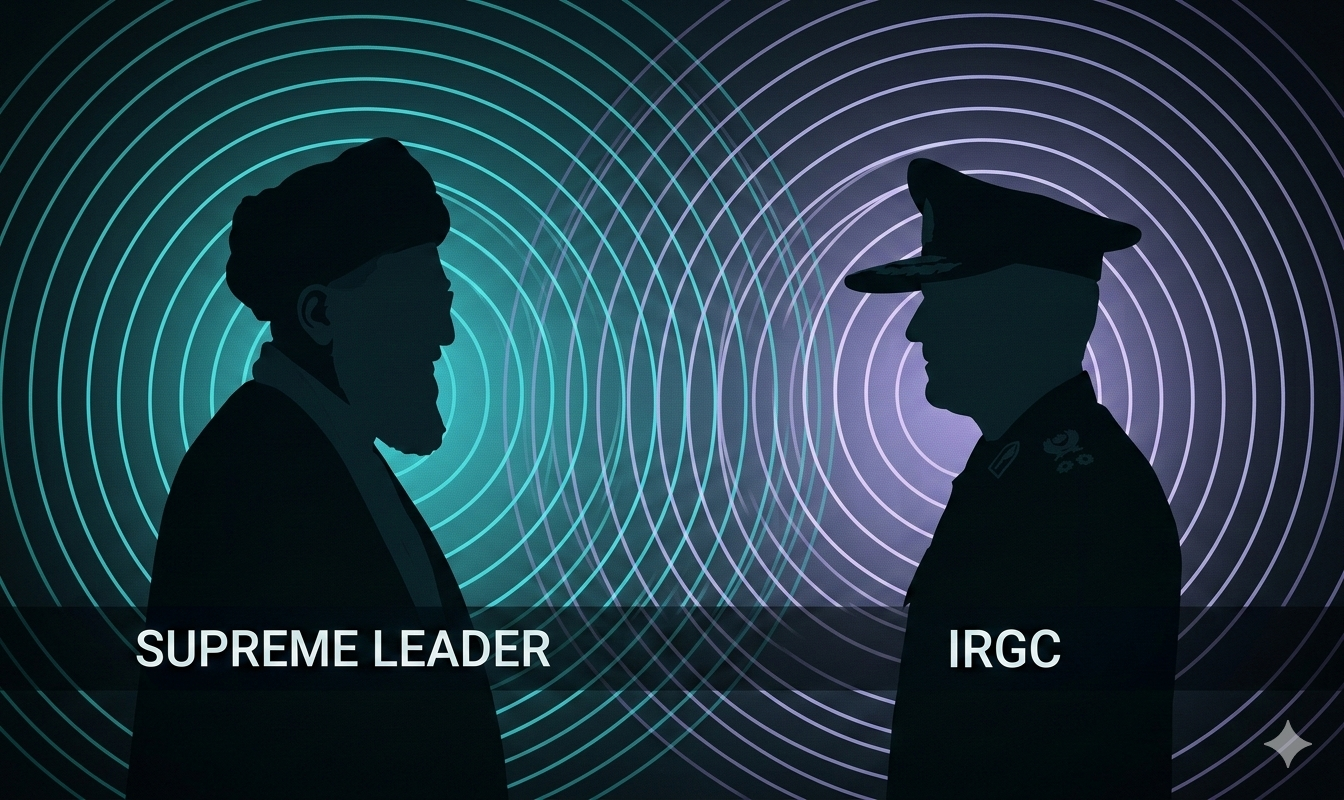
The competing position holds that the Islamic Republic has undergone a decisive institutional transformation over four decades, and that the IRGC has already become the regime’s operational center of gravity — the institution whose cohesion determines whether the state survives or collapses.
Over the past three decades, the IRGC has transformed from a revolutionary militia into a sprawling political-military-economic complex. Through three reinforcing developments — military and intelligence expansion encompassing ballistic missile forces, cyber capabilities, and the Quds Force’s external operations network; deep economic penetration via conglomerates like Khatam al-Anbiya controlling construction, energy, telecommunications, and sanctions-era smuggling networks; and systematic political integration through former officers occupying senior government positions — the Corps has become a parallel state apparatus rather than an instrument of the clerical state.
The functional test for COG identification is asymmetric and revealing. Consider two counterfactuals: if the clerical apparatus collapses but the IRGC command structure remains cohesive, the regime retains the capacity to maintain territorial control, suppress unrest, and eventually generate new legitimizing cover — destabilized, but survivable. If the IRGC fractures — regional commands operating independently, the Quds Force cut off from central direction, economic conglomerates competing rather than cooperating — no clerical institution possesses the organizational capacity to prevent state failure. That asymmetry is the operational definition of which institution is load-bearing.
The regional proxy network supports this reading. When IRGC Quds Force General Qasem Soleimani was killed in January 2020, many observers predicted a collapse in Iran’s proxy coordination across Hezbollah, the Popular Mobilization Forces in Iraq, and the Houthis. That collapse never materialized. The networks reorganized under new IRGC Quds Force leadership. That resilience is institutional rather than personal or theological — it reflects four decades of material support, operational integration, and financial dependency managed through the IRGC, not through any clerical institution.
If this hypothesis is correct, the removal of Ali Khamenei may prove far less structurally disruptive than outside observers expect. The security apparatus can maintain continuity while adjusting the political structure around it — producing Regime 2.0 as an adaptive response rather than a collapse.
The Core Disagreement — and Where It Leads
Both hypotheses acknowledge the importance of clerical legitimacy and IRGC coercive capacity. The disagreement lies in the direction of causality:
Does legitimacy enable coercion — does the Supreme Leader empower the IRGC?
Or does coercion enable legitimacy — does the IRGC ultimately sustain the authority of the Supreme Leader?
Answering that question determines where Iran’s true center of gravity lies. And the honest analytical answer, given current evidence, is that both causal pathways operate simultaneously — with the balance having shifted significantly toward the IRGC over the past two decades without completing the transition.
The most important observation of these competing hypotheses is that the COG in post-Khamenei Iran is not a static institution. It is a dynamic relationship — and the Beyt-e Rahbari, the Supreme Leader’s office as the physical and bureaucratic fusion point of clerical legitimacy and IRGC coercive capacity, may be more precisely the COG than either institution independently.
Strategic Implications of the Current Crisis
The confirmation of a successor — and the possibility that his location may need to remain concealed to protect him from targeting — introduces an analytically unprecedented dynamic.
The Supreme Leader’s authority depends not only on formal constitutional power but on visible leadership: public Friday prayer addresses, religious rulings, symbolic demonstrations of authority that bind the institutional apparatus and the population to a single recognized source of legitimacy. A Supreme Leader whose identity cannot be safely revealed faces severe constraints on performing those functions. He cannot publicly authorize military operations, cannot arbitrate among IRGC factions, cannot be seen to embody the revolution.
That constraint, if it persists, would accelerate the transition toward Regime 2.0 regardless of who was selected — because it would force the regime to govern through institutional intermediaries capable of operating without public visibility. The institution best positioned to do that is the IRGC.
There is also an economic variable worth monitoring. The IRGC has proven more resilient under sanctions than other Iranian state institutions, partly because it controls the informal networks sustaining economic activity under restriction. But prolonged economic contraction creates internal competition for resources among elite factions. If IRGC material interests diverge — particularly over any diplomatic process offering sanctions relief that would restructure the Corps’ economic dominance — that divergence is when the regime’s internal cohesion becomes most vulnerable to decisive pressure.
The Limits of Certainty
False certainty in strategic analysis is more dangerous than acknowledged uncertainty. Both hypotheses about Iran’s center of gravity remain analytically plausible. The coming weeks will provide critical indicators about which better reflects the current operational reality — particularly whether the new Supreme Leader can appear in public and whether the IRGC command structure maintains cohesion across its regional commands and economic networks under sustained external pressure.
History shows that revolutionary regimes often evolve from ideologically driven systems toward security-dominated governance structures. Whether Iran has already completed that transition or remains in a liminal phase between clerical state and security state is the central analytical question of this conflict.
What is clear is that a major shock has been delivered to the system. What emerges will depend not only on the force applied, but on the strategic clarity with which its consequences are understood and managed.
Related Topics