
The Geopolitics of the Zipper
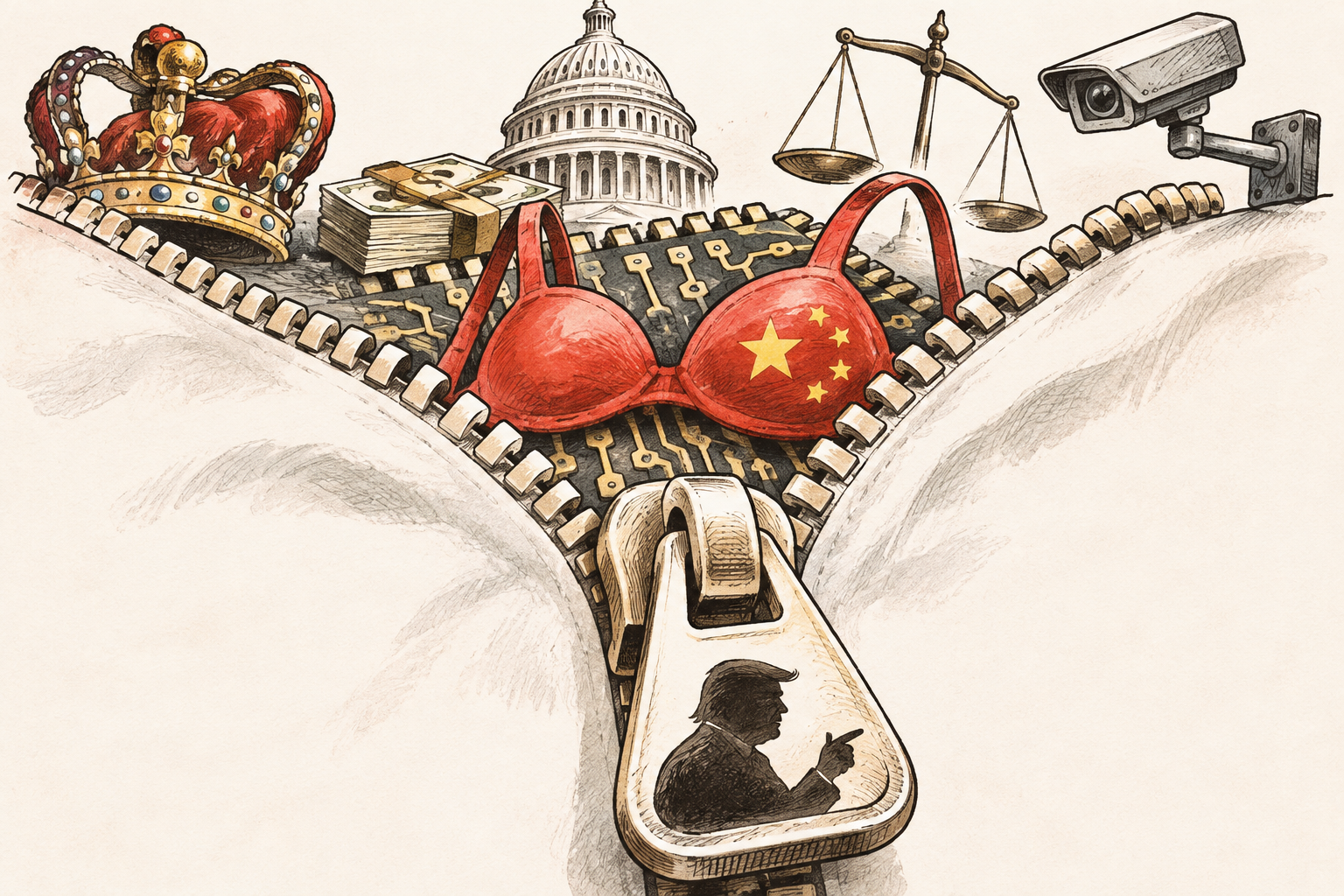
There is something almost comical about a civilization capable of splitting the atom, manipulating the human genome and constructing machines of extraordinary computational power, yet still unable to establish a politically satisfactory distance between the zipper and the affairs of state.
On November 23, Nvidia announced the reinstatement of Jensen Huang as its chief executive following an intervention by Donald Trump. Huang had resigned earlier that month after revelations of extramarital affairs, including one involving a woman suspected of connections to Chinese intelligence. The president’s response on CNBC was remarkably succinct: “Sex sells, fellas.” He subsequently circulated a doctored photograph of Huang holding a red bra.
One might have expected this sort of entertainment from a tabloid. It is rather less amusing coming from the president of a country that has spent years explaining to the rest of the world the strategic dangers associated with China’s access to advanced semiconductor technology.
I have no particular interest in the marital arrangements of billionaires. Adultery is neither a category of political philosophy nor, in itself, a threat to national security. What interests me is the peculiar elasticity of the concept of security when it encounters considerable wealth and proximity to political power.
Those of us who live in countries where security is a permanent subject of public discourse know the vocabulary rather well. We are asked to accept restrictions, financial burdens and decisions taken without our participation. Much of this is presented as being for our own good. The legitimacy of such demands depends, among other things, upon the willingness of public institutions to apply the same standards to those who govern and those who are governed.
Trump and Nvidia’s board maintain that Huang’s return poses no threat to national security. The espionage allegations remain unproven. Nevertheless, I would be interested to know how an ordinary employee of an American defense contractor would be treated under comparable circumstances. Would his professional importance diminish the need for scrutiny?
There is something disturbing about the argument that a corporate executive has become indispensable to the strategic interests of a major power. How did a country with such extensive technological and institutional resources allow itself to become so dependent upon one individual? There is also the inconvenient matter of Trump’s own financial interests in Nvidia, documented by Reuters. His substantial shareholdings warrant independent examination of any potential conflict of interest.
Reading the news from Washington, I found myself returning to the Second Book of Samuel. The story of David, Bathsheba and Uriah is usually presented as a narrative about sin and repentance. I have always found its political dimension more interesting.
David possesses something that other men do not: the machinery of sovereignty. His desire for Bathsheba becomes a matter of military administration. Orders are issued, messengers dispatched, and a soldier is placed in circumstances intended to ensure his death. The king’s private affairs acquire the organizational capacities of a state.
Nathan’s intervention is contained in two Hebrew words: אַתָּה הָאִישׁ — you are the man. David is confronted with a judgment that he himself has pronounced without recognizing its application to his own conduct. Nathan challenges the sovereign’s presumed entitlement to an ethical exception.
Michel Foucault understood that sexuality was hardly an external disturbance of an otherwise rational political order. Secrecy, privileged access and personal dependency belong to the everyday organization of power. Intelligence services have long understood their practical significance.
Political corruption can begin well before criminal law is able to identify an offense. It does not necessarily involve an envelope containing money or a secret bank account. The functioning of public institutions becomes compromised when it is subordinated to the personal interests of those exercising authority. Particularly troubling is the possibility that the preservation of a political career, the avoidance of legal responsibility or the survival of a particular government might be presented as a condition of national security.
Israelis have good reason to examine this possibility. In a country exposed to genuine threats, the invocation of security carries considerable persuasive force. Even legitimate questions about the personal interests of political leaders can be recast as questions about the loyalty of those asking them.
Israel, however, has its own precedent for institutional accountability. In 2011, former president Moshe Katsav was sentenced to seven years in prison for rape and other sexual offenses. The Supreme Court upheld his conviction. The prime minister publicly reaffirmed the principle of equality before the law.
The dignity of the Israeli state did not require the protection of the man who had once represented it. The women who had suffered through his conduct were entitled to justice. It is worth revisiting those public declarations of 2011. Their validity cannot reasonably depend upon the identity of the person appearing before a court.
Unresolved accusations and criminal convictions belong to different legal categories. The presumption of innocence is indispensable, as is the independence of the institutions entrusted with determining whether an accusation is justified.
The Nvidia controversy calls for precisely this kind of institutional scrutiny. Congress should examine the relevant intelligence assessments, compliance with semiconductor export restrictions, the circumstances of presidential intervention and potential financial conflicts of interest. Where information cannot legitimately be disclosed to the public, independent oversight becomes all the more important.
Washington’s allies have been asked to bear considerable economic and political costs in the name of American strategic security. They are entitled to expect something more substantial than a presidential joke when questions arise about the security of the very technologies they have been asked to protect.
We should abandon the paternalistic habit of telling citizens that political authority knows what is good for them. Adults are entitled to ask who decided to expose them to a particular risk, whose interests were taken into consideration and who will bear the consequences. These questions become especially urgent when those making the decisions possess sufficient wealth and influence to insulate themselves from much of the damage.
I am perfectly willing to leave the bedrooms of presidents, billionaires and corporate executives to their occupants. I certainly do not wish to be told that paying for someone else’s zipper is for my own good.
Yochanan Schimmelpfennig