The views expressed herein are solely mine.
Iran’s Endgame Has Begun. Period.
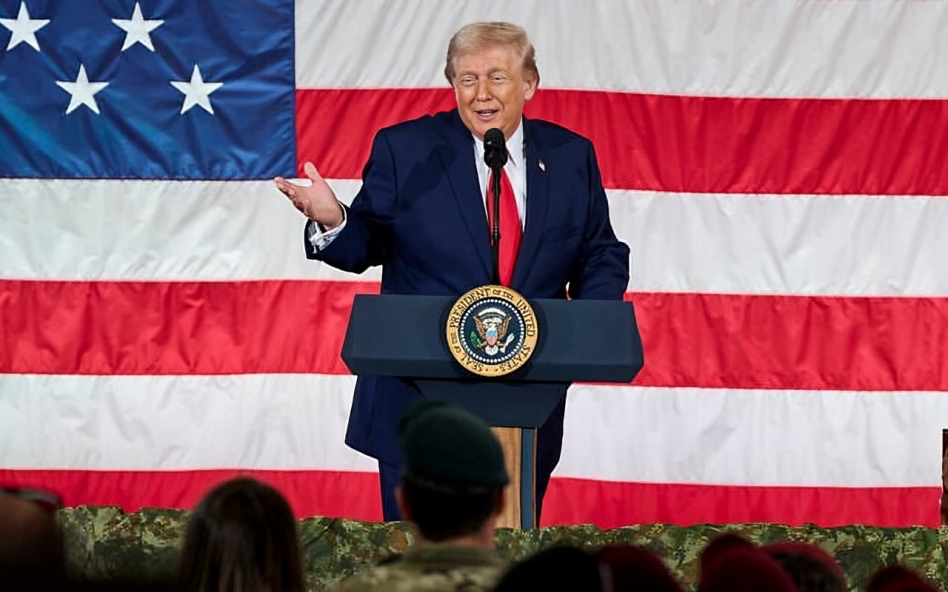
US President Donald Trump delivers remarks to troops at Fort Bragg, North Carolina, February 13, 2026. (AP Photo/Matt Ramey)
When a sitting U.S. president says regime change in Iran “would be the best thing that could happen,” and reports indicate Washington is preparing for a potentially weeks-long military campaign, the era of polite containment talk is over. This is no longer a think-tank parlor exercise. This is live strategic signaling from the White House—backed by force posture.
And yet, European capitals still behave as if Iran is a chronic condition that needs to be “diplomatically treated”: calibrate a response here, resurrect a negotiation there, repeat the ritual and call it stability. The underlying assumption remains untouched—the regime is a rational, cohesive state actor that can be deterred like any other.
However, Israel does not buy that fiction.
In fact, Jerusalem operates from a harder premise: the Islamic Republic is a stressed system. Stressed systems do not bend indefinitely—they fracture. Sometimes gradually. Sometimes all at once. Especially when minorities comprise roughly half the population and more than 90% of them reject the regime outright.
Certainly, deterrence works cleanly only when the adversary is cohesive. But what happens when cohesion becomes the variable? What happens when Iran’s internal structure is strained by elite rivalry, succession uncertainty, competing security barons, and a legitimacy deficit that thins by the year?
In that environment, the danger is not merely what the Ayatollahs decide. The danger is whether anyone decisively controls what they are sitting on.
This is where Israel’s posture diverges sharply from much of the West’s. Israel is not just fortifying against attack; it is preparing for systemic rupture. It is not building a wall—it is bracing for an earthquake.
That is why the Abraham Accords were never about “peace vibes.” They are strategic scaffolding: intelligence fusion, maritime coordination, integrated air defense conversations, and the normalization of a regional security architecture designed for the ugly scenario—an Iran that destabilizes, lashes out, or loses internal command discipline.
Unmistakably, Trump’s rhetoric and reported U.S. military planning simply strip away the diplomatic euphemism. The region is no longer whispering about regime disruption as a theoretical possibility; it is pricing it in as a contingency.
Look at the pattern. Israel continues methodically degrading Iranian entrenchment in the region and tightening pressure on Tehran’s proxy architecture—not out of impatience, but out of foresight. That is why a fractured Iran does not mean its proxies quietly disarm. It means they can become freer agents. If Tehran’s grip weakens, the forward network does not politely dissolve; it metastasizes. Which is precisely why Israel moves now—before command and control fractures into ambiguity.
More importantly, here is the geopolitical truth Washington – unlike Jerusalem – often underestimates: regime instability does not automatically produce a safer Middle East. A weakened Iran can prove more dangerous than a strong one. Ambiguity invites miscalculation, and miscalculation invites war.
Why? Because a centralized regime can be deterred. A fragmented power structure can stumble into escalation.
Yes—Trump is openly floating regime change. Yes—the United States appears to be assembling the machinery for sustained operations. And yes—Israel, alongside Saudi Arabia and the UAE, has been preparing for the moment Iran’s internal contradictions stop playing out as domestic theater and begin transforming the regional order.
Undoubtedly, containment was yesterday’s doctrine. Fracture is tomorrow’s battlefield. Iran’s endgame is no longer theoretical—it is already in motion. The State of Israel is not bracing for impact. It is preparing to win the aftermath.
Related Topics
Related Posts