Iran’s Invisible Supreme Leader
Since an airstrike killed his father in March, Mojtaba Khamenei has led Iran without once appearing in public. Reading the regime’s own channels, what emerges is a leader who exists almost entirely as text.
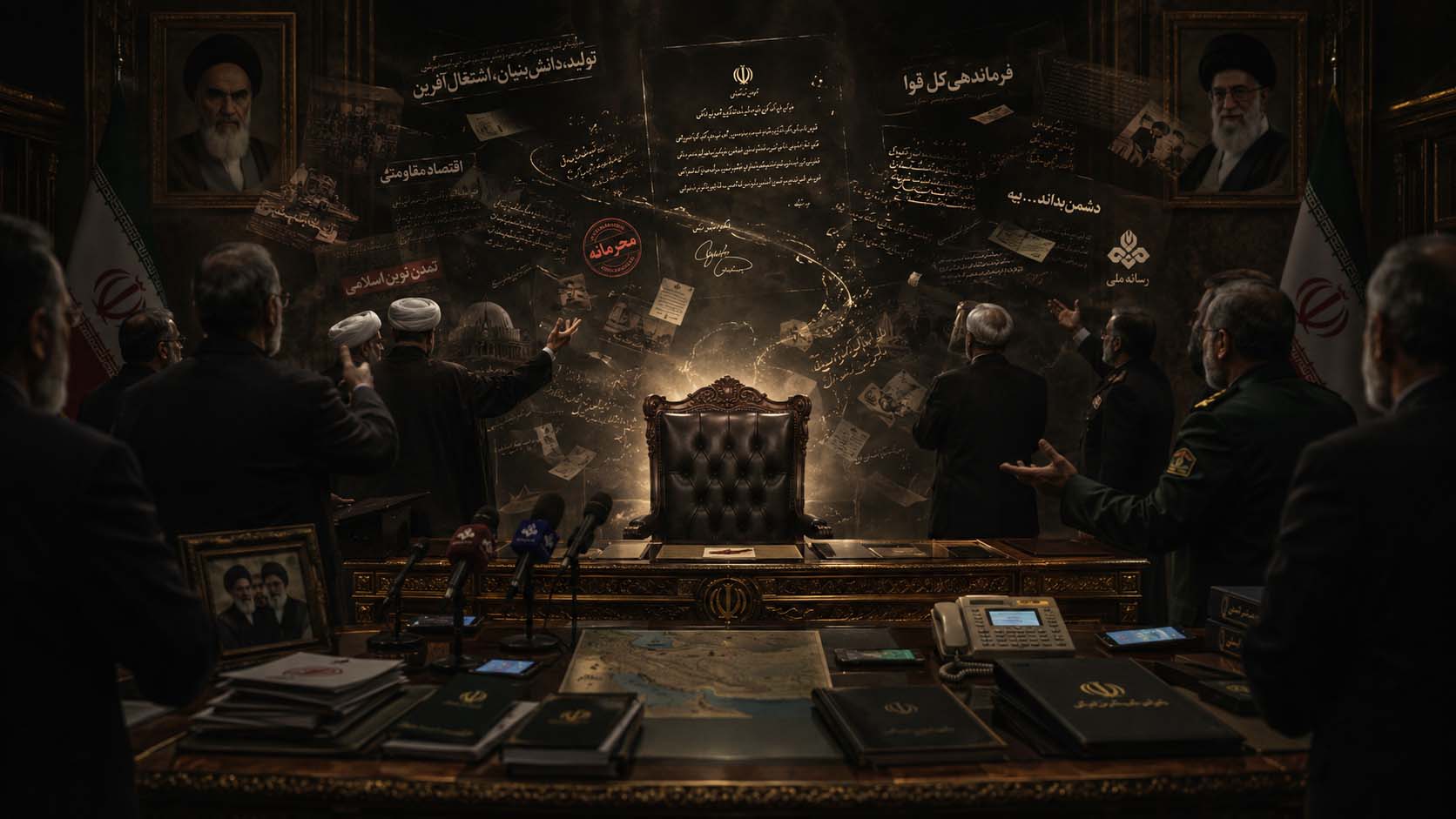
In nearly three months not a single photograph, video, audio clip, or sample of his handwriting has been released to prove he is alive and governing. I have spent that time watching the Persian-language channels of Iran’s own state media, and what they have built in the absence of the man himself is the strangest thing I have followed: a leader who exists almost entirely as text.
The output is relentless. Messages “attributed to” Mojtaba Khamenei arrive for every occasion: Labor Day, Persian Language Day, the Hajj. Officials line up to swear fealty to a name. Teachers “pledged allegiance” to him; crowds in Tehran and Karaj chant “Labbaik Seyyed Mojtaba,” here I am at your service. A pro-regime cleric issued a fatwa redirecting the religious dues of his father’s followers to him. A poem published by Fars casts him as the seamless heir. Commanders report meeting him, while no photograph of any such meeting is ever released. The name does enormous work. The man does not appear.
Two stories, told in parallel
Read the state channels alone and you would think nothing had changed. The deputy for international affairs at the leader’s office declared him in “full health” and “actively managing affairs.” A figure from his father’s office insisted he is so busy that aides “cannot keep up with him.” The official line treats his invisibility as a security precaution, a refusal to give the enemy a target.
Read the opposition and Western reporting alongside it, and a different picture emerges. The Wall Street Journal, citing American and Iranian officials, reported that he has not appeared in public for more than two months after a severe airstrike injury, that the images circulating of him appear to be generated or altered by artificial intelligence, and that his prolonged absence has become a serious problem for a regime divided over the U.S. talks. CNN, citing intelligence assessments, reported he is being treated in isolation for severe burns to his face, arm, torso, and leg, uses no electronic devices, and communicates only in person or by courier, while senior IRGC commanders and parliament speaker Mohammad Bagher Qalibaf effectively run the country day to day.
Both of these are claims, not confirmed facts, and they pull in opposite directions. The regime’s “full health” and the opposition’s “deathbed” cannot both be precisely true, and I cannot independently verify either. But that is the point. The gap between the two is itself the story.
The meeting that may not have happened
No episode captures it better than a reported meeting in early May. President Masoud Pezeshkian announced he had sat with the new leader for nearly two and a half hours in a warm, intimate atmosphere, and described him as humble and a model for the country’s managers. He offered no detail about what was actually discussed. Within hours, Iran International, citing senior IRGC sources, reported that no such meeting took place, and that Pezeshkian’s request to meet had been raised five times and rejected each time. Days later, state media announced that a top military commander had also met the leader and received “new directives” from him. Again, no image was released.
Whether or not those meetings happened, the function is the same. The system needs its leader to be present, so it narrates his presence into being. When it cannot show him, it tells you about him.
A name in whose place decisions are made
This would be a curiosity if the stakes were low. They are not. This past weekend, after Israeli strikes on Hezbollah’s headquarters in Beirut’s Dahieh, two sources told Iran International that IRGC missile units went to full alert and sent a formal request to Mojtaba Khamenei’s office for authorization to strike Israel. By their account, no answer came. The following morning, Iran International reported that his communications had been “disrupted” since the previous night, and that Monday’s strikes on Israel were likely carried out on pre-arranged military protocols, without him, because his response would simply have taken too long.
Set that against the messaging on the state channels, where his authority is total: officials insist the negotiating framework moves only with his permission, that “the only order is Seyyed Mojtaba’s order.” On June 7, in an NBC interview, Donald Trump said of him only that he had been “severely injured,” and that there was “a strong possibility” the United States knew his location.
What the text is for
Strip it all back and a pattern shows through. A regime that has lost the visible center of its own authority is working extraordinarily hard to convince Iranians, and perhaps itself, that the center still holds. The messages, the loyalty oaths, the fatwa, the unphotographed meetings: these are not evidence of a functioning leader so much as substitutes for one. The more text the system produces in his name, the more it underlines what it cannot produce, which is the man.
None of this tells us where Mojtaba Khamenei is, or how much he truly decides. It tells us that Iran’s rulers have built an entire apparatus of presence around an absence, and that when a real decision came due this week, the apparatus may have moved without him. In a system that has always run on the visible authority of a single figure, a Supreme Leader who exists only on the page is not a show of strength. It is a question the regime cannot yet answer.