The views expressed herein are solely mine.
Iran’s Low-Cost Espionage Inside Israel
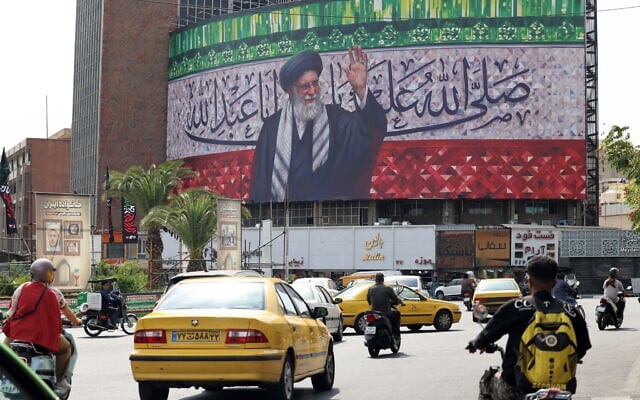
Illustrative: Motorists drive their vehicles past a billboard depicting Iran's Supreme Leader Ayatollah Ali Khamenei, in the center of Tehran's Valiasr Square, on July 13, 2025. (ATTA KENARE / AFP)
Israel keeps misdiagnosing its “fifth-column” problem by simply calling it a crime wave; but it is not. Indisputably, it is a strategic campaign—an Iranian effort to convert Israel’s home front into an intelligence marketplace where loyalty is priced in shekels, not ideology.
The public numbers are damning without exaggeration. In 2024, the Shin Bet -Israel’s internal security and counterintelligence service- reported roughly a 400% increase in Iranian-linked espionage detainees compared to 2023, exposing 13 serious cases and indicting 27 Israelis.
By December that year, Jerusalem had dismantled nine covert cells involving nearly 30 Jewish citizens, the largest Iranian infiltration effort in decades.
In mid-2025, Israel launched the national deterrence campaign “Easy Money, Heavy Cost” after more than 25 espionage incidents and 35 indictments in a single year.
The price tag tells the real story. Recruitment offers reportedly began as low as 5,000 shekels (roughly 1,570 dollars)—money that should not buy a used scooter, let alone access to a country at war.
That is not a bug; it is the model. The Islamic Republic of Iran is not hunting a perfect mole—it is running a volume business.
Hence, recruitment starts online and escalates incrementally: photograph this, map that route, confirm a routine, flag a site. This is “good-enough” espionage—cheap, scalable, deniable—designed for a world where fragmented data, fused over time, enables real-world targeting; inelegant but effective.
Patently, October 7 did not create this vulnerability but it widened it. In parallel, war strain, polarization, and financial pressure dramatically expanded the recruitable pool.
With this in mind, Iran does not need Israelis to love them. It only needs some to feel detached—broke, resentful, bored, reckless, or convinced they won’t be caught. When recruitment happens on the same apps people use to shop or flirt, espionage starts to feel like a side hustle instead of treason.
Within this framework, the geopolitical pattern is clear. Iran is targeting ordinary Israelis, not just extremists—something that surprised Israeli security officials themselves.
Currently, the ecosystem is multinational by design: foreign nationals have been charged, underscoring that this is about access, not identity. Targets cluster around ports, infrastructure, bases, and routines—nodes where marginal intelligence converts directly into operational leverage.
This is why the “it was just photos” defense is strategic illiteracy. Israel is small, dense, and networked. One recruit is noise. Dozens, accumulated patiently, form a mosaic.
Thereby, Iran is assembling that mosaic cheaply and arrests alone are insufficient.
Thus, counterintelligence must be treated as national defense, not public messaging. “Easy Money, Heavy Cost” is necessary—but it must mature into doctrine: early reporting without automatic ruin, faster financial tracing, and targeted counter-recruitment education for reservists, contractors, and access populations near sensitive sites—where “minor” tasks cause disproportionate damage.
The Ayatollahs cannot defeat Israel symmetrically. Therefore, it attacks asymmetrically—by eroding the social contract behind the battlefield. Not through invasion, but by commodifying trust until betrayal becomes routine.
When loyalty becomes cheap, the real battlefield shifts from Israel’s borders to the price at which it allows its cohesion to be sold.
Related Topics
Related Posts