
Iran’s Samson Option: Collapsing the Global Economy Before Its Own Collapses
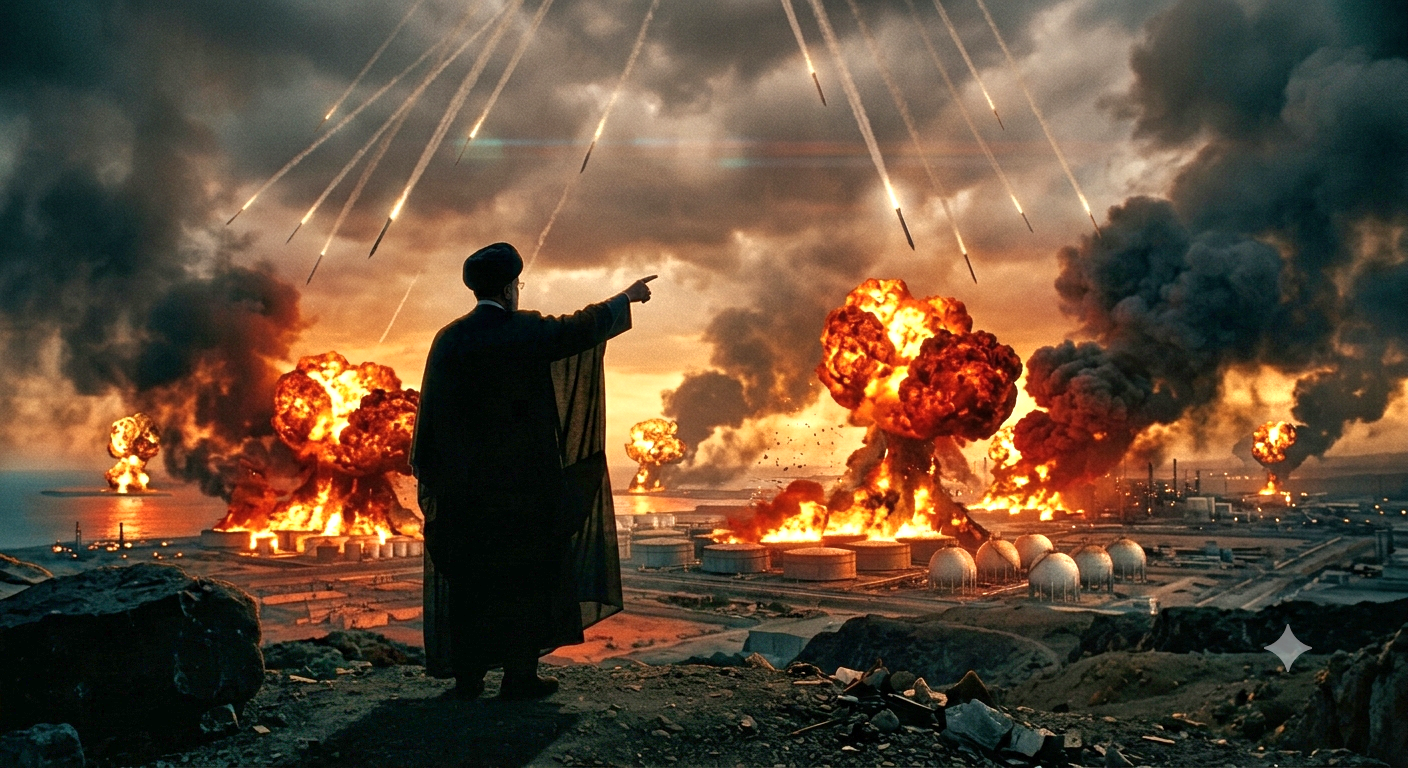
On August 24, Seyed Mohammad Marandi, the University of Tehran professor who has served for years as the Islamic Republic’s English-language voice toward Western media, wrote that the military conflict would quite possibly reignite in the days ahead. He added that any regime cooperating with Trump and Bessent to starve Iranian civilians would be dealt with brutally, warning that the global economy stood on the brink. Hours later he added five words that Washington and Jerusalem had aimed at Tehran for twenty years: all options are on the table.
One word in that first message does the most work. Global.
Trump’s blockade cut Iran’s crude exports first. Closing the Strait of Hormuz afterward cost Tehran nothing it had not already lost, and that pressure has now been applied for weeks without moving Washington.
Its crude exports have been throttled to a fraction of prewar volumes, the rial passed 2.03 million to the dollar on August 24 after trading near 1.53 million in early March, annual inflation runs near seventy percent, and the International Monetary Fund projects the economy shrinking by more than five percent this year. Fewer than twenty vessels crossed the Strait of Hormuz last weekend. The strait is effectively shut, and Tehran has already absorbed the cost of that closure.
The Persian Gulf coastline holds the rest: the refineries, stabilization towers, liquefaction trains and export terminals that supply a fifth of the world’s crude and roughly a fifth of its liquefied natural gas. The desalination plants producing drinking water for several Gulf states sit along the same shore.
Tehran has described this card openly. On March 11, Ebrahim Zolfaqari, spokesman for the Khatam al-Anbiya central military headquarters, told the world to prepare for oil at two hundred dollars a barrel. Later that month, as Trump threatened to strike Iranian power plants, Iranian officials specified that they would target energy, information technology, and desalination infrastructure across the region if their own facilities were struck.
Brent crude had already climbed above 113 dollars by late March. Nobody has published an estimate for what happens if the Gulf’s production capacity itself ceases to exist, simply because no modern market has ever had to price such a scenario.
The instrument relies on ballistic missiles and one-way drones, an inventory Iran spent thirty years building and burying underground on the assumption that its air force and navy could not survive the opening days. Interceptors are the constraint on the other side. A senior American commander has warned that naval resources are stretched thin defending Israel from ballistic missiles, which leaves the Gulf states drawing on the same finite inventory for their own protection. Every interceptor fired at a drone is one less available for the missile behind it. Saturation comes down to pure arithmetic.
What separates August from March is the trigger.
Every previous Iranian statement attached a condition: strike our energy infrastructure and we will strike the region’s. The threat was retaliatory, calibrated, and reasonably credible on those terms, and Washington treated it as such. Marandi’s version carries a different disposition. Nothing in his August 24 message requires a prior attack on Iranian soil. The economic war alone is presented as sufficient cause.
Mohsen Rezaee, secretary of Iran’s Supreme National Security Council and former commander of the Revolutionary Guard, made that logic explicit when he stated that Iran “will regard any country’s participation in or support for America’s economic war against the Iranian people as an act of war”.
Sanctions have become a casus belli. Bessent crosses that threshold every time he adds another government to Operation Economic Outcast.
The clearest confirmation that this threat is real comes from Jerusalem. On July 28, Defense Minister Israel Katz told Channel 14 that Israel wants to strike Iran’s energy targets, but the United States has withheld approval out of concern that Iran would attack neighboring countries and trigger a global oil crisis. Katz added that Israel stands prepared to set Iran back forty years.
Viewed in the context of August, that restraint is revealing. Washington is holding Israel back to protect the global price of oil, which means Trump has conceded that Iran can execute its threat. The blockade exists as the cheaper option.
Iran would go down with the Gulf. Katz has been explicit about what Israel intends once that restraint ends, promising to set Iran back forty years and return the country to darkness and stone by destroying its central energy and electricity facilities. Tehran has understood this through six months of war, which is why the card has remained unplayed.
The scenario changes when the alternative stops looking survivable. Surrender is not in Tehran’s equation. The Islamic Republic treats it as the ultimate humiliation, and the Revolutionary Guard would rather die fighting than sign it. The blockade leaves Tehran no way out except to fire its ballistic missiles at the Gulf’s oil and gas installations.
Marandi may be bluffing. Threats cost him nothing while buying Tehran a risk premium on every barrel and insurance contract, and the brink can stay a brink indefinitely without anyone having to jump. Yet a bluff about timing differs from a bluff about capability, and that capability was confirmed by Israel’s defense minister rather than anyone in Tehran. Katz wants the strike order and cannot get it, for the explicit reason that Iran would hit its neighbors and shatter the oil market.
The weight of the threat lies in that single word. Destroying the energy infrastructure of the Middle East would drag in every country on the planet through one channel or another: fuel, food, freight, electricity, or the cost of anything that moves. Tehran’s own allies would be dragged in alongside the rest. China buys the discounted crude keeping the Iranian economy breathing. Turkey serves as the primary smuggling corridor. Pakistan functions as the land border and pressure valve. India, Iraq, and every government Iran spent two decades cultivating as insurance against this exact moment would pay for the decision without having made it.
Which is why Beijing has to calculate what this threat is worth. China buys the crude that keeps Iran’s remaining income alive, and it has pressed Tehran before against closing Hormuz, with results. Iran is now promising to take the global economy down alongside itself, turning it from a strategic asset into a liability. Beijing and Moscow are playing a longer game against Washington, and Iran remains a regional piece on that board. No regional piece is worth the game itself. Restraining Tehran, or withdrawing enough support to force it toward terms, may serve their interests better than standing behind it.
Five days ago I raised my assessment of this blockade, which is damaging Iran faster than I believed four months ago. I also wrote that the same pressure leaves the regime weaker than it has ever been and, for that reason, more dangerous than it has ever been. This is what that danger looks like when Tehran describes it in its own words.
On the other hand, Iran’s own refineries, power stations, and export terminals would be reduced to ash within days of playing this card, an outcome Katz has already detailed in plain terms. What Tehran would purchase with that ruin is a global economic catastrophe reaching nearly every capital that ever provided it a lifeline.
Yet the arithmetic of that trade contains a fatal flaw. While the global economy would face an unprecedented shock with an unpredictable recovery, Iran would be left without a grid, without energy infrastructure, and without a functional state.
In an exchange of such magnitude, Iran has far lower odds of ever recovering than the rest of the world. When every variable in the equation is added up, Tehran is the player that ends up deepest in the red.
Samson brought down the temple on the Philistines and died beneath the rubble with them. In this version, the Philistines might walk out: wounded, poorer, and set back by decades, but with a chance at survival. Only the state between the pillars guarantees its own absolute ruin.
Whether the Iranian regime has genuinely reached the point of accepting an equation where its own numbers end in permanent extinction is something no one outside Tehran can say, and the answer will arrive only if the pillars ever come down.