Consultant and writer exploring policy, society, and identity
When Settler Violence Tests Bartov’s Argument
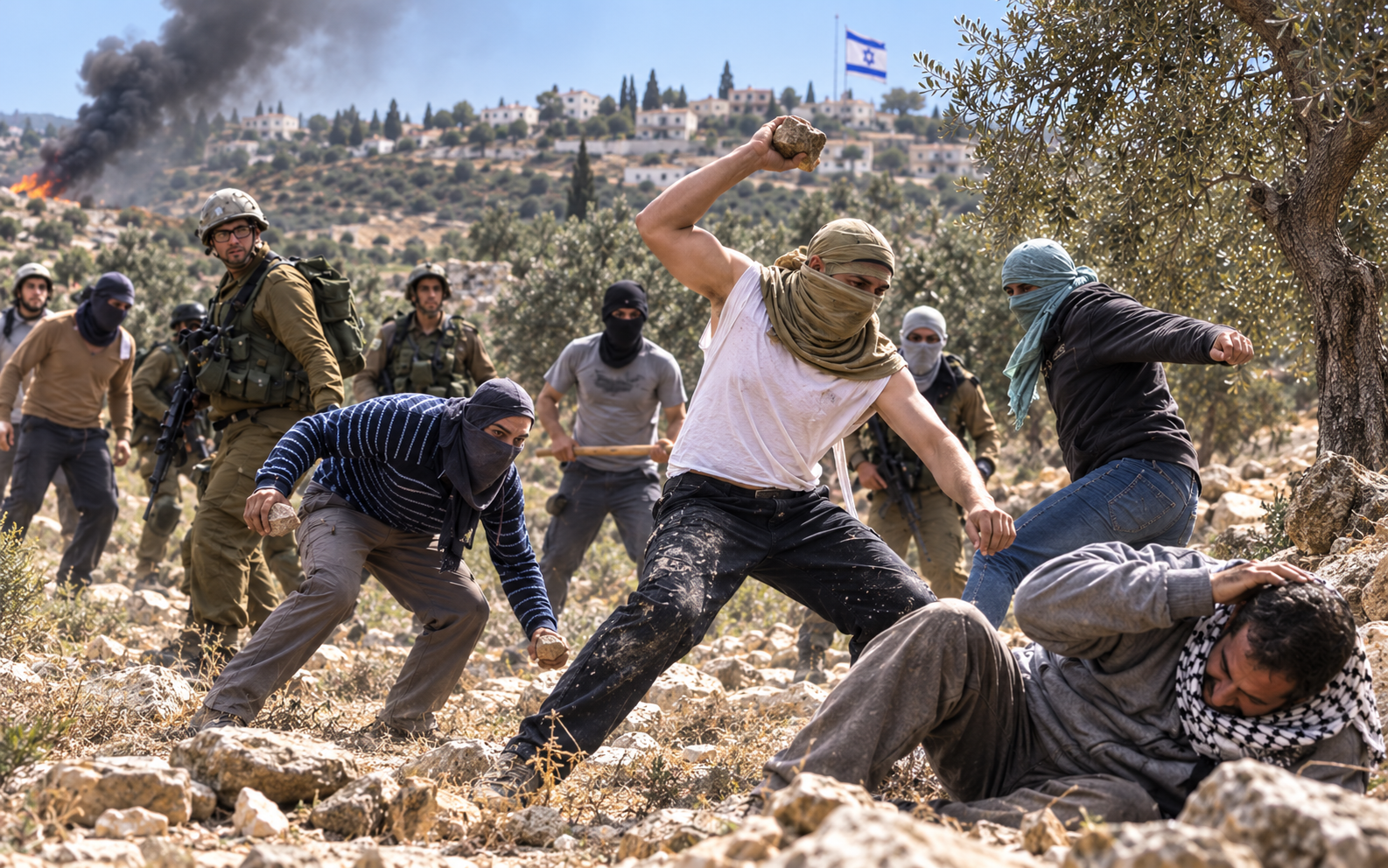
AI Composite Illustration (Bernard Markowicz)
Mike Huckabee’s intervention provides a concrete test of Omer Bartov’s argument about occupation, unequal protection and Israeli institutions. This is the first of three posts. It tests Omer Bartov’s diagnosis against settler violence in the West Bank; the second asks whether Jews could remain under Palestinian sovereignty; the third examines why American politics may now be placing limits on Israeli conduct.
U.S. Ambassador Mike Huckabee was an unlikely person to use the word “terrorists” for violent Israeli settlers. A Baptist minister and committed supporter of Jewish claims to Judea and Samaria, he has long stood on the side of the settlement movement. Yet after attacks on Palestinian American families in Qusra and Turmus Ayya, he publicly crossed a line that many Israeli and American officials had avoided. “If they burn a car, if they torch a mosque, if they go into someone’s home and vandalize it,” Huckabee said during his September visit to Turmus Ayya, the conduct goes beyond ordinary crime. “It’s an act of terror.” His intervention does not settle the argument over Omer Bartov’s new book, Israel: What Went Wrong? It does, however, give us a specific case through which to test it.
What Bartov argues
Bartov’s book asks how Zionism changed from a movement seeking Jewish emancipation into what he describes as an increasingly militarized, expansionist and exclusionary state ideology. His argument is much broader than the West Bank, and his conclusion that Israel committed genocide in Gaza remains the most disputed part of his work. But one part of his analysis can be considered independently of that conclusion: Bartov argues that a prolonged occupation changes not only the people living under it but also the state and society exercising power. When two populations live in the same territory under different political and legal arrangements, unequal treatment gradually becomes routine.
That claim is visible in the West Bank. Israeli settlers are citizens of the state exercising ultimate military power. Palestinians living nearby cannot vote for that government. The two populations encounter different legal processes, different freedom of movement and, often, different levels of protection. This does not prove Bartov’s entire history of Zionism. It poses a narrower question: has long-term control made violence against Palestinians easier to tolerate and less likely to be punished?
A small minority can have a large effect
The strongest answer is that violent settlers represent only a small minority. That distinction matters. The settler population is not a single ideological bloc. It includes religious nationalists, Haredi families, suburban commuters, people attracted by less expensive housing and a smaller group of radical hilltop activists. Most settlers do not attack Palestinians. Israelis in the West Bank are themselves exposed to shootings and other attacks, and the state has an obligation to protect them. Collective accusation would therefore be both inaccurate and unjust.
But numerical size is not the only measure of political importance. A small group can have a larger territorial effect if its violence drives Palestinian farmers from their land, forces families from their homes or establishes outposts that later receive protection and infrastructure. The test is not whether every settler is violent, it is whether violent settlers accomplish objectives that the political system subsequently accepts.
Four tests of the Israeli state
The question can be examined through four observable tests.
- The first is prevention. Do the army and police protect Palestinian communities when attacks are threatened or underway?
- The second is accountability. Are suspects investigated, prosecuted and punished under standards comparable to those applied to Palestinian attackers?
- The third is restoration. When intimidation removes Palestinian families from homes or farmland, are they able to return safely?
- The fourth is political consequence. Are unauthorized outposts dismantled, or are some later connected to roads, electricity and state protection?
Following American pressure, Prime Minister Benjamin Netanyahu reportedly ordered the removal of roughly 100 unauthorized outposts. Israel’s Supreme Court also ordered the safe return of Palestinian families driven from Jalud. Those are potentially meaningful actions. But an order without a timetable is not implementation, and removing an unauthorized structure is not the same as prosecuting violence. The government’s response should be evaluated by what changes on the ground.
Why Huckabee matters
Huckabee’s position cannot be dismissed as a private religious reaction. He spoke as the American ambassador. The State Department confirmed that the United States condemns criminal violence by any party and considers a stable West Bank important to Israeli security and regional peace. The immediate cases also involved Palestinian Americans. Protecting citizens abroad is a normal governmental responsibility. That fact explains part of Washington’s attention, although it raises another uncomfortable question: would Palestinians without American citizenship have received the same response?
Huckabee’s religious position contains less contradiction than it first appears: he can believe that Jews possess a biblical connection to the land while also insisting that this connection does not authorize theft. In Qusra, he invoked the commandment “Thou shalt not steal.” His distinction is between living in the land and taking another person’s property through force. That distinction will matter beyond these particular attacks.
Where Bartov persuades—and where he reaches too far
Bartov is persuasive when he asks what unequal political status does to enforcement and moral judgment. If violence is repeatedly described as the conduct of “a few youths” while its territorial effects remain in place, the language of marginality can conceal an institutional problem. He is less persuasive when he speaks too generally about “Israeli society.” Israelis disagree sharply over the occupation, settlement, the government, military strategy and Palestinian rights. Their security fears are not simply inventions produced by Holocaust memory. Palestinian attacks, October 7, rockets and explicit rejectionist ideologies are part of the reality.
Nor does condemnation of settler violence require rejecting Zionism or Jewish self-determination. Huckabee himself demonstrates that point. But his intervention also makes Bartov’s underlying question harder to avoid. If Israel can act when pressure comes from Washington, why was comparable action not taken before? If violent settlers are truly an isolated fringe, why has the state found it so difficult to prevent their actions and reverse their consequences?
Settler violence does not by itself validate Bartov’s complete argument, but it does create a practical test of it. The answer will not be found in another declaration. It will be found in whether attacks stop, offenders are prosecuted, displaced Palestinians return and unauthorized territorial gains are reversed. Huckabee has drawn a boundary around how a religious claim may be pursued. The next question is harder: could Jews preserve their connection to this land while living under Palestinian sovereignty?
Sources
***
Related Topics