The views expressed herein are solely mine.
Iraqi Kurds Quiet Hand in Israel’s Nuclear Strikes
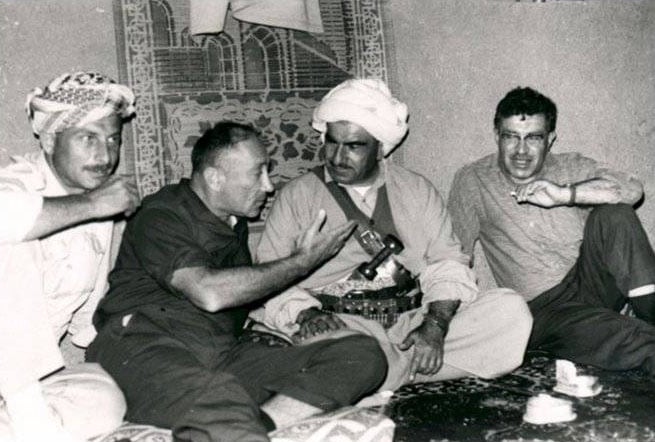
The head of Israel’s Mossad, General Meir Amit, in dark clothing, met with the Kurdish leader Mulla Mustafa Barzani in the Kurdistan mountains (circa 1966). The men on their sides are Mossad representatives.
For decades, Israel and Iraqi Kurdistan have danced in the shadows as natural allies against common enemies. This is no new friendship. Back in the 1960s and 70s, Mossad operatives and Israeli military advisers slipped into the Zagros mountains to train the Peshmerga under Mulla Mustafa Barzani. Weapons, intelligence, money—all flowed in as part of Israel’s famous “periphery doctrine,” the strategy of building alliances with non-Arab nations to box in hostile regimes.
Reports from veterans and academic researchers describe Israelis at Barzani’s headquarters between 1963 and 1975, building the Iraqi Kurdish intelligence service, ‘Parastin’, into a force that current Israeli enemies like Iraq and Iran came to fear. As a result, that bond never vanished.
When ISIS swept northern Iraq, Kurdish oil tankers started showing up in Israeli ports, and in 2017 Israel became the only country on this side of heaven to openly back Kurdish independence. That is not a coincidence. That is a strategic marriage born of necessity.
Tehran knows it too. That is why in March 2022, Iran fired missiles into Erbil, claiming to hit “Mossad bases.” Again in January 2024, Iranian rockets rained down, killing civilians while the Ayatollah’s regime bragged about striking “espionage centers.” The Kurdistan Regional Government (KRG) denied it, but the message was clear: Iran believes the Iraqi Kurds are Israel’s partners.
Then, summer 2025 came. Israel lit up Iran with strikes that went deeper and further than ever before, even destroying an Iranian refueling aircraft over 2,000 kilometers away from Jerusalem. Baghdad rushed to the UN Security Council, screaming that “50 Israeli warplanes” had crossed Iraqi skies. Regional flight warnings confirmed what everyone suspected: Iraq’s skies had become Israel’s highway to Natanz and Fordow. And where was the bottleneck? Iraqi Kurdistan—the same territory Iran keeps targeting with missiles.
Of course, the KRG has publicly condemned Israel’s strikes; they had to. That is the playbook: deny everything, stay quiet, and let history repeat itself. But the circumstantial evidence stacks up: U.S. bases near Erbil suddenly reinforced, Kurdish radars conveniently distracted, and air corridors wide open just as Israel’s jets needed them most. Add to that decades of covert Israeli training for Peshmerga fighters and the consistent pattern of military cooperation, and the picture is clear enough.
Without a doubt, Iraqi Kurdistan did not just look the other way—it played the role it has always had: Israel’s silent partner in breaking Iran’s defenses. The academics can argue over “proof.” But the reality is obvious to anyone paying attention: without Iraqi Kurdistan, Israel’s warplanes would not have hit Iran so hard, so fast, and so deep.
And here is the bitter irony: while Iraq’s Prime Minister Mohammed Shia al-Sudani bows to Tehran’s dictates, while the Houthis bow to IRGC’s demands, and while Ali Khamenei rants about “Zionist aggression” from his bunker (where he is now permanently living since he still afraid of being eliminated by the Jewish State), Masrour Barzani plays the long game.
The Iraqi Kurds -and their relatives in Turkey, Syria, Iran, and Armenia- do not need grandstanding; they need survival. And this means siding with the only regional power willing to punch Iran in the face; Israel. The ayatollahs launch missiles at Erbil because they know the truth: their enemies are not just flying over Iraqi Kurdistan, they are being quietly enabled by it. Sudani, the Houthis, and Khameini roar like lions but act like sheep. Barzani whispers—and Israel strikes. That is the balance of power in the Middle East today.
Related Topics
Related Posts