
Geopolitical Analyst: Bridging Somaliland & Israel to the world
Irro Puts Somaliland on the Washington Financial Map
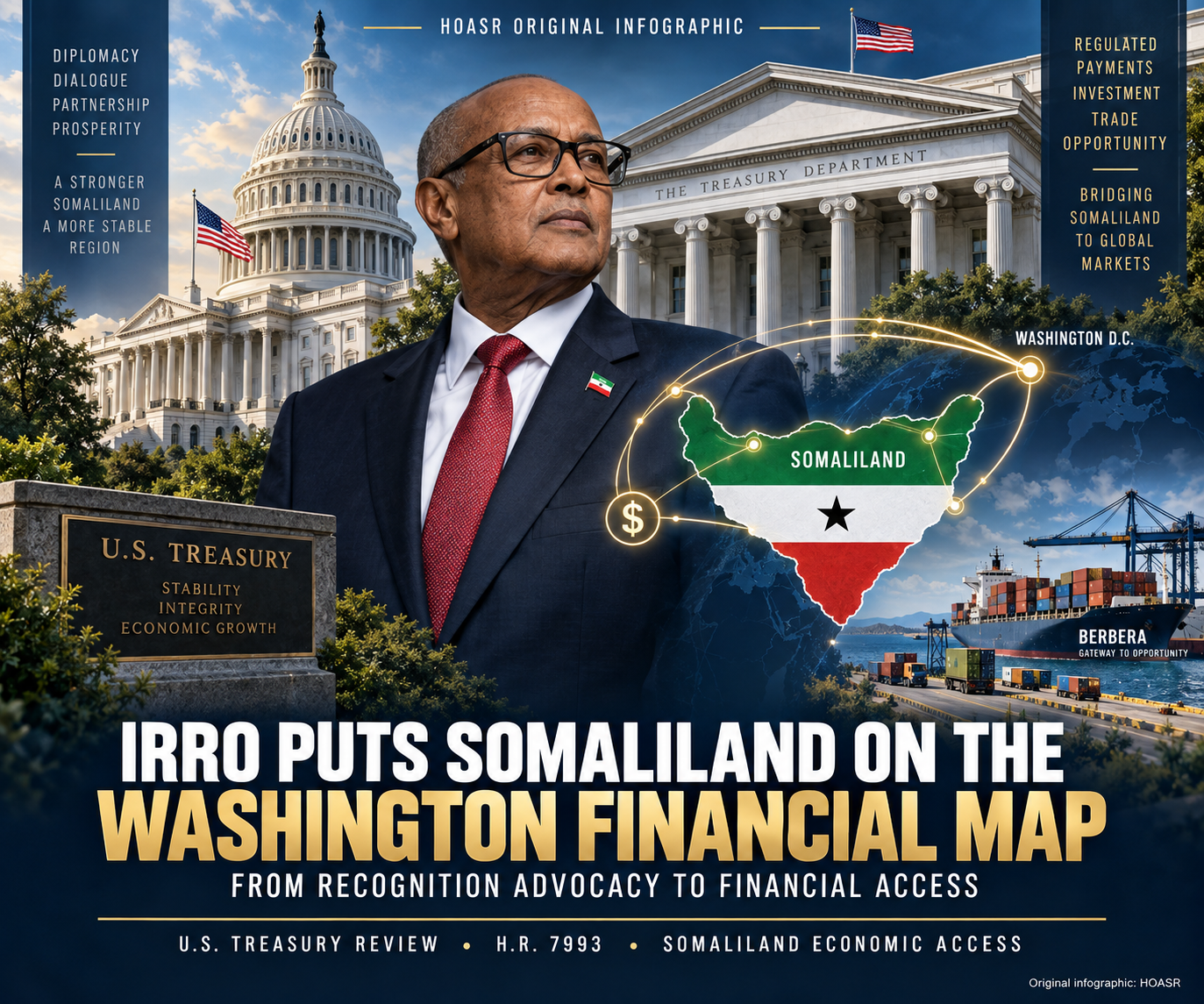
An original HOASR geopolitical infographic illustrating President Abdirahman Irro’s Washington visit and the Somaliland Economic Access and Opportunity Act. The artwork connects Somaliland, Berbera, the US Treasury and Capitol through financial and commercial networks.
The Treasury secretary’s promise to examine Somaliland’s financial isolation gives President Irro’s visit a practical opening that could outlast the recognition debate
President Abdirahman Mohamed Abdillahi Irro went to Washington to argue that Somaliland should be treated as a strategic partner. On September 15, that argument entered a part of the United States government with the power to affect everyday economic life. During the House Financial Services Committee’s annual hearing with Treasury Secretary Scott Bessent, Representative John Rose asked the secretary to examine the Somaliland Economic Access and Opportunity Act. Bessent agreed to review the legislation, seek a briefing from Treasury’s International Affairs team and continue the discussion with Rose’s office.
The exchange took place in an official House Financial Services Committee hearing, not at a campaign rally or think-tank discussion. Somaliland’s case reached the Cabinet department that oversees American financial policy, sanctions architecture and US engagement with international financial institutions.
This is one of the most practical openings created during Irro’s visit. Washington has spent years debating whether Somaliland deserves recognition. Rose has forced a second question onto the table: why should a peaceful, functioning and strategically located partner remain financially isolated?
A Cabinet Level Opening
Diplomatic visits are often judged by the rank of the people who receive a president. That perception can be misleading. A meeting may produce a photograph and disappear from the policy process the next morning. The better test is whether an issue enters an institution, gains an official sponsor and generates work that must be followed up.
Rose’s intervention meets that test. He placed Somaliland by name before the Treasury secretary, connected the issue to pending legislation and secured a commitment for departmental review. Treasury officials must now confront a problem that Washington has largely treated as somebody else’s responsibility. Somaliland has its own government, currency, security institutions and commercial life, but its businesses and citizens continue to encounter international systems that frequently classify them through Somalia or treat them as an undefined compliance risk.
For Irro, the timing is politically valuable. His Washington mission can now be linked to an identifiable policy track. The visit was not confined to recognition speeches. It coincided with a congressional effort to examine whether the United States can establish safer and more direct financial relations with Somaliland.
What Rose Put Before Treasury
The official record shows that H.R. 7993 was introduced on March 19, 2026, by Rose with Representatives Andrew Ogles and Pat Harrigan and referred to the House Financial Services Committee. The bill would require Treasury to submit a comprehensive report within 180 days of enactment on the barriers restricting Somaliland’s access to the US financial system.
Washington is now asking the important questions. What legal and regulatory obstacles arise from Somaliland’s recognition status? How well do Somaliland’s institutions meet anti-money-laundering and counterterrorist-financing standards? What constrains remittances and correspondent banking? How could the United States use its influence at the World Bank, the International Monetary Fund and other institutions? What would it take to connect Somaliland more securely to international financial messaging and payment channels?
Semafor’s reporting on the legislation correctly described it as modest in legal form but ambitious in strategic intent. The immediate product would be a report rather than recognition or automatic market access. Yet a Treasury report can identify the rules, risk assessments and institutional practices that keep Somaliland outside normal financial channels. It can also recommend what Somaliland must change and what the United States can do.
Why Financial Access is Important
Recognition answers the question of political status. Financial access determines whether sovereignty can function in the world economy. A flag and an embassy do not by themselves provide correspondent banking, affordable remittances, trade finance, investment protection or reliable dollar transactions.
Somaliland’s exclusion creates costs for families, traders and investors. It increases dependence on indirect arrangements, raises compliance uncertainty and discourages institutions that may otherwise see commercial opportunity in Berbera, telecommunications, livestock, energy, fisheries and critical minerals. It also produces a security contradiction. Western governments demand transparent financial systems while leaving Somaliland’s legitimate commerce dependent on channels that can be harder to monitor.
A responsible path into regulated finance would support both Somaliland and the United States. Somaliland would gain access to capital and more predictable commercial transactions. American regulators would gain clearer information, stronger compliance relationships and a partner prepared to meet defined standards. The objective should be a fair technical process in which Somaliland is assessed on its own institutions and conduct rather than automatically filtered through Mogadishu.
Why is this important for Irro’s visit
Irro’s central challenge in Washington is to turn sympathy into policy. Somaliland already has supporters who admire its elections, stability and resistance to extremist violence. Admiration alone has not changed its international position. The president must connect those qualities to decisions that American agencies and legislators can take.
His public appearance at the Hudson Institute helped frame Somaliland as a partner in Red Sea security and competition with China. The Rose bill adds an economic instrument to that strategic argument. Berbera cannot become a serious platform for American commerce, logistics or investment if companies cannot move money confidently. A security partnership without financial infrastructure will remain insufficient for both countries needs.
This is why the Treasury exchange may prove more durable than some higher-profile encounters. It establishes a bridge between Irro’s geopolitical message and the practical requirements of investment. It also gives congressional supporters a way to advance Somaliland’s interests without waiting for the White House to decide the entire recognition question at once.
Functional Access and Formal Recognition
Somaliland should welcome this. Financial access can improve lives and strengthen state capacity. It can also normalize direct US engagement with Somaliland ministries, regulators and private institutions. Each official relationship makes the fiction that all Somaliland affairs must pass through Villa Somalia harder to sustain. Rose himself has connected the legislation to that larger objective. In a March interview, he said stronger relations should provide a path toward what he hoped would become full US recognition of Somaliland. That makes H.R. 7993 part of a wider strategy rather than an isolated banking study.
What Hargeisa Must Do Next
Bessent’s commitment creates an opportunity, but Treasury will examine evidence rather than patriotic claims. Somaliland must be ready before the International Affairs team begins asking many detailed questions including:
- A documented account of banking regulation, supervision and enforcement in Somaliland.
- Current laws and institutional procedures governing money laundering, terrorist financing, beneficial ownership and customer identification.
- Reliable data on remittances, trade flows, correspondent relationships, and the economic cost of existing barriers.
The presidency should create a small working group linking the Ministry of Finance, the central bank, the Foreign Ministry and major private financial institutions. Its purpose should be to answer Treasury quickly and consistently. Somaliland should also ask Rose to seek bipartisan co-sponsors, committee consideration and a Senate partner.
Irro should also bring the private sector into the case. American officials need to hear how current barriers affect remittances, investment, port activity and legitimate trade. Specific transactions and compliance problems will carry more weight than general appeals for economic justice.
A Gain That Must Be Converted
President Irro came to Washington at a moment when Somaliland’s strategic value is increasingly difficult to ignore. Israel’s recognition changed the diplomatic context. Houthi pressure on Red Sea shipping, China’s military presence in Djibouti and competition over ports have changed the security narrative. The Rose bill now introduces a practical economic question: can the United States continue describing Somaliland as a useful partner while its financial system remains largely beyond direct American engagement?
Bessent has not answered that question. He has agreed to look at it. That is the opening Irro must now convert into a sustained process.
If Somaliland supplies credible evidence, accepts serious compliance standards and builds a broader congressional coalition, the Treasury review could become one of the lasting achievements associated with Irro’s visit. It would not replace recognition. It could make recognition easier by proving that direct US dealings with Somaliland and recognition are both possible and beneficial.
Washington’s recognition debate will continue. Meanwhile, financial access offers Irro a place to begin changing policy in tangible ways. Somaliland has entered the Treasury conversation. It must now prepare to get onboard.
Related Topics
Related Posts