
Is NATO Finished?
“A strong NATO is essential to American security, and I believe the obligation of Article 5 is sacred … we can and will defend every inch of NATO territory, and we’ll do it together.”
— U.S. President Joe Biden, remarks at the July 2024 NATO summit
“Depends on your definition. There’s numerous definitions of Article 5. You know that, right? But I’m committed to being their friends.”
— U.S. President Donald Trump, en route to the July 2025 NATO summit
“I left here saying, ‘These people really love their countries. It’s not a rip-off.’ And we are here to help them protect their country.”
— President Trump, the next day
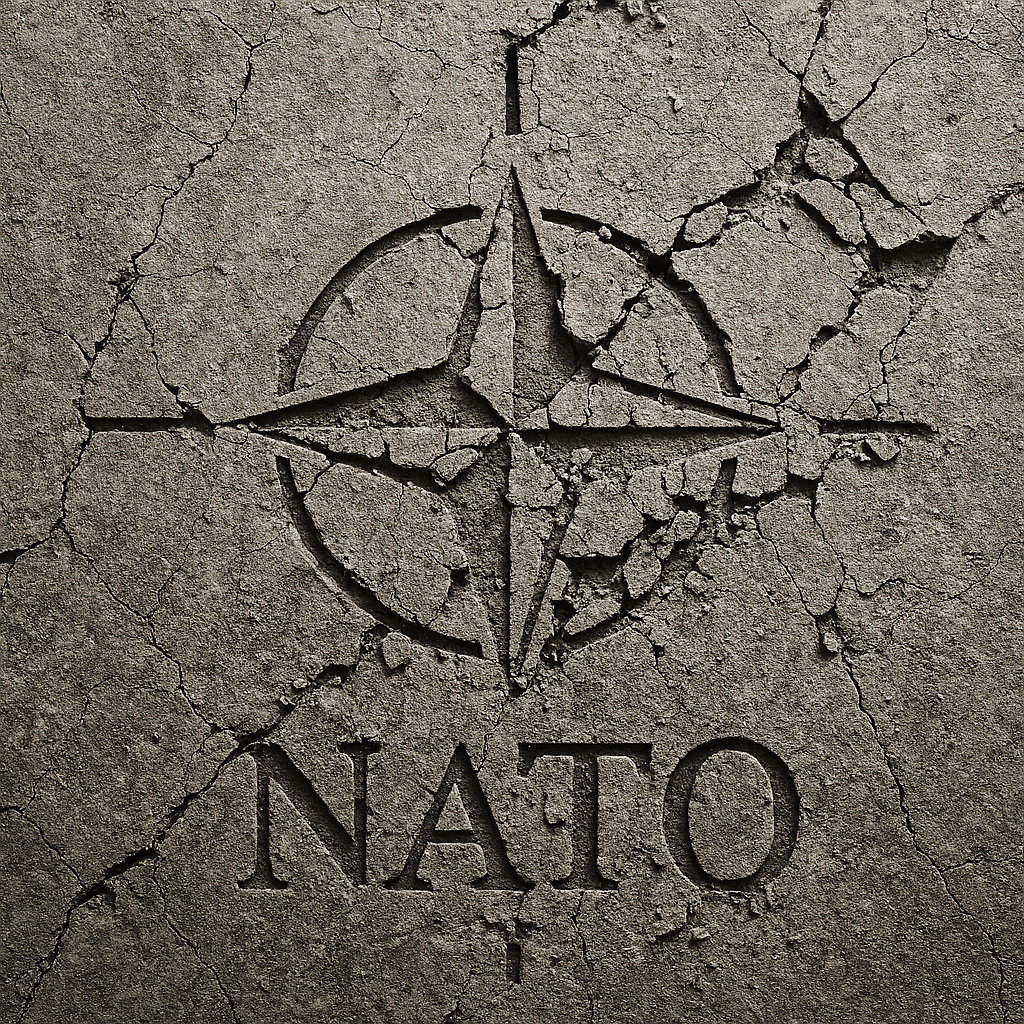
NATO breathed a collective, fawning sigh of relief when Donald Trump walked back his statement questioning the meaning of Article 5 of the founding treaty, which unambiguously declares an armed attack against one member state to be an attack against all. Seemingly satisfied with NATO members’ pledge — with the defiant exception of Spain — to devote 3.5% of gross domestic product (GDP) to defense spending and another 1.5% to infrastructure upgrades to facilitate military deployments, Trump hailed the summit as a success. In response, a relieved NATO Secretary-General Mark Rutte gushed, “Europe is going to pay in a BIG way, as they should, and it will be your win.”
Let’s file that statement under the audacity of hope. Europeans who used to deride Trump’s foreign policy as transactional now, for the most part, desperately want a done deal. The price has increased dramatically since Trump’s first term, when he chided NATO members for largely shirking the traditional defense target of 2% of GDP. Following Russia’s invasion and attempted conquest of Ukraine, however, European countries suddenly and ungrudgingly lined up to boost defense spending. Trump’s punitive target increase and NATO’s show of obedience reflect two stark realities. First, Russian President Vladimir Putin, who called the collapse of the Soviet Union “the greatest geopolitical catastrophe of the [last] century,” has neo-imperialist eyes for European territory well beyond Ukraine. And second, without the forceful intervention of the United States, there is little to stop him.
To take one example, northeastern Estonia is home to a sizable Russian-speaking population that has long refused to assimilate. The very existence of this subgroup arises from a historical crime: after World War II, Soviet dictator Josef Stalin forbade ethnic Estonians from returning to parts of their country, which he instead repopulated with workers from elsewhere in the Soviet Union. What if Putin begins his campaign to absorb the Baltic states into Russia by seizing a hunk of Estonia? NATO’s Article 5 has been invoked only once — on September 12, 2001, following the 9/11 terrorist attacks on the United States. NATO unstintingly rose to assist the United States. Would the U.S. go to war for Estonia?
Maybe not. Trump’s remark that “we are here to help them protect their country” is hardly a promise to “defend every inch of NATO territory.” It could mean selling Europe weapons. Or maybe red-carpet summitry with Putin in Alaska. At best the statement is a hedge to keep options open, and at worst a dodge to avoid any actual commitment.
Undoubtedly this reflects the special relationship, for lack of a better term, between Trump and Putin. It also reflects the deep antipathy for Europe exhibited by Trump’s defense and foreign-policy teams. “I just hate bailing Europe out again,” wrote Vice President JD Vance on an inadvertently leaked Signal chat debating a strike against the Houthis in Yemen. “I fully share your loathing of European free-loading. It’s PATHETIC,” agreed Secretary of Defense Pete Hegseth. These remarks reflect the sentiment of Trump’s base. A Pew Research Center survey from February 2025 indicated that less than half of Republicans see a benefit from NATO membership.
Given Russia’s horrific losses in Ukraine and its persistent inability to overwhelm or even make further significant gains on the Ukrainian battlefield, the notion of further imperial projects may seem far-fetched. But Russia has managed to outmaneuver Western economic sanctions and retool its industrial production to a war footing. It is now producing more tanks and armored vehicles than it is losing. Its production of artillery shells, combat drones, and missiles dwarfs European capacity. Despite sanctions, Russia is the world’s third-largest oil producer and its GDP exceeds pre-war levels. If Putin decides to end his war on Ukraine, Russia may be capable of pivoting relatively quickly to new military adventures.
Europe is not ready. NATO’s theory of operation has always depended on European deference to U.S. leadership and military strength. The first Secretary General of NATO, Lord Hastings Ismay, famously said the alliance was created “to keep the Russians out, the Americans in, and the Germans down.” The Germans and other NATO members have happily kept their heads down — it’s a lot cheaper. Sacrificing martial pride to free up money for social welfare programs struck European leaders as a pretty good deal. During Trump’s first term as president, Berlin went so far as to argue that the billions it was spending to house and integrate refugees should be recognized as “security related” and therefore count toward its then-2% target (which it probably still would not have met).
That kind of arrogance led Trump, who relishes opportunities for performative disruption, to muse that the U.S. might honor its obligations under Article 5 only for countries that meet the military spending target. (Estonia is such a country.) Suddenly the Americans might not be altogether “in,” and by invading Ukraine with no justification other than manufactured historical grievance, the Russians were not staying out. Europe panicked. Russia’s invasion triggered the most dramatic rearmament pivot in modern German history, with an immediate pledge to reach and exceed the 2% target “from now on.”
When Trump upped the ante from 2% to 5%, it struck many as setting an unattainable bar to punk Europe into admitting its own unseriousness and justify further U.S. distance from its NATO obligations. The fact that 5% of spending significantly exceeds America’s own defense budgeting (currently 2.9% of GDP) exposes the demand as a theatrical slap in the face rather than a brotherly kick in the rear. Trump’s tepid expression of support for Europe, even after its promise to jump higher and clear the new bar, means that, for the foreseeable future, NATO’s ability to deter Russian aggression is severely compromised.
Bereft of U.S. leadership, logistics, and materiel, a full-scale NATO military response to a Russian invasion of Estonia or any other eastern country would be unlikely. NATO decisions are made by consensus. Achieving enough unanimity among perennially squabbling European countries, with differing national priorities and divergent threat perceptions, to support a swift and forceful military response would be impossible. A nuclear response is unthinkable. At best, a “coalition of the willing” among, for example, Poland, the United Kingdom, France, and Germany might emerge to challenge Russia. But European militaries still rely heavily on the U.S. for critical “enablers” such as intelligence, surveillance, and reconnaissance, long-range strike capabilities, air-to-air refueling, strategic airlift, and command and control. NATO without the U.S. likely would not represent a decisive strategic impediment to Russia’s expansionist ambitions.
As the failed Alaska summit over the Ukraine war made clear, the U.S. is increasingly irrelevant to Putin’s thinking as well — with or without an American commitment to NATO. While there is no evidence that Putin has kompromat on Trump — the so-called Steele dossier, ginned up by Democratic operatives in 2016 to discredit Trump before the election, has been thoroughly discredited — both leaders behave as though its most salacious allegations were true. Putin is unassailably confident that Trump will not seriously challenge him in Ukraine or anywhere else, repeatedly humiliating him by escalating attacks on Ukrainian civilians whenever Trump boasts of diplomatic progress. Trump, an impulsive pugilist always poised to punch back harder, reserves his blows for others. He announced embargo-level tariffs on China when that country had the temerity to retaliate against Trump’s first punitive round of tariffs; and he did so heedless of America’s dependence on China for everything from life-saving pharmaceuticals to rare earth metals critical to strategic weapons systems. Though he ultimately backed down, the fiasco was classic Trump — hit back hard and clean up the mess later.
With Putin, it’s been hands off. Nearly every country in the world now faces at least a 10% “reciprocal” Trump tariff unless they’ve negotiated a special rate. Not Russia. Around 90 countries now have elevated tariff rates — anywhere from 15% to 50% — depending on trade balances, political disputes, or specific policy grievances. Russia is not among them. True, trade with Russia has diminished sharply since the post-invasion sanctions regime imposed under President Joe Biden took effect. But the U.S. has imported nearly $2.5 billion in goods from Russia this year alone, which is hardly trivial.
If Putin really did have devastatingly embarrassing material on Trump, his overriding priority as a trained KGB operative would be to preserve the asset. That means allowing Trump enough agency to pass for an independent, uncompromised leader. Trump can threaten, he can call Putin names, he can express faux outrage — any form of stage management is fine as long as no policy red lines are crossed. For his part, Putin will flatter and express affection for Trump in order to provide an alternative basis — a “legend,” as the Cold War spies used to say — for Trump’s highly uncharacteristic deference. Teasingly, when publicly questioned whether he holds compromising material on Trump, Putin never denies it.
Forbidden from acting but mindful of his own tough-guy persona, and politically unable to outright support a brutal murderer who continues to slaughter civilians, Trump is left to kick cans down the road that would otherwise cross Putin’s red lines. No new sanctions. No U.S. weapons transfers to Ukraine, even if they pay, unless delivery times are distant enough to make them theoretical. New range restrictions on weapons already delivered. Trump must keep scrambling the same script of threats and two-week postponements, counting on short news cycles and hoping for some decisive turning point — a crippling Russian breakout along the front, a brilliant Ukrainian operation that changes the calculus of war for Russia — that will let him off the hook and maybe even claim Nobel-worthy credit.
How soon and on what terms Russia’s latest war ends will dictate Putin’s next imperial adventure to reclaim lost Russian greatness. Poland and the Baltic nations could be forgiven for hoping NATO’s critical test comes after Trump has passed from the political scene. Unfortunately, America’s doubts about NATO will outlast him. Today, a solid majority of Americans continue to support NATO and believe it benefits the U.S. But that support, while durable, has become increasingly polarized, rising among Democrats and falling among Republicans.
During the Covid pandemic, Trump managed to freight the simple expedient of wearing a facemask with political salience. He is doing the same with NATO. Back when no one judged you for wearing a mask and NATO’s ability to deter Russian irredentism was beyond serious question, support for the alliance was an easy consensus position. Its success was marked by its longevity and U.S. leadership earned national prestige without risk or significant sacrifice. Today Russian missiles are landing near the Polish border. Trump’s demands for greater European contribution and the truculent pushback he initially received played right into his narrative of an America eternally suckered by freeloading friends. Combine perceived ingratitude with the sudden reality of risk to American troops and you have a political wedge issue. An alliance requires commitment that endures through successive administrations and survives shifting political winds. It depends on a sense of national honor so strong that its betrayal would be politically unthinkable, a shaming that would forever damn the betrayer regardless of party.
If a majority of Americans support NATO today, most do so out of sentiment, if not nostalgia. To many, U.S. support for Ukraine has proven costly and ineffective, and they will see the experience not as a testament to the value of alliances but as a template for the stalemate NATO will face should it defend Russia’s next victim. As a result, were Putin to surge tanks and troops into Estonia, Trump could placate Putin and keep America on the sidelines without significant political downside. He has turned support for alliances into a partisan cue. NATO joins free trade, multilateralism, fiscal prudence, and vaccines as matters of traditional establishment consensus that have become fraught tribal emblems.
Fortunately for Estonia, Putin is unlikely to invade any time soon. Now, again, there is no evidence — zilch, nada — that Putin has Trump in his pocket. But if he did, why put an asset of such surpassing value at political risk for limited territorial gains at even the moderate military and economic cost the Europeans could inflict by themselves? Merely by shifting the Overton window enough to make support for NATO a debatable proposition, the two leaders have ruptured the alliance and its capacity to deter — perhaps permanently. It is difficult to see how the foundation of trust and shared mission can be rebuilt.