A Liberal Atheist Who Supports and Studies Israel
‘Is This Antizionism?’ — Identifying the Culture behind the Chants
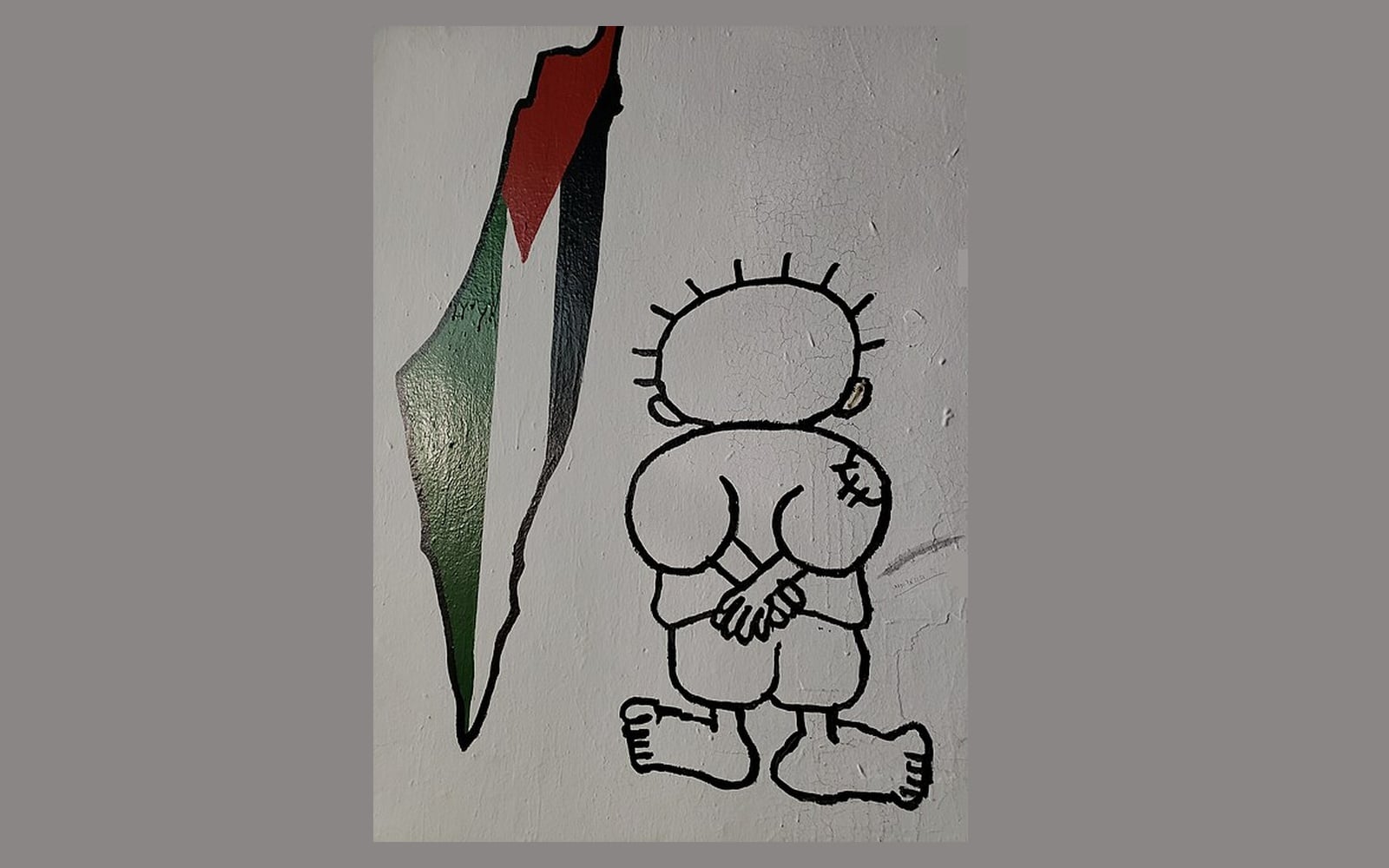
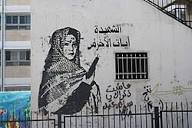
Handala graffiti, Nazareth, 2021. Wikimedia Commons.
A political position has arguments and posits critiques about policy decisions. A subculture is different. A subculture has specific clothing, an insider language, a worldview: as a social movement, antizionism has all three. It meets the criteria for a subculture.
I’ve written about the chants, lexicon, inversion, curriculum, detection, and code-words of modern antizionism: now it’s time to examine it as a subculture.
It seems we’ve been arguing back and forth about antizionism the wrong way. Some treat it as a set of propositions, true or false, fair or unfair. We answer it with counter-evidence about what Zionism amounts to, marshaling historical facts, and questioning their values. We don’t realize that a proposition was never in front of us. What assembles on the quad and spreads in the feed is not an argument, it’s a culture. A dense interwoven knitting of clothing, speech, norms, heroes, and martyrs. You don’t refute a culture: you identify, read, and critique it.
Dowd and Dowd reduce a subculture to three conditions: its members “interact frequently,” “share a worldview,” and “remain unwilling or unable to assimilate into the dominant culture.” Those in subcultures don’t want their membership to become normalized and assimilated. (Dowd & Dowd, 2003).
What follows is a kind of ethnography. If we learn antizionism’s norms, aesthetics, rituals, and social habits, we don’t need to condense it to a definition like “opposition to Israel.” And unlike a definition, this form of antizionism can be seen, heard, and touched. It has clothing, slogans, codes, and social expectations.
Antizionists can be found from Southeast Asia to Norway, each setting shaped by its own history and style. In the West, the dominant form is organized through the pro-Palestinian movement, but antizionism is not reducible to that movement. Its ideas and vocabulary have been shaped by Soviet Russia, Arab states, the Global South, and Nazi Germany.
Today antizionism appears at the UN, throughout academia, and within the professional class. “American antizionism,” writes Shaul Kelner, “finds its social base in the same educated, urbanized professional class that most Jewish Americans inhabit.” Because of this, Kelner points out, “Jews are more likely to personally encounter antizionism in their workplaces, schools, and communities.”
The Aesthetic
Let’s begin with dress, because a subculture outwardly shows its membership before it speaks. The keffiyeh is the foundational garment. It’s worn not as a Palestinian wears it. To the member its connection to the Levant has generally been severed, its meaning has been emptied of geography, being replaced as a symbol of allegiance. Around it are other recognizable markers: the “Free Palestine” t-shirt, kaffiyeh-print everything, the bag and bandana in tatreez cross-stitch, the silver shape of Mandate Palestine with Israel deliberately absent, the way it’s taught in Palestinian textbooks. There’s Arabic the wearer cannot read, “فلسطين حرة,” “Free Palestine,” or a line taken from Mahmoud Darwish. There’s the merchandised face of Greta Thunberg. There’s images of “political prisoners.” The wardrobe is not incidental. It’s the most efficient set of products the movement issues.
The Iconography
A culture reveals its devotions through signs. The decoy comes first, the watermelon on a pin, an emoji, and a sticker. Then, its the symbol that has become the movement’s Che Guevara: Handala, the barefoot child drawn from behind with his hands clasped behind his back, created by cartoonist Naji al-Ali in 1969. He is stenciled on walls, tattooed on arms, pinned to lapels, and cast in silver—an icon of refusal so ubiquitous most don’t know the author/s name. Beside him run the deeper signs: the key of “return,” the kite, the inverted red triangle taken from Hamas combat videos designating targets for death. Then the horribly offensive para-glider, which commemorates only one morning. This is a system of symbols that advertise what the movement holds dear. This one uses the iconography of killing Jews and makes them wearable and mobile.
The Liturgy and the Argot
The antizionist movement’s speech is not about critical analysis. It’s a liturgy: phrasing built for cadence and for a crowd, designed for repetition. The call-and-response chant is fixed: “From the river to the sea”; “Globalize the intifada”; “There is only one solution”; “We don’t want no two states”; and when the mask slips, “Khaybar Khaybar ya yahud,” which points to a seventh-century massacre of Jews.
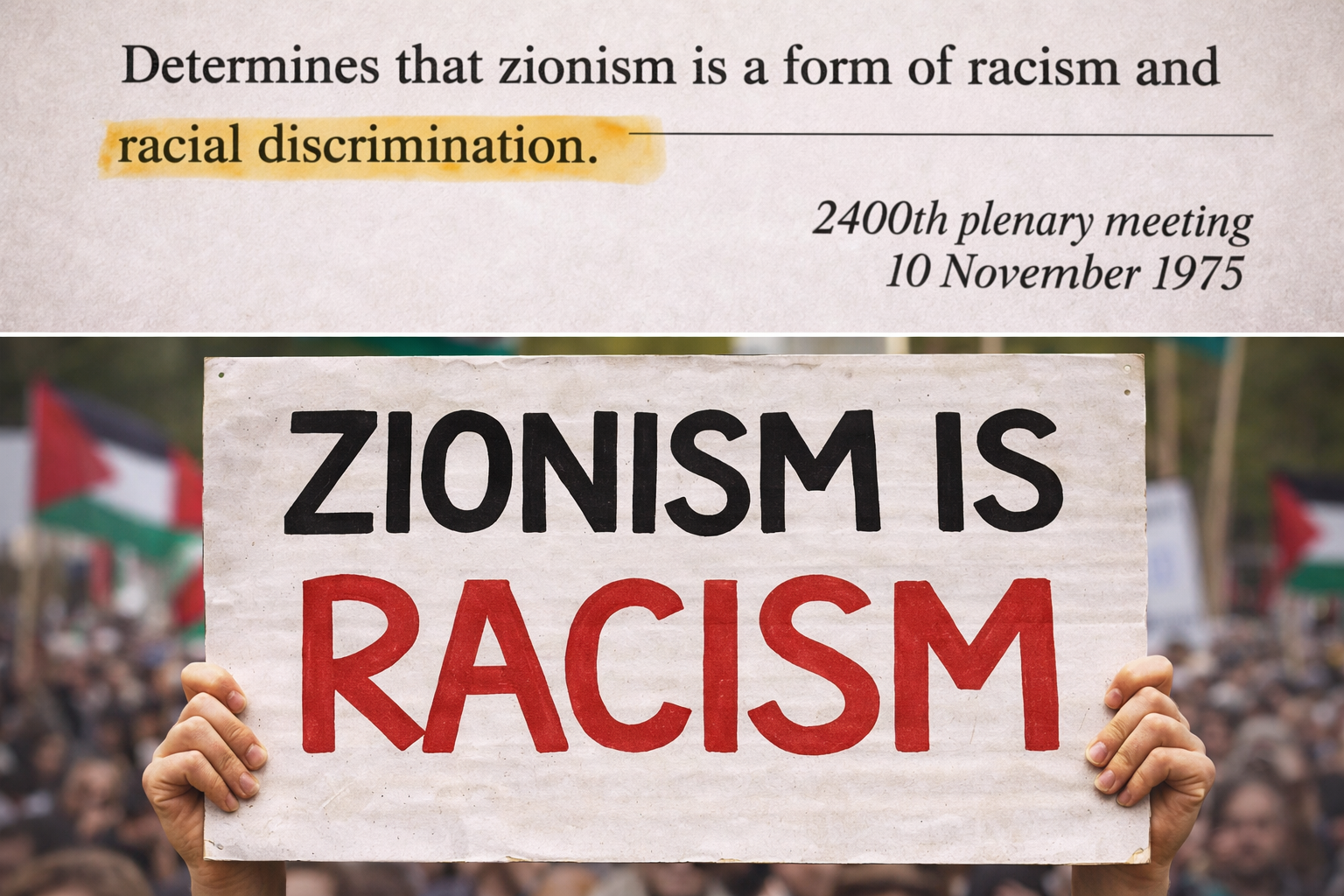
The replacement of its predicate—Zionism is racism, capitalism, colonialism, even Nazism—points to the fact that in the minds of antizionists, “Zionism” is neither the self-determination of Jews, an expansionist ideology, or a racist one: it’s all of them. It’s a folk-devil, or negative totem: an idea or word onto which the group’s grievance is transferred and encapsulated. It’s what’s called a shibboleth: an in-group word for the “enemy.”
This becomes important when discussing what antizionists thinks of Zionism. To them, Zionism is not just a supremacist ideology held by militaristic Israelis in Knesset: its the total sum of all negative attributes contained in a single word.
Beneath the chanting is the argot. An argot is a coded-word used by a subgroup to prevent outsiders from understanding their meaning. “Zionist,” “Colonizer” and “settler” is a proxy word for “Jew”; “The entity” refers to Israel without the dignity of the word “country” or “nation”; “apartheid state” and “Nazi state” use inversion and turn the victim into the perpetrator; “genocide” denotes Israel’s self-defense in any form; “by any means necessary” justifies events like October 7; “decolonization” names the removal of Jews and their “entity” without having to say it out loud. The lexicon also includes pejoratives like “Zio” and “Hasbara.”
Another noticeable part of the language are the verbs. Zionists control, infiltrate, harvest, erase, replace, cleanse, manipulate. This is grammar inspired by the blood libel.
Run the antizionist lexicon to the ground and every term lands on one of two referents: Jews and Israel.
The Canon
Every literate culture has sacred texts, and this one keeps two layers. The deep layer is academic and half a century old: Edward Said’s “Orientalism” and “The Question of Palestine”; Frantz Fanon’s “The Wretched of the Earth,” especially its chapter on violence; Ilan Pappé’s “The Ethnic Cleansing of Palestine” and Rashid Khalidi’s “The Hundred Years’ War on Palestine”; Patrick Wolfe’s settler-colonial theory that “invasion is a structure, not an event”; and, rarely credited, Fayez Sayegh’s “Zionist Colonialism in Palestine” (1965), the Arab League pamphlet that first taught the UN to call Jews colonizers.
The new material is the post–October 7 wave that now fills the bookshop window and the library display. What Matti Friedman calls “Gazology.” There’s Ta-Nehisi Coates’s “The Message”; Omar El Akkad’s “One Day, Everyone Will Have Always Been Against This,” which received the 2025 National Book Award; Nathan Thrall’s Pulitzer-winning “A Day in the Life of Abed Salama”; the poet Mosab Abu Toha’s “Forest of Noise”; Pankaj Mishra’s “The World After Gaza”; Andreas Malm’s “The Destruction of Palestine Is the Destruction of the Earth”; and Mohammed El-Kurd’s “Perfect Victims.” The titles vary, but the conclusions are the same.
The Hagiography
The living cast recurs across every feed and is recognizable on sight. Francesca Albanese laundering antizionism through a UN mandate; Hasan Piker teaching a generation through a Twitch chat; Judith Butler furnishing the “as a Jew” endorsement the movement values above nearly anything; Mohammed El-Kurd as poet-in-residence; Norman Finkelstein and Noam Chomsky as elders; Roger Waters as the arena act; Greta Thunberg and the flotilla cohort as photo opportunists; Rashida Tlaib and Ilhan Omar as the congressional wing. Behind this Western group sits the source from which the symbols and the goal emerge: Hamas.
The Martyrology
A culture is defined by who it canonizes in death and by whom it elevates in life, and here the dead comes in two types. There are the martyrs the movement mourns in English: Aaron Bushnell, who immolated himself outside the Israeli embassy; Rachel Corrie; the journalist Shireen Abu Akleh; Refaat Alareer, whose poem “If I Must Die” became the movement’s. These receive the vigils and the murals the flotilla occupants yearn for.
Then there are the martyrs honored in Gaza and the West Bank where the youth are formed—and it’s these who disclose the reality the Western version ignores. Dalal Mughrabi led the 1978 Coastal Road massacre, taking over a bus and helping to murder some three dozen civilians, many of them children; the Palestinian Authority has named schools, a summer camp, and a public square in her memory, so that children learn her name as other children learn a founder of a state.
Leila Khaled, who hijacked airliners, survives in poster form—keffiyeh, rifle, with the full romantic attire—and is booked onto campus panels by organizers who would gasp at her resume. A movement announces what it loves by whom it enshrines. This one enshrines those who killed Jews and puts that devotion under the category of “memory.”
The Institutions
Antizionism has the propensity to spread institutionally. Students for Justice in Palestine, National SJP, with American Muslims for Palestine are behind much of its apparatus and supplies the campus environment; Faculty for Justice in Palestine does the same thing credentialed and lecturing from the front of the room. CodePink; Within Our Lifetime; the Palestinian Youth Movement; the US Campaign for Palestinian Rights; Samidoun, the PFLP-linked network; the BDS National Committee; and Palestine Legal. The Jewish-branded auxiliary groups—Jewish Voice for Peace, IfNotNow—exist for creditialing. Over all of it floats the convention you can see across a parking lot: “[Anything] for Palestine.”
This loose structure no longer confines itself to the quad, has spread to the institutions, and surfaces as the city-council ceasefire resolution. It’s seen in the public-library display and the bookshop’s front table on “the genocide in Gaza.” And let’s not forget the U.N.
The Demographics
The best available data suggest that antizionism’s strongest demographic profile is young, left-wing, and rooted in college, activist, and urban professional circles.
Boundary Maintenance
The “Zionist” is the enemy, but a worse offender is the one on the inside, the “normalizer,” the “PEP”—Progressive Except Palestine—who marches for every cause but declines to attend this one. These heretics are met with the struggle session, the public denunciation, the quiet exclusion from the group-chat and email list. The apostate is a category with a whole procedure. The existence of that procedure is a diagnosis. Debate societies don’t excommunicate: faiths do.
The Unmarked Communicant
The hardest case wears none of the kit. No keffiyeh, or merchandise, and no marching. A “Free Palestine” signature to an email, a whispered “end the occupation,” or a slight “well, the Zionists.” “The powerful lobby,” and “the occupation” said during times of group discussion. The clothing isn’t required. One phrase can establish that the antizionist lexicon reached him, and it points only one way.
A subculture, according to Dowd and Dowd, coheres around what “defines the group most thoroughly.” When you strip everything away, what can the antizionist movement not live without?
It’s not Palestinian statehood, or anti-war feelings, human rights, the evils of capitalism, or climate change. The costume, canon, calendar, and catechism have one terminus: destruction of the state of Israel, and hatred for Jews. That’s the center. By the movement’s own landing spot, this becomes clear. Of course, there are those who say it’s a “political critique”—but by the visible markers of a social movement, these members are mistaken.
This is why the protest ends at a synagogue and not an embassy. The embassy is where one goes to show disapproval for a policy. The synagogue is where one goes to reach Jews collectively—the Jewish Federation in Michigan, where the date allegedly chosen to act was October 7; The Hanukkah crowd on Bondi Beach; the Jewish museum in Washington, where a man shot two Israeli embassy staff and shouted “Free, free Palestine” where a man shot and killed two Israeli staffers. And why did he say “Free” twice? Because that’s how you say it in a crowd. It was always in plain sight, wearing its uniform and chanting its hymns.
The task is to read it, call it out, and critique it.
Related Topics
Related Posts