The views expressed herein are solely mine.
Is Trump Engineering Bibi’s Honorable Exit?
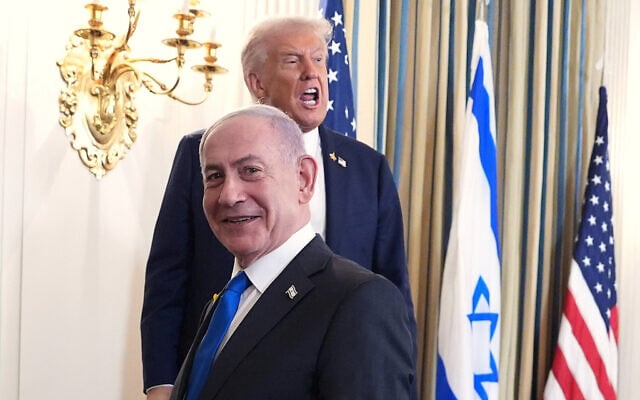
US President Donald Trump speaks upon departing a news conference with Prime Minister Benjamin Netanyahu, in foreground, in the State Dining Room of the White House, September 29, 2025, in Washington. (AP/Evan Vucci)
Tellingly, although it slipped under the radar, Netanyahu’s request that President Isaac Herzog pardon him may be the first visible crack in the façade of Israeli politics’ great immovable object.
For decades, Bibi has survived indictments, wars, collapsing coalitions, street revolts, and every American president from Clinton onward.
Yet this legal maneuver does not belong to his old survival playbook. In fact, it belongs to a new geopolitical map—one in which Donald Trump is back, and Netanyahu is no longer an asset but a strategic obstruction.
Empirically, political-science data on leadership exits during alliance realignments show the same pattern every time: when a leader’s survival interferes with the patron’s regional project, the patron eventually forces the recalibration.
Historically, U.S.–Middle East realignments—Sadat’s pivot in 1977, Hussein’s normalization in 1994, the Oslo Accords in 1993, even the Gulf’s silent realignment in 2020—prove the rule.
In 2025, the actor complicating Washington’s geometry is Netanyahu.
Strategically, Trump’s vision is sweeping: formal Israel–Saudi normalization, civil-nuclear cooperation with Riyadh, security guarantees, F-35 transfers, expanded Gulf–Israel energy and tech corridors, and a regional containment system designed to freeze Iran’s expansion before it reaches the nuclear threshold.
Analytically, every pillar of that agenda becomes cleaner, faster, and diplomatically less toxic without Netanyahu standing at the podium in Jerusalem.
In strategic terms, Netanyahu’s presence is now a liability. Riyadh distrusts him. Doha sidesteps him. Abu Dhabi is exhausted by him. Washington sees him as the architect of the very strategic drift that pushed the U.S. into concessions it never intended to make—deepening ties with Qatar to the brink of an Article-5-style arrangement, expanding nuclear cooperation with Turkey, supporting Saudi Arabia’s civil-nuclear program, and laying the groundwork for future defense guarantees that will outlast Trump’s second term.
According to the emerging consensus, academic assessments and private briefings from Israeli security figures now acknowledge this openly: Netanyahu’s errors boxed Israel into a regional balance that weakens its long-term leverage.
Then came October 7—Netanyahu’s “1973 Yom Kippur” moment; and he failed.
Every empirical study of leadership survival after catastrophic security failure shows the same trajectory: leaders cling on temporarily, but the decisive blow comes when external allies no longer trust them to anchor the next strategic phase. Netanyahu has crossed that line.
In political reality, that is why President Trump’s dramatic plea in the Knesset—pressuring President Herzog to consider a pardon—felt less like legal accounting and more like the controlled demolition of a political dynasty.
President Herzog, who long resisted anything resembling absolution, is now facing intense American pressure as the U.S. secured the liberation of our hostages, pushes for regional stabilization, and seeks a symbolic Israeli “give-back.”
Hence, a pardon becomes the perfect currency: a reset for Trump’s regional file without formally announcing Netanyahu’s political end.
According to the “political-exit theory”, Netanyahu knows the cost of accepting it: implicit guilt, public humiliation, and the irreversible slide into political twilight.
And the theory is unambiguous—when leaders accept legal arrangements they once vowed to fight to the death, it signals that the geopolitical environment has narrowed, locking them into an exit corridor.
Ironically, the man who branded himself “Mr. Security” lost that title in a single morning.
The man who warned for decades about Iran now “leads” over unprecedented strategic chaos.
The man who boasted of controlling Washington’s ear now watches Trump’s agenda bypass him entirely.
Ergo, the pardon request is the moment the mask slipped—forced by a moral, political, and personal obligation to pursue the only path left for his legal survival.
Unmistakably, this is the signal that Netanyahu finally understands the region has moved on—and that Trump intends to move on without him.
Bibi did a lot for the country—turning Israel into a tech superpower, turbocharging GDP growth, dragging foreign investment into Tel Aviv like a magnet, and building the kind of Start-Up Nation ecosystem that transformed a tiny state into a global innovation hub.
Under his watch, Israel’s armed forces did not just expand; they modernized. He pushed F-35 acquisitions, deepened missile-defense integration, fortified cyber capabilities, and positioned the IDF as one of the most technologically advanced militaries on earth.
Diplomatically, he cracked open doors no one thought would ever budge—from Africa to the Gulf—and he paved the runway for the Abraham Accords long before they had a name.
But precisely because of all that, he now stands in his own shadow. The same political instincts that served Israel for almost three decades are becoming liabilities in a region shifting faster than he is.
Today, the strategic horizon has moved: normalization with Saudi Arabia, realignment with a returning Trump White House, and a historic chance to redraw the Middle East map all require a fresh figure unburdened by criminal cases, coalition dramas, or endless domestic trench wars.
In other words: Bibi built the engine, but he is no longer the one who can drive it where Israel needs to go next.
Related Topics