"Violence can be justifiable, but it will never be legitimate." — Hannah Arendt
Featured Post
Islamabad
In the US-Iran memorandum hammered out in Pakistan's capital, Israel's exclusion was not a flaw – it was the point
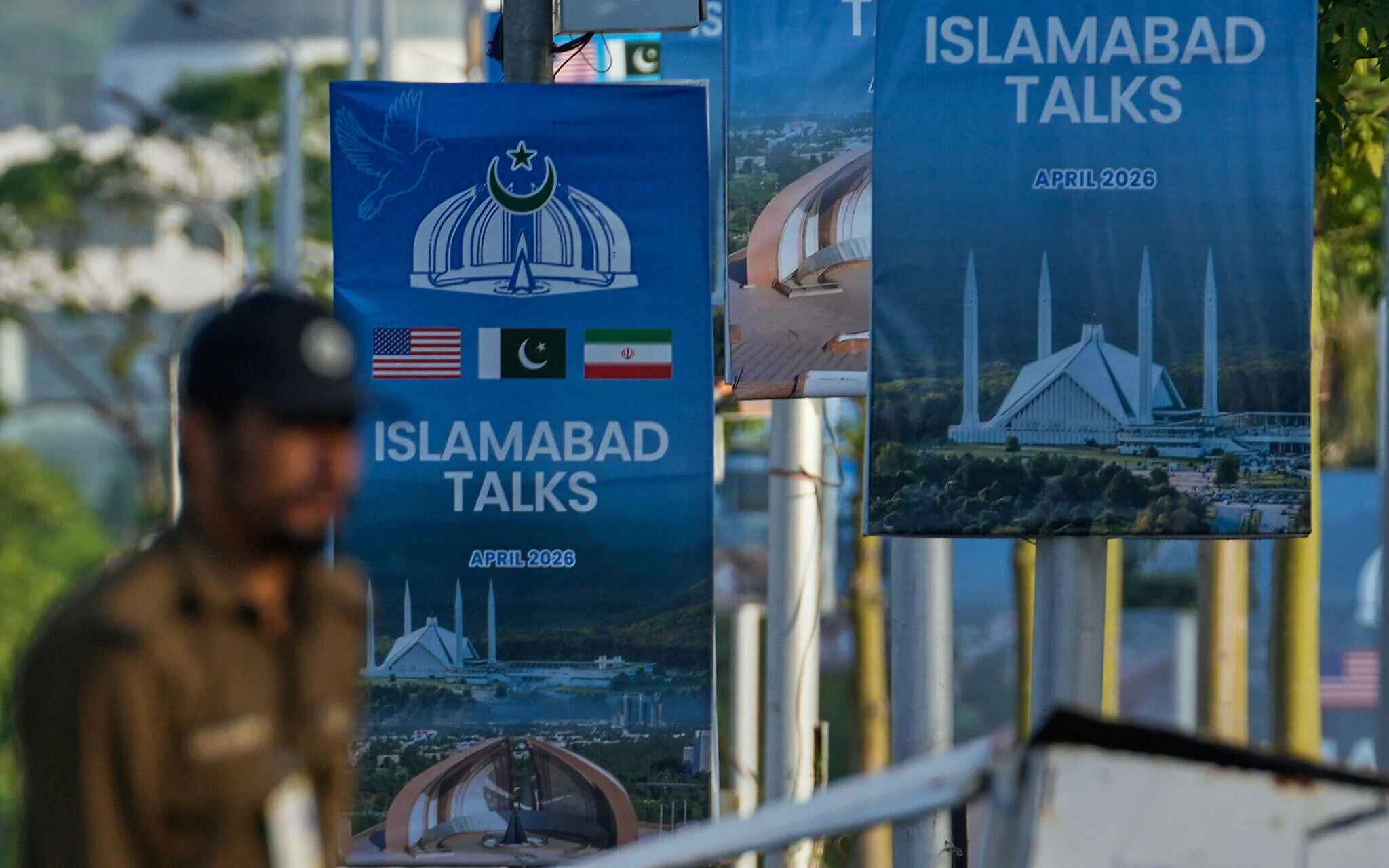
A police officer walks past posters of US and Iran talks near a possible venue in Islamabad, Pakistan, April 25, 2026. (AP Photo/Anjum Naveed)
Islamabad was born of a delusion.
In 1960, when the Pakistani government decided to build a new capital to replace Karachi, the Greek urban planner Constantinos Apostolou Doxiadis was mandated to create a perfect order out of nothing. Isolated from popular pressures and coastal instabilities, the city was drawn on a symmetrical grid of self-contained sectors, where every bureaucratic and diplomatic function conformed to a theoretical blueprint immune to the chaos of the real world.
It is this very mindset, addicted to abstractions and blind to the reality on the ground, that explains how we ended up here. That the fate of the Middle East was sealed within this concrete utopia says everything about the extent of our isolation, because the reshaping of the region took place in a capital that does not even recognize our existence, at a table where we were reduced to zero by those who actually decide the map.
In the Islamabad Memorandum of Understanding, signed separately by Donald Trump and Iranian President Masoud Pezeshkian on June 17, 2026, the most alarming detail is what is not there. The document contains 14 points. The first declares an immediate and permanent cessation of military operations on all fronts, including Lebanon. Israel is not mentioned in any of the 14 points. We were not part of the negotiations. We currently occupy approximately one-fifth of Lebanese territory, maintaining forces at a depth unprecedented since 1982, yet the agreement that ends this war was signed without our voice being necessary for any of the parties who drafted it.
This is no technical omission. It is the central core of the agreement. The memorandum was negotiated between the United States and Iran, communicated to the world through Pakistan and Qatar, two countries with no diplomatic relations with us, and proclaims a cessation of hostilities in a theater where the principal military actor signed nothing. Two days after the signing, we were still launching strikes in southern Lebanon. Iran responded by closing the Strait of Hormuz, arguing that the continuation of our operations constituted a violation of the agreement it had struck with the United States, not with us.
Iranian Foreign Minister Abbas Araghchi told a group of diplomats that, in Tehran’s view, the two sides of the memorandum are the United States and Israel on one hand, and Iran and Hezbollah on the other. In Tehran’s formulation, Hezbollah is elevated to the same political status as the United States and Israel. It positions us as a party to an agreement we did not sign, with obligations over a territory we occupy but about which we never negotiated with Iran.
The Tasnim News Agency, affiliated with the Islamic Revolutionary Guard Corps, celebrated the outcome as an Iranian victory over Washington and over us, and the celebration was not unfounded.
Prime Minister Benjamin Netanyahu declared that we will not withdraw from southern Lebanon and that we maintain full freedom of action in that territory. Itamar Ben Gvir was more direct, stating that Trump’s deal does not bind us. Both are right in a technical sense, because we did not sign it.
The problem is that the agreement that does not bind us does bind the United States, and the United States is the one that decides whether interceptors arrive, whether munitions cross the ocean, and whether a favorable vote appears in the Security Council. When our country’s primary ally signs a document defining the conditions of our military withdrawal from a territory we occupy, the sovereignty that remains is purely rhetorical.
What is being contested in Geneva and Islamabad is not just the text of the memorandum, but the meaning of that text, at a time when the document is not yet public in its entirety and each government reads aloud the version that best suits it before the actual text can contradict them. Iran and Hezbollah read the version of total withdrawal, Washington reads the version of reopening the Strait, Netanyahu reads the version where the agreement obligates him to nothing, and Trump reads the version where he ended a war. In an agreement that remains invisible, each party interpreting it in public tries to forge its own interpretation into the actual deal before the original text can constrain them, and Iran is executing this strategy far more aggressively than Washington.
I live in the north of our country, on the inside of the map that everyone else analyzes from the outside, and I have lived inside this war long enough to know that the battle over the meaning of an agreement is often more decisive than the battle that produced it. Already, dozens of our soldiers have been killed since the fighting began, with the projection of more lives being claimed each additional day we keep our boys stuck in that Lebanese mud where they do not belong. Faced with this unsustainable cost of blood, our cabinet intoxicates itself with the rhetoric of absolute victory, promising that the army’s might will dictate the terms of regional peace and guarantee the immediate return of the displaced to their homes.
The public watches the speeches, believing that national sovereignty and our country’s borders are being decided by the actions of our soldiers on the front line. What the Islamabad Memorandum exposes, however, is the absolute bankruptcy of this incompetent government. Hezbollah remains intact and has been enshrined as a legitimate actor by an agreement between the world’s foremost superpower and the region’s dominant power, signed without either of them needing to so much as hear our voice. The agreement that purports to end this war contains 14 points. The most important one did not need to be written, because our absence was the agreement itself.
Related Topics
Related Posts