
Russian-American-Israeli Palestinian. Palestine is Israel.
Islamo-Capitalist Alliance
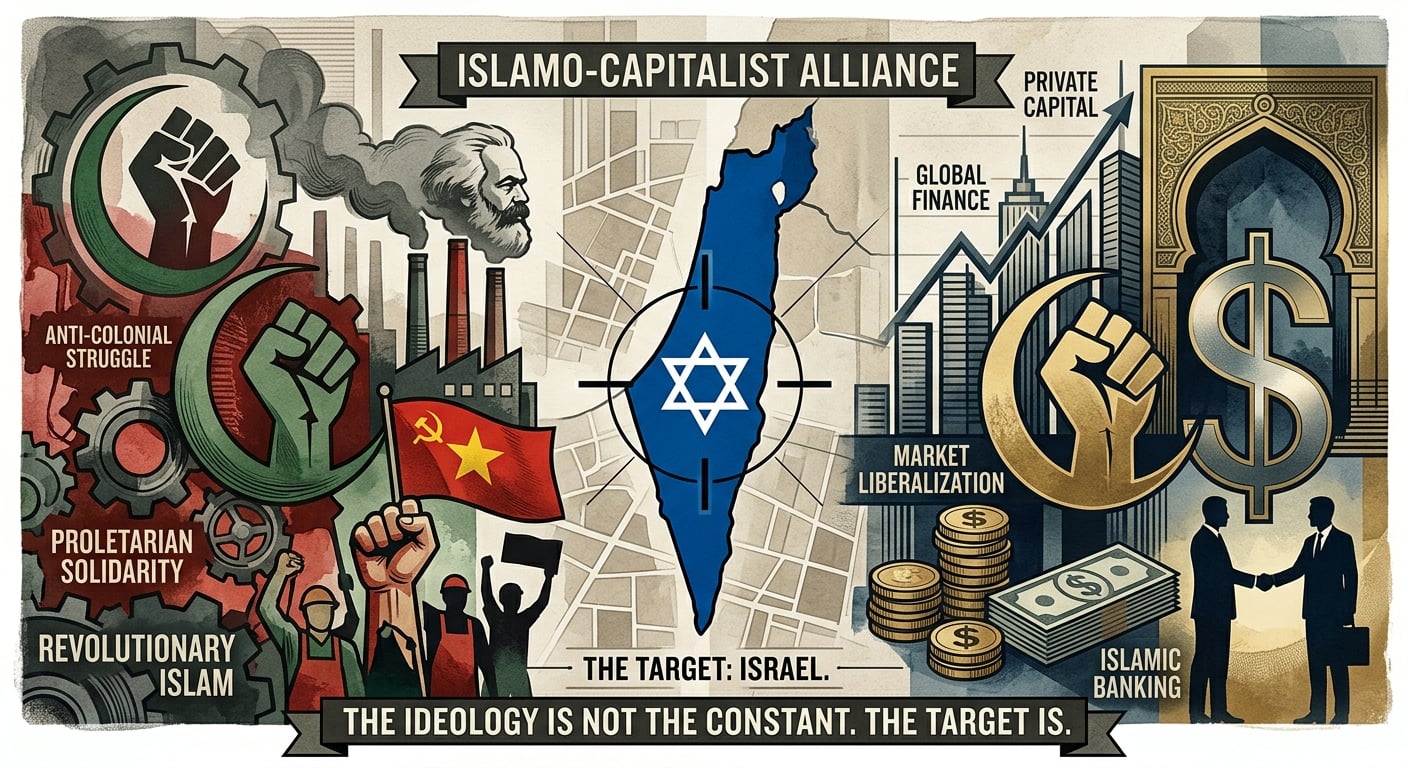
There is nothing special about the Islamo-Leftist Alliance. The ideology is not the constant. The target is. Image © Ivan Bassov, 2026. Licensed under CC BY 4.0.
There Is Nothing Special About the Islamo-Leftist Alliance
Why do Islamism and the political left so often find themselves on the same side against Israel? Why does anti-Zionism so often accompany anti-capitalism?
These questions have generated an impressive amount of analysis. We are offered explanations involving youth unemployment, stagnant wages, inequality, housing costs, precarious employment, globalization, automation, declining social mobility, university culture, social-media radicalization, postcolonial theory, anti-imperialism, and disillusionment with capitalism.
Others try to identify some deeper ideological compatibility between Islamism and the left. What, they ask, could these apparently incompatible movements possibly have in common?
The question sounds reasonable.
But I think it starts in the wrong place.
We are trying to explain the coalition’s ideology before examining its target.
The term “Islamo-Leftist Alliance” itself encourages the wrong analysis. It makes Islamism and the left look like the two components that need to be explained, as though their convergence were the phenomenon. But if the coalition could just as easily be called an “Islamo-Capitalist Alliance” under a different Israeli political system, then neither “Islamo” nor “Leftist” explains the underlying phenomenon.
And that may be why the phenomenon appears so mysterious.
Who Do They Have in Common Against?
In Us vs Them, Part I, I wrote:
The more completely people divide the world into two opposing camps, the fewer bridges remain between them. And when several identities align—when the same people are perceived simultaneously as belonging to the wrong religion, the wrong ethnicity, the wrong nation, and the wrong political camp—the boundary becomes especially powerful.
That is the key.
We tend to look at two groups standing together and ask what they have in common.
But coalitions are not necessarily formed because their members share a coherent ideology. Sometimes they are formed because their members agree about who belongs on the other side of the boundary.
Now look at Israel.
It is a Jewish state.
It is a nation-state.
It is capitalist.
It is Western-aligned.
It is allied with the United States.
It is militarily powerful.
In other words, Israel can be placed on the “wrong” side of multiple ideological boundaries simultaneously.
For Islamism, Israel is a Jewish state.
For radical anti-nationalism, Israel is a nation-state.
For anti-capitalism, Israel is capitalist.
For anti-imperialism, Israel is aligned with the United States and the West.
For postcolonial ideology, Israel can be cast as colonial or settler-colonial.
For the contemporary intersectional worldview, Israelis can be placed on the side of privilege, power, and oppression.
Different ideologies provide different accusations.
But they can all arrive at the same destination.
Israel is placed on the wrong side.
The ideological differences between the people in this coalition therefore need not be the most important fact about the coalition. They may actually be a distraction.
They do not need to agree about economics.
They do not need to agree about religion.
They do not need to agree about the proper structure of society.
They do not need to agree about the role of the state.
They do not even need to agree about what Israel supposedly is.
One can call Israel a Jewish religious enemy.
Another can call it a colonial project.
Another can call it a capitalist outpost.
Another can call it an American imperial proxy.
These explanations may contradict one another.
That doesn’t matter.
They all perform the same function:
They put Israel on the other side of the boundary.
What If Israel Were Communist?
Now consider a simple thought experiment.
Suppose Israel had remained a socialist or communist country after its establishment.
Suppose the kibbutz movement, Histadrut, state ownership, and socialist economic institutions had developed into a genuinely communist Israeli state.
Imagine that instead of becoming a capitalist democracy closely aligned with the United States, Israel had remained an explicitly communist state: state-owned industry, a centrally planned economy, collectivized agriculture, and a political system aligned with the communist world.
Would the hostility toward Israel disappear?
Would Islamists suddenly embrace Israel because it was no longer capitalist?
Would the contemporary left suddenly become Israel’s defender because it had adopted its preferred economic system?
Obviously not.
The ideological vocabulary would simply change.
Instead of puzzling over an Islamo-Leftist Alliance against Israel, we might be puzzling over an Islamo-Capitalist Alliance.
And the questions would sound remarkably familiar:
Why would Islamists and capitalists unite against a communist Israel?
What could political Islam and free-market capitalism possibly have in common?
Why are young capitalists suddenly supporting Islamists against Israel?
What are the economic roots of this strange alliance?
What role do globalization, entrepreneurship, technological change, and labor markets play in the emergence of Islamo-Capitalist politics?
There would be conferences about it.
There would be academic papers about it.
There would be television panels explaining the surprising convergence.
And eventually, we would probably have a sophisticated intellectual literature explaining why Islamism and capitalism had discovered some previously unnoticed common ground.
But there would be a much simpler possibility:
They had found the same enemy.
That is the point of the thought experiment.
If the ideological explanation changes while the target remains the same, the ideology cannot be the fundamental explanation.
If Israel’s economic system changes from capitalism to communism, but the coalition against Israel remains, then capitalism was never the reason for the coalition in the first place.
It was merely one more attribute that could be incorporated into the narrative.
Antisemitism Adapts
This is where the larger pattern becomes visible.
Antisemitism has never depended on one particular political ideology.
It has adapted.
When religion dominated political thought, Jews could be cast as religious enemies.
When nationalism became dominant, Jews could be cast as alien nationals.
When racial theory became dominant, Jews could be cast as a dangerous race.
When communism dominated revolutionary thought, Jews could be cast through the language of class, capitalism, and reaction.
And today, when the dominant vocabulary includes colonialism, imperialism, capitalism, nationalism, intersectionality, and decolonization, the same hostility can be expressed through those categories.
The vocabulary changes. The Jew remains on the wrong side.
That is what makes antisemitism so resilient.
It does not require a permanent ideology.
It only requires a framework capable of dividing the world into legitimate and illegitimate groups—and a place for the Jew on the illegitimate side.
Today, that place is increasingly occupied by Israel.
The transformation is therefore not necessarily from antisemitism to something entirely new called anti-Zionism.
In many cases, it is the opposite:
Antisemitism has acquired a new political vocabulary.
The Jew becomes Israel.
Jewish collective self-determination becomes Zionism.
Exclusion of Jews from national sovereignty becomes opposition to a Jewish state.
And hostility toward Jews can be reformulated as opposition to the political existence of Israel.
The language becomes ideological.
The structure remains remarkably familiar.
Anti-Capitalism Is Just Another Marker
This also explains why anti-capitalism can become part of the anti-Israel coalition.
Israel is capitalist.
Therefore, capitalism becomes another available marker placing Israel on the wrong side.
But capitalism is not fundamental to the hostility.
It is simply useful.
If Israel were communist, capitalism would not be available as an accusation.
Something else would take its place.
The same logic applies to colonialism, nationalism, Westernness, American alignment, militarism, and virtually every other ideological category through which Israel is condemned.
Remove one category and another can be substituted.
The target survives the substitution.
This is why I think we should be suspicious of explanations that begin by asking why young people have become anti-capitalist, why the left has become anti-imperialist, or why Islamists have become allies of the left.
Those questions may explain the vocabulary.
They do not explain the target.
And the target is the more revealing variable.
Suppose tomorrow Israel abandoned capitalism.
Suppose it abandoned its alliance with the United States.
Suppose it adopted a different economic system.
Suppose it changed its political institutions.
Would the ideological industry opposing Israel simply disappear?
Or would the narrative adapt?
History suggests the latter.
Because the remarkable feature of antisemitism is precisely its ability to explain why Jews are objectionable according to whatever intellectual system happens to dominate at the time.
The accusation is infinitely adaptable because the target is fixed.
The Target Is the Constant
Perhaps, then, we have been asking the wrong question.
We keep asking:
“What do Islamists and the left have in common?”
But perhaps the more revealing question is:
“What do Islamists and the left have in common against?”
Once we ask that question, the mystery begins to disappear.
There is nothing inherently Islamo-Leftist about the alliance.
The left supplies one set of reasons.
Islamism supplies another.
Anti-capitalism supplies another.
Anti-imperialism supplies another.
Postcolonialism supplies another.
But they can all perform the same basic operation:
Place Israel—and through Israel, Jews—on the wrong side of the boundary.
The ideological language is interchangeable.
The target is not.
And perhaps that is why the hypothetical Islamo-Capitalist Alliance is so useful.
It exposes the trick.
If Israel were communist, we would invent an explanation for why Islamists and capitalists had united against it.
If Israel were capitalist, we invent an explanation for why Islamists and leftists have united against it.
In both cases, we would be tempted to search for the hidden common denominator between the two ideologies.
But perhaps we should stop looking there.
The ideology is not the constant.
The target is.
And when the target is Jews—or their collective political expression, Israel—the simplest explanation may also be the oldest one:
antisemitism.
—
See Also
Related Topics
Related Posts