
Israel at the Ballot Box
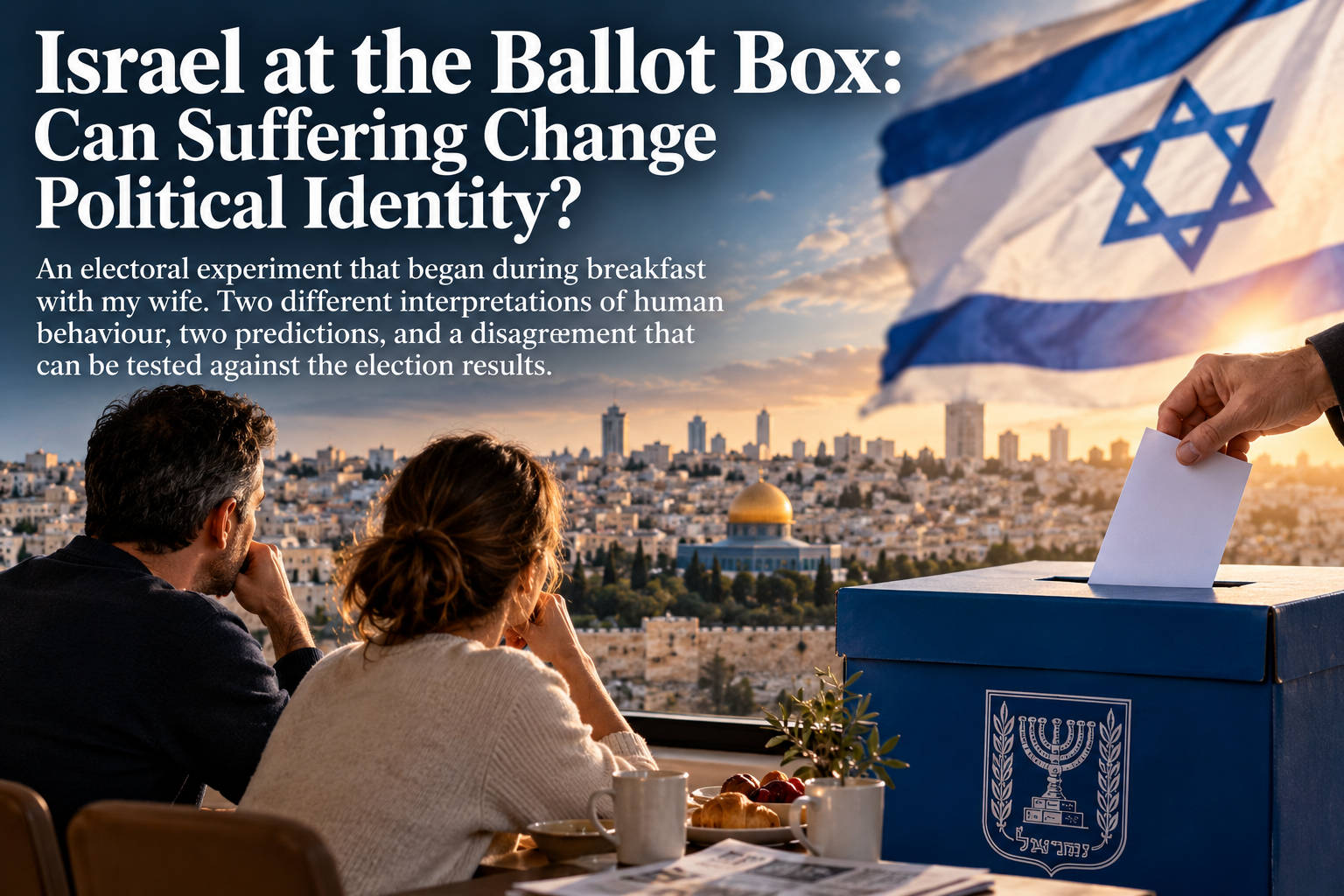
An electoral experiment that began over breakfast with my wife: two different interpretations of human behaviour, two predictions, and a disagreement that can be tested against the election results.
The conversation began over breakfast because my wife and I were listening to the news about Israel and the forthcoming elections. We remembered two positions we had heard the day before on Kan Reka, in Spanish: that some voters were hiding their real opinions, or did not want to state them to the pollsters, and that others held firmly established political preferences and did not change them. We were looking at the same political situation, but my interest had moved to a question that went beyond which party would win.
After everything Israeli society has experienced since 7 October 2023, can we still assume that people will vote according to the political identities they held before the war? There are good reasons to think so, and others to doubt it. My thought was that experience can change consciousness, and that this change of consciousness can alter the vote.
We decided to examine two different interpretations: start from the same polling figures, develop two scenarios and compare them with the election results. The disagreement turned on how human beings respond to extreme experiences.
The Weight of Political Identity
The first interpretation gives considerable weight to the persistence of political identity. Political loyalty is rarely a matter of weighing a party programme and choosing the most convincing one. Family history, religion, community and personal convictions shape the way people vote, as do their perceptions of security, and over time those loyalties can become part of a person’s identity. In Israel this is especially relevant, since questions of security, national survival and political leadership are closely connected.
A voter can be deeply dissatisfied with a government and still support it, because the alternative may appear less trustworthy, less familiar or less capable of providing protection. A national catastrophe does not necessarily weaken these loyalties. Fear can strengthen them. People who feel threatened may become more attached to the leaders, parties or political traditions that have long represented stability to them, even when those leaders have made serious mistakes. From this perspective, war may have less dramatic electoral consequences than expected.
That argument is psychologically plausible: human beings do not abandon deeply held convictions simply because circumstances change. I see a problem, though, in relying too heavily on that principle. If we always assume that political identity will survive a crisis, how will we recognise the moment when it no longer does?
My Interpretation: Experience Can Change Consciousness
My starting point is different, though I agree that political identities resist rational argument. People can listen to criticism for years without changing their convictions, and they may recognise mistakes and contradictions while continuing to support the same political leaders.
An argument and a personal experience need not have the same effect. Knowing that something terrible has happened is profoundly different from having that event enter your own life. The death of someone close, the destruction of a home, persistent fear or the feeling that those responsible for providing security have failed can change the way a person understands reality. A political leader who once represented protection may no longer mean that to them, and a conviction that once seemed unquestionable may suddenly become difficult to maintain.
This kind of change interests me because conventional political analysis may underestimate it. A person does not necessarily change because someone has finally presented a better argument; sometimes experience changes the meaning of arguments the person had previously rejected. If enough individuals undergo such a transformation, the consequences may become visible in an election.
My hypothesis is narrower than the claim that every person affected by war will turn against the government; some may move in the opposite direction, demanding stronger leadership and more aggressive security policies. The number of people whose political loyalties have been altered by personal suffering may be large enough to affect the electoral result substantially, and that is what I want to test.
Turning Two Interpretations into Numbers
To make the disagreement measurable, we constructed two scenarios from the same starting distribution of 120 Knesset seats. The baseline below is the working polling average for our experiment, and it should not be confused with an independently verified, current average of all Israeli polling institutes.
My wife’s scenario represents the persistence of established political loyalties, including the possibility that support for Netanyahu’s traditional bloc is underestimated. Mine assumes that the psychological consequences of the war could produce a larger shift towards selected opposition parties. The complete comparison follows.
| Party | Polling baseline | My wife: continuity | My scenario: transformation |
|---|---|---|---|
| Likud | 23 | 25 | 21 |
| Eisenkot | 22 | 20 | 24 |
| Bennett | 12 | 11 | 13 |
| Democrats | 10 | 10 | 11 |
| Yisrael Beiteinu | 8 | 8 | 8 |
| Otzma Yehudit | 8 | 9 | 7 |
| Shas | 8 | 9 | 8 |
| United Torah Judaism | 8 | 9 | 8 |
| Religious Zionism | 7 | 7 | 6 |
| Joint Arab List | 8 | 7 | 8 |
| Ra’am | 6 | 5 | 6 |
| Total | 120 | 120 | 120 |
For this experiment I define the Netanyahu bloc as Likud, Shas, United Torah Judaism, Otzma Yehudit and Religious Zionism. The grouping is analytical, based on their traditional political alignment; it does not claim that every party has formally committed to joining a future Netanyahu government. The non-Arab opposition consists of Eisenkot, Bennett, the Democrats and Yisrael Beiteinu, while the Joint Arab List and Ra’am are counted separately. With these definitions, the bloc estimates are:
| Electoral bloc | Polling baseline | My wife | My scenario |
|---|---|---|---|
| Netanyahu bloc | 54 | 59 | 50 |
| Non-Arab opposition | 52 | 49 | 56 |
| Arab parties | 14 | 12 | 14 |
Our two estimates for Netanyahu’s bloc differ by nine seats. For my wife, the bloc reaches 59 and Likud remains the largest party, with 25 seats. In my scenario the bloc falls to 50, and it is Eisenkot, with 24 seats, that becomes the largest party. Neither scenario gives the non-Arab opposition an automatic majority of 61 seats: winning more seats and forming a government are separate questions.
Where the Eleven Per Cent Comes From
My scenario applies an adjustment factor of eleven per cent to the original polling baseline. The assumption is that war-related psychological disruption may reduce support for Likud, Otzma Yehudit and Religious Zionism, and increase it for Eisenkot, Bennett and the Democrats. The baseline of the three parties assumed to lose support is multiplied by 0.89, that of the three assumed to gain support by 1.11, and the other parties remain unchanged at this stage.
These calculations produce fractional seat values and a total slightly above 120, so the values are normalised back to 120 seats and allocated as whole numbers by the largest-remainder method. Likud, for example, begins at 23 seats; the factor gives 20.47 before normalisation and approximately 20.36 afterwards, which the allocation method turns into 21 seats. Eisenkot rises from 22 to 24.42 before normalisation, to approximately 24.29 afterwards, and to 24 seats in the final scenario.
The eleven per cent is applied to the original baseline, not to my wife’s estimate. Her scenario rests on a different method, a judgment-based allocation reflecting stronger support for the traditional governing bloc, with no equivalent uniform adjustment factor. Our comparison is therefore a contest between two explicit forecasts, not a controlled experiment in which only one parameter changes.
Israel’s electoral system adds a limitation: a party must receive at least 3.25 per cent of the valid national vote to qualify for Knesset representation, so smaller parties can have a disproportionate effect on the final distribution of seats if they fail to cross the threshold.
Our model assumes that every party listed in the table qualifies for representation, and it does not calculate the probability that any particular list will fail to cross the threshold. If one does, the resulting redistribution of seats could affect both predictions. We will consider that risk when evaluating the final results, but it will not be used to rewrite the original estimates.
The Most Difficult Part of My Hypothesis
My eleven per cent assumption is inspired by the possibility that a very large number of Israelis have experienced serious psychological consequences from the war. A hypothetical one million affected people in a population of roughly nine million would amount to approximately eleven per cent. But this is where I have to be particularly careful.
Suffering because of war, changing one’s political convictions and changing one’s vote are three different events, and one does not automatically lead to the next. Not everyone affected by the war is eligible to vote. Some may already have opposed Netanyahu, others may have strengthened their support for him, and existing polls may also reflect changes that occurred after 7 October. Nor should we confuse psychological distress with a confirmed clinical diagnosis of post-traumatic stress disorder.
The figure of one million affected people is not established here as a verified clinical statistic, and the eleven per cent is a modelling assumption, not a measured electoral effect. The psychological mechanism may exist without producing the electoral shift I have estimated, or the shift may exist but be smaller, and no amount of more precise calculation can remove that uncertainty. I am willing to leave it visible, because otherwise the prediction would lose its meaning as a test.
What Would Count as Being Right?
We have fixed both scenarios before the election on 27 October 2026, which allows us to evaluate them without adjusting the numbers after the result is known.
The main measure will be the absolute error in the number of seats won by Netanyahu’s bloc, using the five-party definition stated above. My wife predicts 59 seats and I predict 50. If the bloc wins 55 seats or more, my wife’s estimate will be closer; if it wins 54 or fewer, mine will be closer.
We will also compare the total absolute error across the eleven party estimates, adding up the absolute difference between each predicted seat count and the actual result; the lower total indicates the more accurate party-level forecast. If electoral lists merge, withdraw or fail to qualify, we will document how the original categories correspond to the final results. The official seat allocation remains the reference point, and we will not redistribute our predicted seats retrospectively to improve either forecast. The primary bloc comparison remains our simplest test.
The election can test our estimates, but on its own it cannot reveal every cause behind the result. A closer numerical forecast will not automatically prove the psychological theory behind it. If my prediction performs better, that will not establish that trauma caused the movement of votes, since other factors may have contributed, including turnout, campaign events, leadership changes or voters’ evaluations of economic and security policy. To examine the psychological explanation itself, we would need evidence about how individual voters changed their preferences and why.
What Our Disagreement Reveals
What interests me most about our breakfast conversation is the difference between the questions behind our predictions. One asks why people remain loyal to their political identities even after severe crises; the other asks what kind of experience might finally make those identities change.
I do not think either question can be dismissed. The persistence of identity is a powerful feature of human behaviour, and so is the capacity of experience to transform consciousness. Both may be operating within Israeli society at the same time: some citizens may have emerged from the war more attached to their previous convictions, others may have begun questioning assumptions they once considered permanent. We do not yet know the relative size of these groups, or how their experiences will translate into votes.
I suspect that understanding political change requires closer attention to the difference between information and experience. People can know something intellectually without allowing that knowledge to alter their lives, whereas an experience can sometimes cross a boundary that years of argument never managed to cross, and it would be a mistake to assume either that this always happens or that it never does.
After the Election
On 27 October, Israeli voters will provide the results against which our two estimates can be measured. My wife expects Netanyahu’s bloc to win 59 seats, with Likud as the largest party; I expect 50, with Eisenkot as the largest. Perhaps my wife will be closer. Perhaps I will.
The value of our experiment does not depend entirely on who gets the numbers right; the outcome may also expose weaknesses in both interpretations. Knowledge of the past allows us to recognise patterns in human behaviour, and without it prediction would be little more than speculation. Yet those same patterns can become an obstacle if we assume they must continue indefinitely.
What began as a conversation with my wife over breakfast will now be tested against reality: the figures are fixed, the assumptions are visible and the criteria for judging them were established before the vote. I believe personal experience can sometimes change consciousness more deeply than any rational argument, and whether that has happened on a large enough scale in Israel to alter this election remains an open question.