Geopolitical Analyst: Bridging Somaliland & Israel to the world
Israel Comes to Hargeisa as Somaliland Opponents Close Ranks
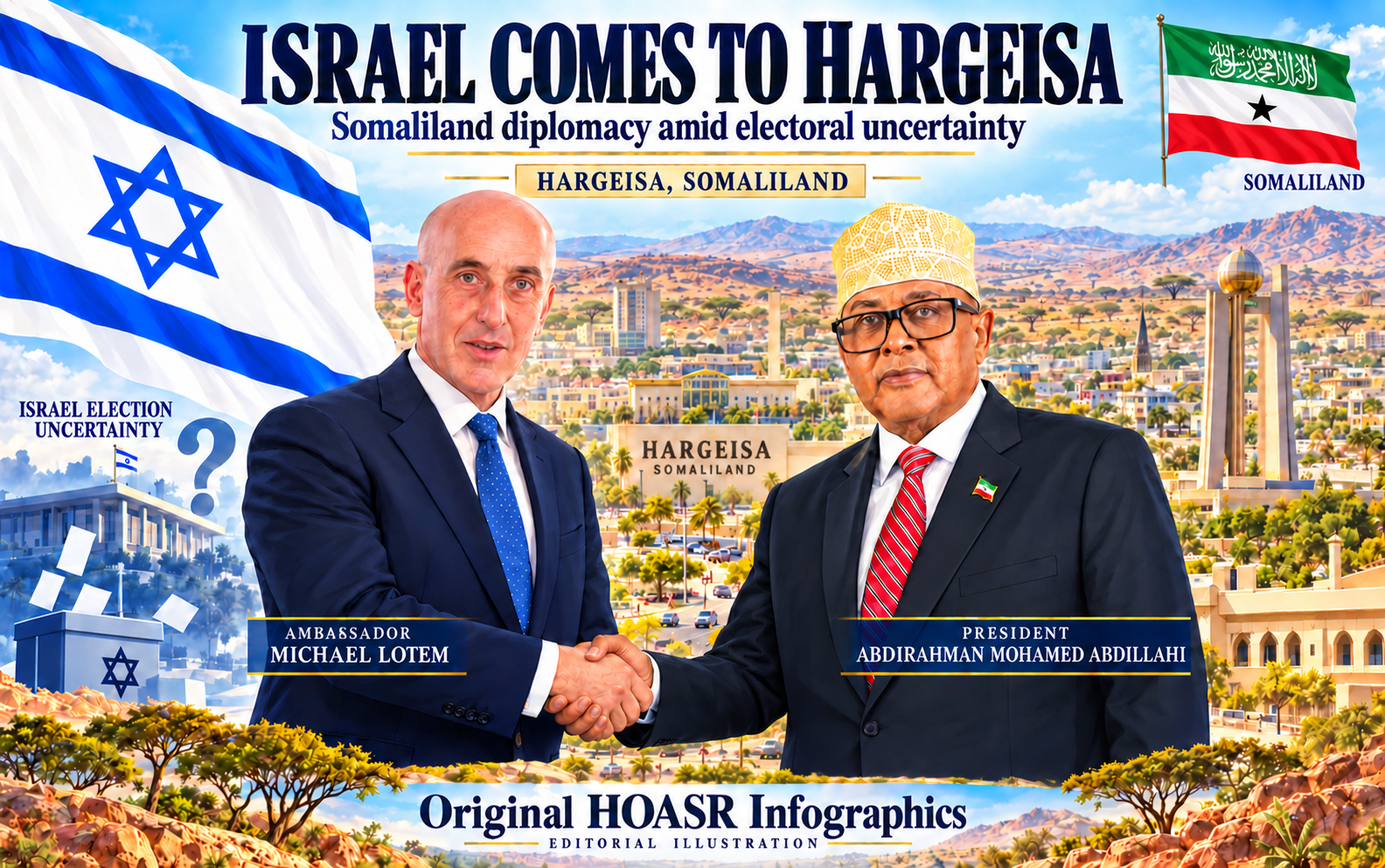
Ambassador Michael Lotem and President Irro depicted in Hargeisa against a backdrop of Israeli electoral uncertainty. Editorial illustration. Credit: HOASR Infographics
Israel’s first ambassador to Somaliland has arrived in Hargeisa at a moment when the country’s opponents are working openly to restrict its diplomatic advance. The visit comes immediately after an inconclusive Israeli election, amid continuing Red Sea insecurity and a dangerous war in Ethiopia with mounting regional implications.
The visit’s strongest message is persistence: Israel is proceeding with the practical work of its Somaliland relationship while the surrounding political environment becomes more difficult. For President Abdirahman Mohamed Abdillahi “Irro,” that gives substance to a partnership whose durability is now being tested.
Qaran News reported on 30 October that Ambassador Michael Lotem had arrived to present his credentials and attend a groundbreaking ceremony for an Israeli embassy. The Somaliland presidential agenda also listed a credentials presentation for that date.
At the time of writing, a completed official account identifying the accompanying delegation and detailing any security agreements remains unavailable in the sources reviewed. Nevertheless, the visit provides substantial grounds for examining the direction of the relationship, while its precise outcomes await confirmation.
Recognition Acquires a Working Presence
Lotem’s appointment was publicly announced in April, months after Israel recognized Somaliland in December 2025. His October arrival belongs to the implementation of that decision.
Accreditation establishes an envoy’s formal relationship with the receiving government, while a functioning embassy supplies the people and procedures through which political decisions continue to work. In Somaliland’s circumstances, those ordinary diplomatic arrangements carry unusual political weight.
For decades, Somaliland’s external engagement has depended heavily on representative offices, special arrangements and relationships conducted beneath the level of formal recognition. Israel’s engagement gives Hargeisa a bilateral relationship in which its government is treated as the sovereign counterpart.
A permanent embassy would give that position an institutional home and make future cooperation easier to organize. It would also create commitments that a subsequent Israeli government would have to weigh before contemplating any reversal.
Yet, that does not settle Somaliland’s wider international status. It does, however, demonstrate a diplomatic strategy built around bypassing Mogadishu’s demand that every foreign government defer engagement until Mogadishu agrees.
Israel has already chosen a different course. Each implemented step gives Somaliland additional evidence that external opposition, however extensive, has failed to prevent this relationship from developing.
An Unsettled Israeli Election Tests Continuity
The electoral timing deserves close attention. Israel voted on 27 October, and the results published on 30 October left Netanyahu’s bloc with 53 seats, the opposition bloc with 48 and Arab-led parties with 19.
Neither principal bloc secured a governing majority. Lotem’s reported arrival therefore coincided with uncertainty over the composition of Israel’s next government.
Proceeding with the visit during that uncertainty is reassuring for Hargeisa because it shows diplomatic implementation continuing through domestic political turbulence. Recognition has acquired an ambassador and an announced embassy programme, giving the relationship momentum beyond a single public declaration.
There is still insufficient evidence to claim that all prospective Israeli governing parties share an identical Somaliland policy. Sustained engagement after government formation would provide a stronger test of that durability.
The timing can also be read as establishing further commitments before a possible political transition. An operating mission, trained personnel and ongoing projects would all raise the practical cost of retreat.
Yet no public evidence establishes that the date was deliberately selected to shape the election aftermath or pre-empt a successor government. The defensible finding is that implementation continued during uncertainty; the intentions behind the precise schedule remain undisclosed.
El Alamein Exposed the Contest Over Participation
The clearest regional backdrop is the El-Alamein declaration of 4 October. Egypt, Eritrea, Somalia and Sudan explicitly rejected recognition of, or support for, Somaliland. Their declaration also asserted that governance of the Red Sea was the exclusive responsibility of coastal states.
Opposition to Somaliland’s diplomatic standing and an effort to define participation in maritime affairs appeared together in the same document.
That combination reveals a struggle over who may help shape the regional order. Somaliland’s location makes its cooperation attractive to external partners, while denial of its statehood provides an argument for excluding it from arrangements concerning its own coastline.
Israel’s continuing engagement challenges that exclusion through direct dealings with Hargeisa. The visit’s political effect is therefore intelligible even without assuming a new military agreement.
China and Djibouti reinforced the pressure later in October. Their joint position opposed Somaliland recognition and Somaliland–Taiwan cooperation, while China’s official account of the accompanying talks emphasized Djibouti’s logistics role and railway connectivity with Ethiopia.
Lotem’s subsequent arrival shows that these objections have not stopped the Israeli relationship. Although it does not prove that the visit was scheduled as a direct response to Beijing, the sequence is politically significant.
Pressure Reaches the Commercial Systems
Diplomatic exclusion becomes materially consequential when it affects the systems through which people travel and businesses operate. Somaliland’s 25 October aviation directive rejected tickets issued through Somalia’s Billing and Settlement Plan (BSP) for departures from Hargeisa and Berbera.
It also required airlines to work through authorized channels and agents meeting Somaliland’s licensing rules. The dispute carries competing claims of jurisdiction into commercial transactions and passenger arrangements.
The e-visa problem reveals a related vulnerability. British travel guidance acknowledges that passengers travelling to Hargeisa may be asked for Somalia’s e-visa before boarding, although Somaliland does not accept it for entry.
International systems can therefore transmit Mogadishu’s claims into travels to a territory it does not control and administer. Administrative recognition can produce practical influence even where territorial control is absent.
An Israeli embassy could help Hargeisa develop direct bilateral procedures and provide a regular channel for commercial problem-solving. Lotem’s background in economic and energy diplomacy is relevant to that possibility. But accreditation alone does not create banking relationships, export insurance or investment finance.
Financial significance will emerge through funded projects and workable transactions, while the evidence presently supports a narrower finding of diplomatic pressure and contested administrative authority rather than a comprehensive, coordinated financial blockade.
Red Sea Security Gives Partnership Strategic Value
The security rationale was publicly established before the election. During Irro’s June state visit, President Isaac Herzog identified maritime freedom and regional stability as shared interests. Somaliland’s Gulf of Aden coastline places it close to the approaches to Bab el-Mandeb and across the water from Yemen.
Continuing insecurity gives practical weight to cooperation involving maritime awareness, logistics and the protection of commercial movement.
There is already documented security cooperation. In June, Somaliland’s defense minister told Reuters that Israel was training police and military personnel, while denying that negotiations over an Israeli military base were underway at that time. That provides a concrete foundation for further discussions. It does not establish what the October delegation agreed or whether any new deployment has been authorized.
Strategic assessments point in different directions. IISS examined how potential access to Somaliland facilities could broaden Israel’s military options, while a joint INSS–ISIR analysis warned that military exposure could increase retaliation and regional backlash.
Both considerations belong to an assessment of Somaliland’s position. A closer relationship can increase the value partners attach to its security while also attracting greater, hostile attention.
Ethiopia Makes the Stakes More Dangerous
Ethiopia’s war sharpens that tension. Reuters reported on 30 October that drone strikes killed at least 15 people at a displacement camp in Amhara, with responsibility unclear. Earlier that month, Ethiopia alleged an Eritrean incursion, while Eritrea rejected the accusations and sought Security Council action. These contested claims sit within an increasingly dangerous regional confrontation.
For Somaliland, instability in Ethiopia creates an uncomfortable economic and strategic combination. Dependable coastal infrastructure becomes more desirable as other routes and relationships face pressure.
At the same time, war threatens the commercial demand and reliable inland movement on which the Berbera corridor depends. Greater strategic interest in a port can coexist with worsening conditions for the businesses expected to use it.
Israel’s engagement gives Somaliland another consequential external relationship during a period of pressure on Ethiopia. The partnership does strengthen Hargeisa’s room for maneuver, but it does not establish that Somaliland has joined Ethiopia’s war. Reuters’ analysis of the regional conflict describes overlapping rivalries and fluid relationships rather than a single disciplined alliance.
The Message Travels Beyond Mogadishu
Mogadishu can read the visit as evidence that its objections have failed to prevent Israel from dealing directly with Hargeisa. Egypt and Eritrea can see a partnership advancing outside their preferred regional framework, while Türkiye faces another external actor cultivating a relationship with Somaliland alongside its own close engagement with Somalia.
China and Djibouti can see that their public position has not secured compliance from Israel. These are plausible geopolitical readings of the visit’s effect, rather than verified accounts of private deliberations in those capitals.
For other international actors, the visit offers evidence of a relationship surviving a difficult environment. Governments may find it easier to expand practical engagement when another state maintains an established diplomatic channel.
Businesses may benefit from regular official contact, provided security and payment arrangements remain workable. Neither result follows automatically, and one functioning relationship cannot be assumed to produce a chain of recognition.
Pressure can also produce unintended consequences. Efforts to narrow Somaliland’s choices may increase the value it attaches to partners prepared to sustain direct relations. Those partners may then acquire greater influence as alternatives become harder to access. Somaliland gains from reliable engagement, while concentration of its external options carries the dependence risk identified in RUSI’s analysis of selective recognition.
The Scoop
The central finding is that diplomatic opposition and diplomatic implementation are advancing simultaneously. Regional declarations seek to deny Somaliland an independent place in the emerging order, while Israel continues building the bilateral machinery through which it can participate.
Ambassador Lotem’s arrival in Hargeisa makes that divergence visible at a moment of Israeli political uncertainty. Its significance rests on the decision to proceed under pressure.
The deeper contest concerns Somaliland’s capacity to sustain relationships that others are trying to constrain. An embassy, if established and staffed, would make exclusion harder to enforce in that bilateral relationship.
Subsequent security programmes and economic agreements would give the commitment further substance, with their value measured by what is delivered. The implicit message reaching Somaliland’s opponents is that their objections have raised the costs of engagement without stopping Israel from coming to Hargeisa, Somaliland.
Related Topics
Related Posts