Beyond Recognition: What Israel and Somaliland Must Build Next
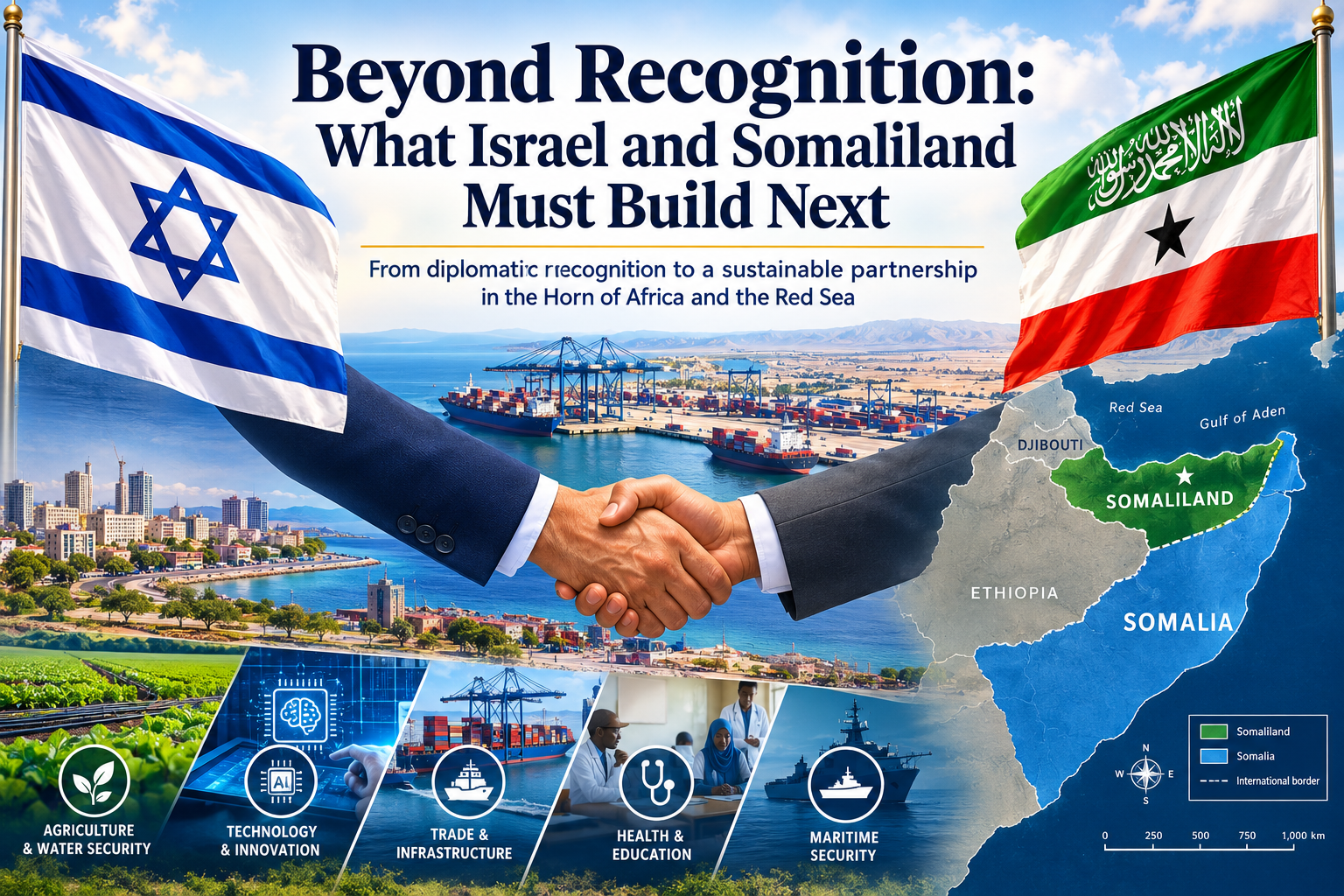
From diplomatic recognition to a sustainable partnership in the Horn of Africa and the Red Sea
The recognition of Somaliland by Israel on December 26, 2025, marked a significant development in the diplomatic landscape of the Horn of Africa and the wider Middle East. For Somaliland, which has maintained its own political institutions, security structures, and system of governance since restoring its independence in 1991, the decision represented an important milestone in its long pursuit of international recognition. For Israel, it opened a new diplomatic relationship in a region whose geographical position, maritime routes, and evolving security environment have become increasingly important to international affairs. Yet diplomatic recognition, significant as it may be, should not be viewed as the final achievement. It should be understood as the beginning of a more demanding process: building a practical, sustainable, and mutually beneficial partnership.
The diplomatic relationship has already moved beyond its initial announcement. In January 2026, Israeli Foreign Minister Gideon Sa’ar visited Hargeisa, demonstrating the intention of both governments to advance bilateral engagement. In June 2026, Somaliland President Abdirahman Mohamed Abdullahi made his first state visit to Israel, where he was received at the Knesset. Somaliland also opened its embassy in Jerusalem during the visit. These developments established an important diplomatic foundation. However, the long-term significance of this relationship will depend less on the symbolism of official ceremonies and more on the institutions, agreements, and practical projects that follow.
One of the most important areas for cooperation is economic development. Somaliland occupies a strategic geographical position along the Gulf of Aden, close to one of the world’s most important maritime corridors connecting the Red Sea with the Indian Ocean. Its coastline, the Port of Berbera, and its proximity to major international shipping routes offer opportunities for trade, logistics, infrastructure development, and regional economic integration. Israel, meanwhile, has experience in technological innovation, agricultural development, water management, medical research, and entrepreneurship. A structured partnership could connect these capabilities with Somaliland’s development priorities, creating opportunities that extend beyond diplomatic relations.
Agriculture and water security should be among the earliest priorities. Somaliland faces persistent challenges related to water scarcity, climate variability, land degradation, and food security. Israeli expertise in drip irrigation, water recycling, desalination, agricultural technology, and efficient water management could contribute to addressing some of these challenges. Cooperation should focus on practical initiatives, including demonstration farms, technical training, research partnerships, and technology transfer. Such projects would be particularly valuable if they reach rural communities, farmers, and pastoralist populations rather than remaining limited to government institutions or major commercial centres.
Technology and human capital development represent another important dimension of the relationship. Somaliland’s young population requires greater access to education, professional training, innovation, and employment opportunities. Israel’s experience in technology-driven entrepreneurship and research could provide opportunities for cooperation in digital governance, cybersecurity, information technology, healthcare innovation, and higher education. Joint training programmes, university partnerships, professional exchanges, and private-sector investment could help strengthen Somaliland’s institutional capacity while creating opportunities for a new generation of skilled professionals. The objective should not simply be to introduce foreign technology, but to develop local expertise capable of maintaining, adapting, and expanding it.
Maritime security is equally important. The Red Sea and the Gulf of Aden are not merely geographical spaces; they are strategic corridors through which international trade, energy supplies, and commercial shipping move between continents. Developments around the Bab al-Mandab Strait have demonstrated how regional instability can affect global economic activity. Piracy, armed conflict, attacks on commercial shipping, and geopolitical competition have made maritime security a shared international concern. Somaliland’s geographical position gives it a relevant place in discussions about the security of these waters. Nevertheless, any cooperation in this field should be transparent, consistent with international law, and focused on legitimate maritime security objectives, including search and rescue, information-sharing, port security, and the protection of commercial navigation.
For Israel, a constructive relationship with Somaliland could contribute to broader engagement with African states and strengthen its diplomatic presence along an important maritime corridor. For Somaliland, engagement with Israel could provide access to technological knowledge, investment opportunities, diplomatic experience, and new channels of international cooperation. These interests are not necessarily identical, and they do not need to be. A successful partnership requires both sides to understand their respective priorities and establish clear areas of common interest. Mutual benefit, rather than strategic symbolism alone, should remain the guiding principle.
However, the relationship must also be managed within a complex regional political environment. Several regional and international actors, including Türkiye, Egypt, the African Union, and the European Union, have raised concerns about the implications of the recognition for Somalia’s territorial integrity and regional stability. The United Nations has also emphasized the importance of peaceful and constructive dialogue between Somaliland and Somalia. These positions reflect a wider diplomatic disagreement that neither government can simply ignore.
For Somaliland, the challenge is to expand its international engagement without allowing its diplomatic relationships to become a source of unnecessary regional confrontation. Its foreign policy should remain grounded in peaceful coexistence, respect for international law, economic development, and constructive relations with neighbouring countries. Engagement with Israel should not be presented as a substitute for relations with Africa, the Arab world, or other international partners. Instead, it should form part of a broader and more diversified diplomatic strategy. Maintaining channels of communication with neighbouring states and international institutions will be essential to reducing misunderstandings and preventing political tensions from undermining economic opportunities.
Israel also has an interest in ensuring that its relationship with Somaliland contributes to regional stability rather than intensifying existing divisions. Diplomatic recognition creates expectations, but it also creates responsibilities. A relationship built exclusively around security considerations would risk overlooking the economic and social opportunities that make long-term partnerships meaningful. By prioritizing development, education, health, agriculture, technology, and transparent economic cooperation, both sides can demonstrate that their engagement offers benefits to ordinary citizens.
The Abraham Accords framework, which was referenced in the joint declaration accompanying the recognition, could also provide a diplomatic context for broader engagement. However, its significance should be measured by practical cooperation rather than political language alone. Somaliland’s interest in expanding its international partnerships and Israel’s interest in developing relations across Africa and the Middle East could create opportunities for cooperation involving trade, innovation, education, and regional connectivity. Such engagement should remain consistent with international law and should not come at the expense of the rights, dignity, or legitimate aspirations of other peoples in the region.
Ultimately, the future of Israel–Somaliland relations will depend on the ability of both governments to translate diplomatic goodwill into measurable outcomes. This requires a clear bilateral cooperation framework, regular diplomatic consultations, investment protections, institutional partnerships, and projects with realistic objectives and timelines. It also requires transparency about the nature of cooperation, particularly in sensitive areas such as security and strategic infrastructure.
Somaliland must approach this new diplomatic opportunity with strategic patience and institutional preparedness. Recognition can open doors, but it cannot independently create prosperity, strengthen public institutions, or guarantee international acceptance. Those achievements require effective governance, economic reform, professional diplomacy, and the ability to build constructive relationships with a diverse range of international partners. Israel, for its part, has an opportunity to demonstrate that its engagement with Somaliland can contribute to development and stability in a region of considerable strategic importance.
The central question, therefore, is no longer simply whether Israel has recognized Somaliland. That historic decision has already been made. The more important question is what both sides intend to build from it. A successful partnership will not be measured by the number of diplomatic ceremonies, official statements, or political declarations, but by the opportunities it creates, the institutions it strengthens, the economic value it generates, and the contribution it makes to regional stability.
Recognition opened the diplomatic door. What matters now is what Israel and Somaliland choose to build together beyond it.