
Israel Is Committing Suicide by Tyranny of the Majority
The next election might be the last one.
Israel has no written constitution, and it is about to find out what that omission actually costs. A government commanding a Knesset majority in a system without a constitutional ceiling is not merely powerful — it is, in principle, unlimited, restrained only by whatever independence the judiciary is still permitted to exercise. Remove that restraint, and there is no remaining mechanism, none, standing between a ruling majority and whatever it wishes to legislate. That is not a metaphorical death. It is the literal removal of the only backstop a constitutionless democracy has against becoming something else entirely.
The Likud-led coalition has spent years working to remove exactly that backstop, subordinating the judiciary to the majority that appoints and directs it rather than leaving it as a check upon that majority. That alone would be a form of national suicide. What makes it worse — what makes it certain rather than merely risked — is that the man leading this coalition has shown, repeatedly and without much concealment, that he will pay almost any price in extremist concessions to keep his majority intact. Between the two — a judiciary being fitted for a leash, and a prime minister willing to hand that leash to whoever will keep him in office — Israel is not flirting with self-destruction. It is carrying it out, by majority vote, with the full procedural legitimacy that makes the act so hard for many of its own participants to recognize as what it is.
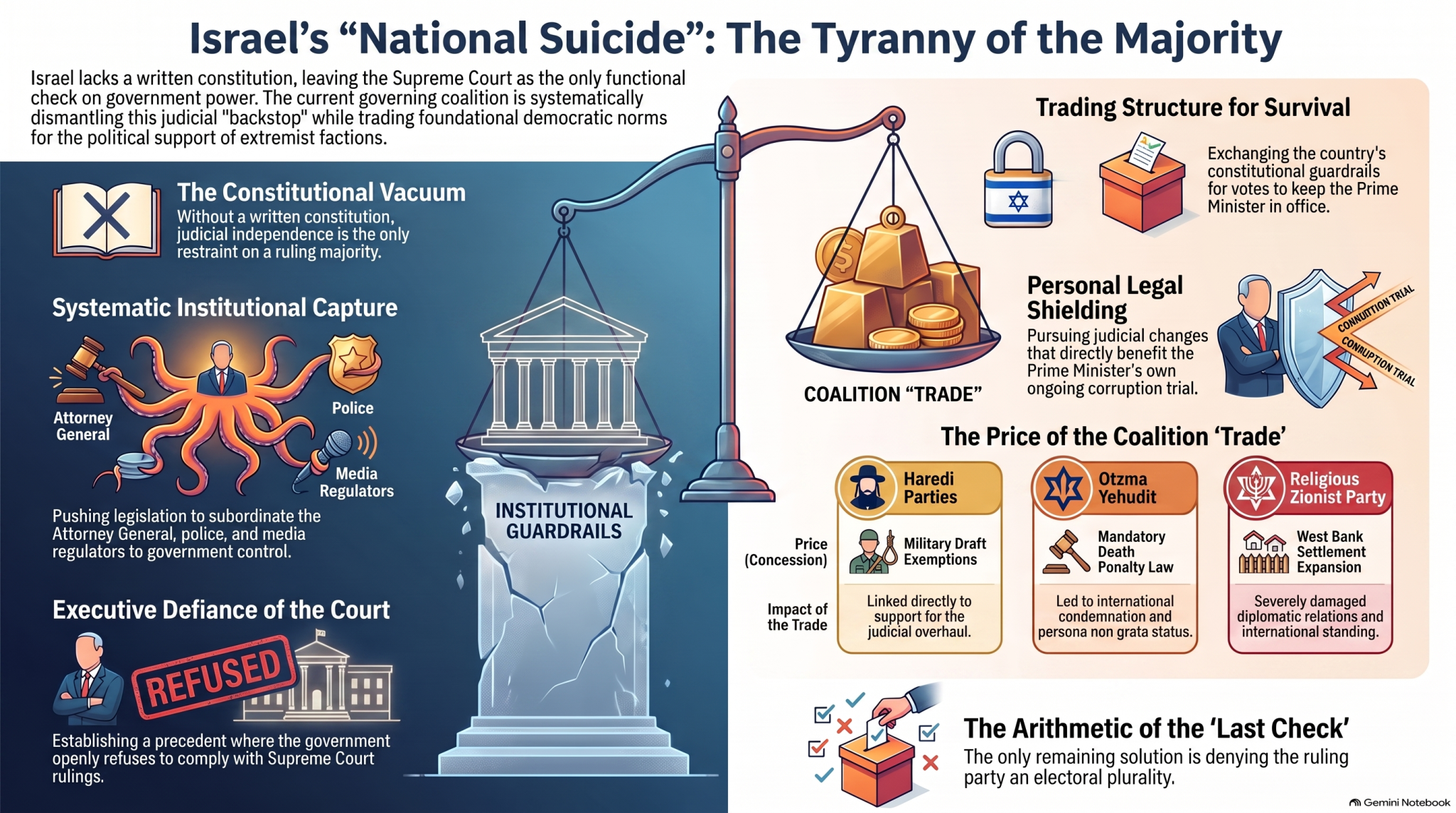
Start with the mechanism, because it is the part too often lost in the noise of any single week’s headlines. A judiciary’s independence is not a courtesy extended to it by the government of the day. It is the only thing, in a country with no constitution to appeal to, standing between “the majority has decided” and “the majority may do anything at all.” Britain manages without a single written constitutional document because it has centuries of unwritten constraint, precedent, and institutional culture holding the same weight; Israel, a much younger state built amid existential threat and constant political turnover, never developed anything comparable, and instead relied on the Supreme Court’s willingness to review legislation and executive action against the Basic Laws as its functional substitute. That substitute has been the target of the current coalition’s judicial overhaul program since it took office — bills to split and neutralize the office of the attorney general, who serves as the government’s own legal watchdog; legislation to bring the broadcasting regulator under direct political control, aimed in no small part at blocking a sale of a television channel seen as critical of the prime minister; a bill subordinating the police’s internal affairs unit to the justice minister rather than leaving it independent of the officials it might need to investigate. None of these, individually, reads as the end of a country. Together, pushed by the same governing majority in the same term, they describe a single project: making every institution capable of checking the government answerable instead to the government.
The clearest single moment came this past summer, when the government did something it had never done before in the history of the state: it said openly that it would not comply with a Supreme Court ruling. Whatever the technical merits of the underlying dispute, the significance of that moment has nothing to do with the specific case and everything to do with what it establishes as a precedent — an executive branch declaring itself, for the first time, not bound by the judiciary’s authority to say what the law requires. Once a government has said this once, it has said it permanently; the claim does not need to be repeated to remain available. That is not incremental erosion anymore. That is the wall being tested to see whether it is load-bearing, in public, on purpose.
It would be one thing if this were simply a governing majority pursuing its agenda within a system still capable of checking it. It is another thing entirely when the very agenda is the removal of the check, because at that point majority rule stops being one input into a democratic system and becomes the whole of it — unaccountable to anything outside itself, including the next majority that might disagree. This is worth stating plainly rather than delicately: a government that captures the referee is not competing anymore. It is deciding, alone, whether there will be a next match at all.
And this is where the second half of the argument becomes unavoidable, because the judicial overhaul alone, serious as it is, does not fully explain why this particular moment reads as terminal rather than merely dangerous. The other half is Benjamin Netanyahu’s own conduct in assembling and preserving his coalition. A prime minister facing a fragmented electorate has to build a majority somehow, and coalition compromise is not itself a scandal — it is ordinary parliamentary life. What is not ordinary is the specific pattern of what has been paid, and to whom, to keep this particular coalition together. To secure Haredi parties whose leaders’ central demand is exemption from military service at a moment of genuine manpower strain on the IDF, the coalition has tied draft-exemption arrangements directly to those parties’ support for the judicial overhaul itself — a straightforward transaction in which the country’s constitutional structure is being traded for votes. To secure Otzma Yehudit’s Itamar Ben-Gvir, the coalition delivered a mandatory death penalty law aimed at terror offenses and oversaw a marked hardening of prison conditions for Palestinian inmates, policies whose international reception has been severe enough that Ben-Gvir himself has been declared persona non grata by multiple European governments. To secure the Religious Zionist Party’s Bezalel Smotrich, the coalition has enabled a dramatic expansion of West Bank settlement activity, drawing the identical diplomatic response. And running underneath all of it is the plainest possible conflict of interest: several of the specific judicial changes under consideration would directly benefit Netanyahu’s own ongoing corruption trial and would allow the reinstatement of his ally Aryeh Deri to ministerial office despite Deri’s own criminal convictions. This is not a prime minister occasionally accommodating difficult partners to hold a government together. This is a prime minister who has demonstrated, across every major coalition decision of this era, that there is no policy position too extreme, no democratic norm too foundational, and no personal conflict of interest too glaring to trade away in exchange for the votes that keep him in office.
Put the two halves together and the picture sharpens considerably. A judiciary being fitted for subordination to the majority is dangerous on its own. A prime minister who has shown he will grant almost any demand to preserve his majority is dangerous on its own. But a coalition in which the second is actively purchasing the first — in which draft exemptions, a death penalty law, settlement expansion, and personal legal protection are all being paid for with the very constitutional guardrail that would otherwise exist to check a government willing to make such trades — is not two separate problems. It is one mechanism, and it has a name: tyranny of the majority, in its purest and most literal form, because the majority in question has arranged for nothing whatsoever to remain outside its own reach.
None of this requires believing the coalition’s voters, or even most of its leaders, intend national catastrophe. Almost no one who has ever dismantled a democratic check has believed, in the moment, that this is what they were doing. Each individual bill can be, and is, defended domestically as correcting an unaccountable judiciary, an unelected legal establishment, an entrenched elite that has substituted its own judgment for the people’s for too long — and it would be dishonest to pretend that Israel’s judiciary has never given its critics real material to work with. That defense is sincerely held by many who offer it. It is also, precisely, the defense every majority that has ever disabled its own system’s capacity for self-correction has offered, because that is what makes the disabling possible in the first place: it does not feel, from the inside, like an act against democracy. It feels like democracy, finally, unobstructed.
That is the suicide this piece’s title is not being dramatic about. A country does not need a foreign enemy to end its own democratic character. It needs only a majority large enough, and a leader willing enough, and a judiciary weak enough, and no constitution standing in the way of any of the three. Israel currently has all four conditions in place at once, and the fourth — the absence of a constitutional floor beneath any of this — is precisely why the first three are able to run as far as they have. A written constitution would not eliminate political conflict over the judiciary, the settlements, or Haredi conscription; Israel would still be having versions of these fights. But it would put a hard boundary around how far any single majority could go in each direction before running into a wall no ordinary legislative session could remove. Israel has never built that wall. It has instead trusted, for its entire history, in judicial independence and democratic norms to perform the wall’s function informally — and it is now watching a governing majority, assembled and held together by a prime minister for whom almost nothing appears to be off the table, dismantle the substitute it has always relied on in place of the real thing. That is not a policy dispute. It is the removal of the only thing that was ever standing between a majority and everything.
Which is why this argument cannot end at diagnosis. Israel goes to the polls with the outcome of this project still genuinely undecided, and the single fact that will decide it is arithmetic: Likud is the enabling party. Every element of what has been described here — the attorney-general split, the broadcasting bill, the police-independence bill, the government’s open defiance of the Supreme Court, the draft-exemption trade, the death penalty law, the settlement expansion, the personal legal shielding — required a governing majority organized around Likud and led by Netanyahu to exist at all. None of it is possible without that party at the center of the coalition math, because no other party currently commands the seats to build a government around itself instead. This is not, in the end, a case that can be settled by better arguments reaching the coalition’s leadership, because the leadership’s incentives are already fully explained by the pattern above: whatever keeps the majority intact, it will do. It can only be settled by the arithmetic changing.
That means the immediate, practical conclusion of everything argued here is electoral, not rhetorical: Likud must be denied a plurality in the coming election. Not defeated on some policy or other, not pressured into some further compromise it will abandon the moment the coalition math allows — denied the plurality that lets it credibly claim first right to form the next government at all. A Likud that leads the largest bloc retains the leverage to run this same trade again, with whichever partners the arithmetic requires next time, because the trade has worked before and nothing in this pattern suggests a fifth or sixth iteration would end differently from the first four. A Likud that is not the largest party loses that leverage structurally, regardless of what any individual member of it currently believes about the judiciary, the settlements, or the coalition partners it has spent this term accommodating. The vote is not a referendum on any single bill. It is the only mechanism left that can still change the incentive structure that has produced all of them — which makes it, in the most literal sense available in a country without a constitution, the last check remaining.