
CEO of Time to Stand Up for Israel
Israel Is Not America’s Charity Case
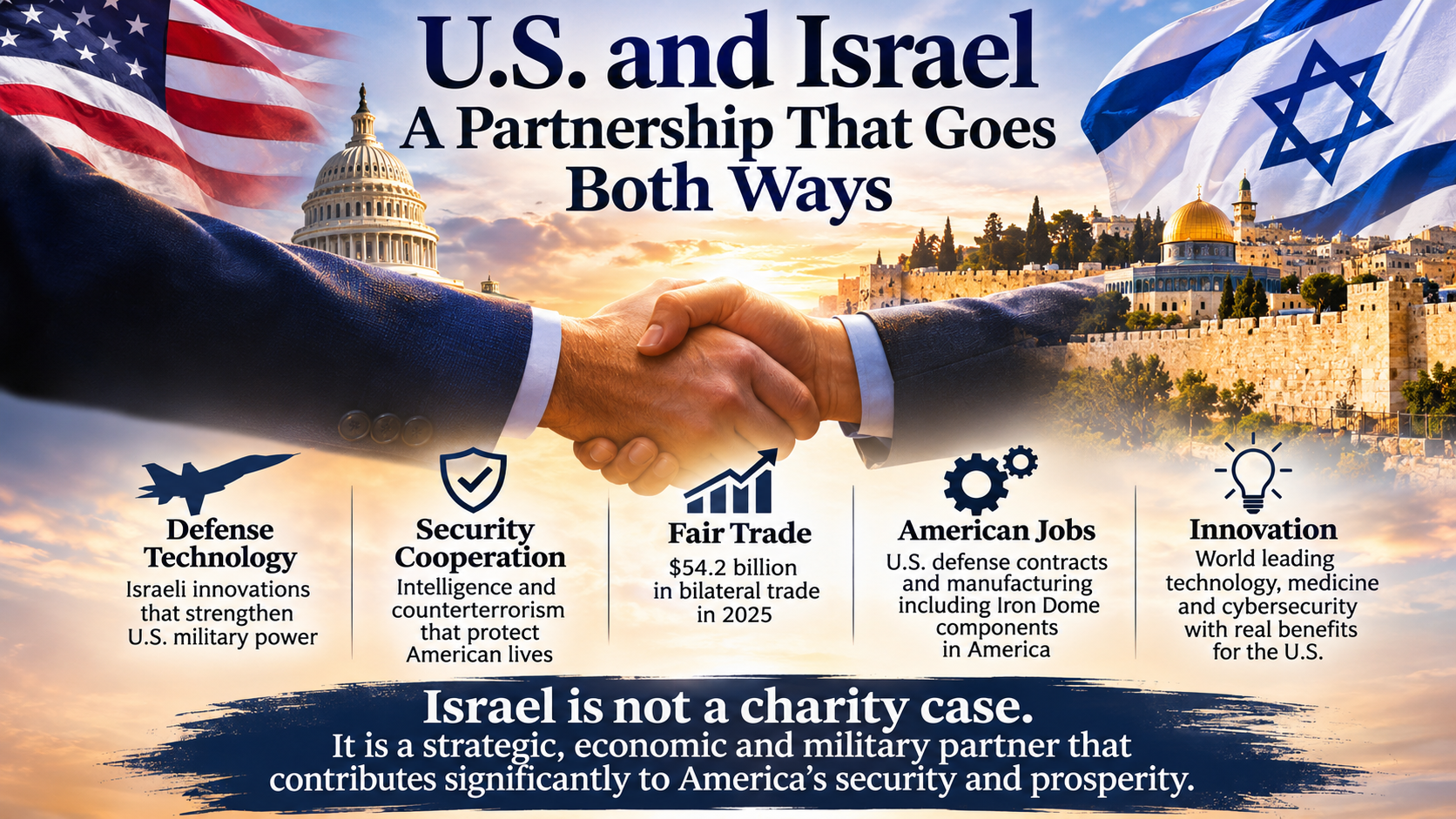
Photo Credits: Dabine Sterk ( AI)
Israel Is Not America’s Charity Case. It Is One of America’s Most Valuable Partners.
For decades, we have heard the same tiresome argument repeated whenever the United States provides military assistance to Israel. Why should American taxpayers pay billions of dollars to a foreign country? Why should Israel receive American money? Why should Americans finance Israeli security? And now, following President Donald Trump’s announcement that approximately $4 billion in annual military assistance to Israel will be discontinued, the debate has returned with renewed intensity. But there is one rather inconvenient detail that seems to escape many of those complaining about the money. The relationship between Israel and the United States has never been a one-way street. Israel is not some helpless country standing with its hand out, begging Washington for financial support. Israel is a highly developed technological, economic and military powerhouse that contributes enormously to American security, innovation and industry.
Let us begin with something that critics conveniently overlook. Under the existing military assistance agreement, most of the $3.3 billion in annual Foreign Military Financing must be spent purchasing American defense equipment. By 2028, the agreement requires that all of that financing be spent on American products. In other words, much of the money allocated to Israel flows directly into the American defense industry, supporting manufacturers, suppliers, engineers and employment throughout the United States. It is not simply money disappearing into an Israeli bank account. It is an arrangement that also benefits American companies. Does that mean every dollar returns to the American economy? Of course not. But portraying the entire amount as an American financial loss without acknowledging the economic activity it generates is intellectually dishonest.
And then there is the military relationship itself. Israel has developed extraordinary expertise in missile interception, intelligence gathering, cyber defense, unmanned systems and battlefield technology. Consider the Iron Dome missile defense system, developed by Israel’s Rafael Advanced Defense Systems, with American financial support and industrial cooperation. American companies participate in its production, while the United States has acquired Iron Dome batteries and benefited from cooperation on missile defense technologies. Israeli defense technology also contributes to American military capabilities through systems, components and joint development programs. The exchange is not charity. It is cooperation between two countries that possess valuable and complementary expertise.
Israel’s contribution extends far beyond weapons. American and Israeli security institutions cooperate on counterterrorism, intelligence and emerging threats. Israel operates in one of the world’s most challenging security environments, confronting missiles, drones, terrorism and hostile regional actors. Its operational experience provides lessons that can inform American military planning and technological development. Naturally, not every intelligence operation or security benefit can be publicly quantified, but pretending that the United States receives nothing of strategic value from this relationship is simply absurd.
Now consider the broader economic picture. According to the Office of the United States Trade Representative, bilateral trade in goods and services reached approximately $54.2 billion in 2025. American businesses export aircraft, machinery, technology, services and numerous other products to Israel, while Israeli companies supply American markets with advanced technology, pharmaceuticals, medical equipment and industrial products. American technology companies have invested extensively in Israeli research, development and innovation. The relationship creates commercial opportunities, technological advances and employment on both sides of the Atlantic. Israel is a serious trading partner, not an economic dependent whose only contribution is accepting American assistance.
Of course, Israel benefits enormously from its relationship with the United States. American military assistance, diplomatic support and advanced weapons have played important roles in maintaining Israeli security. Nobody needs to deny that reality. Nor should anyone pretend that military assistance has no cost to American taxpayers. It does. But serious discussions about public expenditure require examining both costs and benefits, rather than presenting a single figure stripped of its economic and strategic context.
Personally, I would welcome a future in which Israel no longer requires American military assistance and both countries continue their relationship through direct purchases, joint investments, technological cooperation and mutually beneficial trade. A strong, independent Israel is perfectly capable of contributing to American interests without being portrayed as a permanent recipient of charity. But any transition must be carefully managed because security cooperation and military procurement cannot simply be reorganized overnight.
What irritates me most is the astonishingly simplistic narrative that America gives and Israel merely takes. That narrative ignores billions in bilateral trade, American defense contracts, shared technological development and decades of strategic cooperation. It reduces one of the most sophisticated international partnerships to a political slogan about taxpayer money.
Israel is not America’s charity case. Israel is America’s customer, technological collaborator, intelligence partner and strategic ally. The United States provides substantial support, and Israel provides substantial value in return. Those contributions are not identical, and they cannot all be measured in dollars, but they deserve to be acknowledged.
If the financial assistance ends, the partnership does not suddenly become worthless. The real question is not merely how much America gives Israel, but how much both countries gain from working together. Anyone demanding an honest accounting should have the courage to examine both sides of the ledger.
Related Topics
Related Posts