The views expressed herein are solely mine.
Israel Must Smash Iran’s Andean Terror Hub
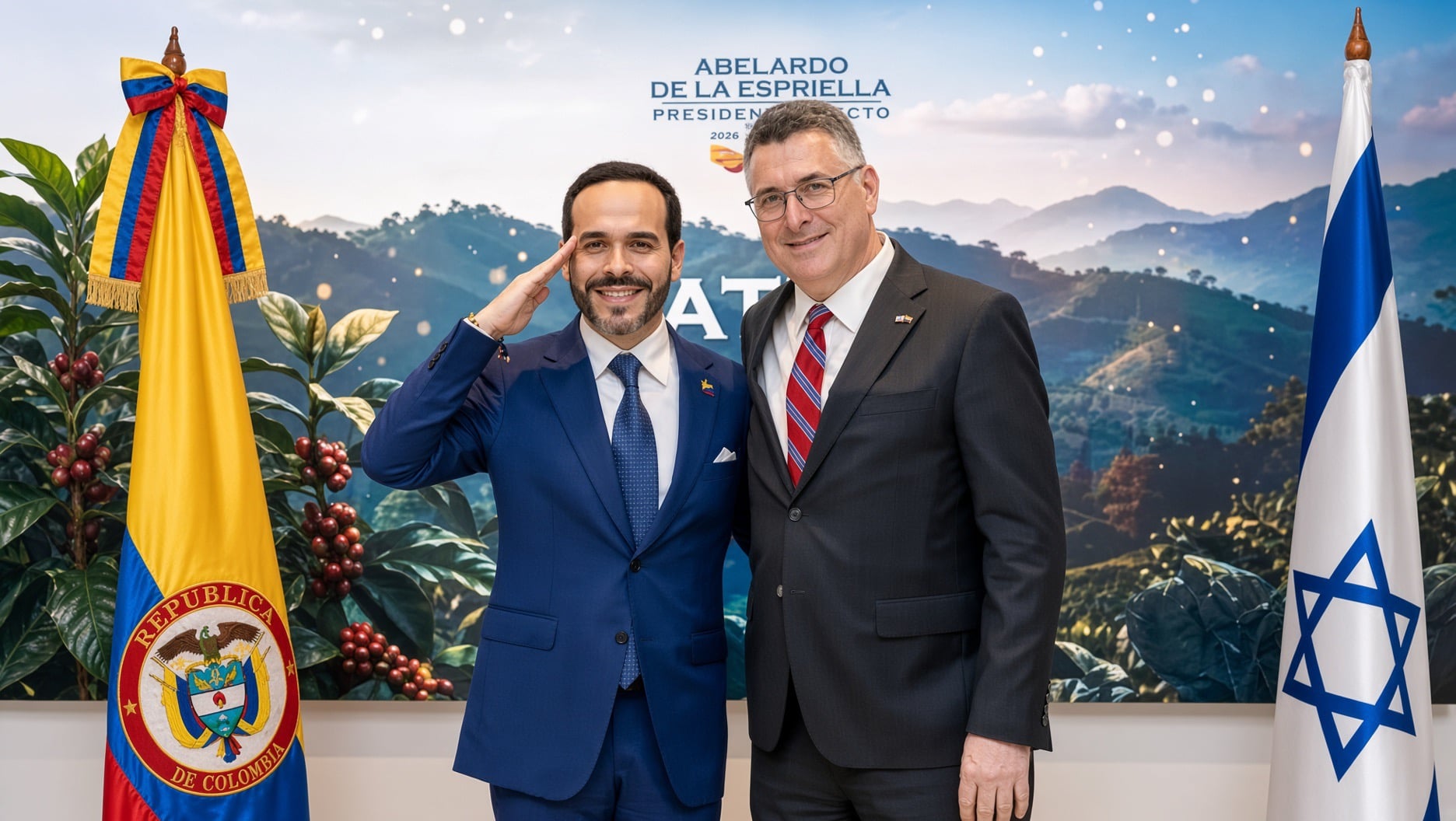
Colombian President-elect Abelardo de la Espriella (left) and Israeli Foreign Minister Gideon Sa’ar meet in Barranquilla, Colombia, ahead of the president’s inauguration, Aug. 6, 2026. Credit: Lodis Studios.
On September 1, 1932, a mere eighteen policemen stood between Colombian sovereignty and subversion when forty-eight Peruvian terrorists captured the isolated Amazon port of Leticia in just fifteen minutes. Separated by 600 miles of treacherous Andes and dense jungle, Bogotá sat entirely detached, possessing a mere three military vessels to project power. Critically, while aggressive tactical commanders in Iquitos correctly recognized this vital Amazon trapecio as a ripe operational chokepoint, complacent capital bureaucrats dismissed the territory as a distant clerk’s file. Colombia reclaimed the port only because President Enrique Olaya Herrera rapidly acquired European gunboats and forced a decisive river campaign before the League of Nations could freeze the boundary. The crisis cemented a broader geopolitical axiom—the ‘Leticia Rule’: unguarded borders invite foreign aggression, and regimes unable to secure their frontiers telegraph their own internal decay.
Colombia’s Communist National Liberation Army (NLA) activated this regional playbook on September 1, 2026, by transferring an ammo-packed, disguised taxi from safe havens in Venezuela into the metropolitan area of Cúcuta. This lethal vehicle—stolen from an owner who was promptly executed—subsequently devastated a police station in Los Patios, killing one Venezuelan civilian and wounding eleven others. Following the carnage, the NLA brazenly demanded negotiations with President Abelardo de la Espriella, oblivious that he had already been assassinated.
The NLA threat matrix claims at least 75 of Colombia’s 204 explosive attacks in 2026, fielding 6,000 terrorists garrisoned deeply inside Venezuelan territory. Geopolitically, the Catatumbo region functions not as a remote hinterland but as a critical strategic land bridge. Cocaine and illicit gold flow north and east toward Venezuelan sanctuaries for Caribbean export, while weapons and cash move in reverse—with Cúcuta anchoring that transit corridor.
The Islamic Republic of Iran and Hezbollah have long exploited this network, building upon a cocaine-for-cash pipeline that investigators first exposed in Colombia in 2008. Today, Tehran and its Lebanese puppies utilize South American transnational crime exactly how the IRGC Quds Force deploys terrorists in the Levant: leveraging trade cover, free zones, gold, and narcotics as self-sustaining logistical engines.
The Western Hemisphere’s security architecture remains dangerously compromised because Venezuela consistently still supplies the sovereign sanctuary while the Caribbean serves as the financial transit corridor. The sole major Andean state with two oceans and a physical gateway to this network, Colombia remains the ultimate geopolitical prize. Hence, if Washington limits the emerging Israeli-led Abrahamic Security Framework (ASF) to the Mediterranean or the Strait of Hormuz, it is willfully surrendering the Western Hemisphere to America’s adversaries.
Gustavo Petro’s ideological crusade to sever ties with Jerusalem handed Tehran a dangerous vacuum in the Western Hemisphere. Latin America historically captures a microscopic two percent of Israel’s record-shattering $19.2 billion defense export market—a strategic blind spot that left the region vulnerable to hostile infiltration. President Abelardo de la Espriella moved rapidly to reverse this vulnerability. Following an August 6, 2026 summit with Israeli Foreign Minister Gideon Sa’ar that secured reciprocal visa-free travel, Bogotá recognized Israeli sovereignty over the Golan Heights on August 10, 2026. Yet, real statecraft is tested by crisis. Days after taking office, de la Espriella had to navigate a deadly 7.4-magnitude earthquake that claimed over 100 lives. This disaster served as a stark reminder: while diplomacy exists on paper, hard geography determines whether a state survives the tremors of revisionist aggression.
Consequently, Jerusalem must establish the ASF’s regional command node in Cúcuta, not Bogotá. A standard capital fusion cell inevitably becomes an empty photo-op and a political hostage. Conversely, a hardened dual-use campus on the Norte de Santander seam—framed as post-quake border reconstruction—should drive Financial-Terrain Fusion. This facility should integrate Colombian human networks with Israeli SIGINT and UAV orbits to target gold desks, hawala networks, crypto ramps, and free-zone commerce feeding NLA bomb fronts, FARC dissidents, Clan del Golfo brokers, and Hezbollah cutouts. Embedding an Emirati financial officer and a Moroccan Sahel officer ensures vital Abrahamic cover, while hosting liaisons from Ecuador, Paraguay, Panama, and Argentina exports the methodology. Certainly, this will anchor the alliance to military technicians whom a sudden political communiqué cannot easily dismiss.
Concurrently, industrial defense integration must permanently bind tech to Colombian payrolls. A licensed joint venture should build tactical drones, loitering munitions, and border radars inside Colombia, with explicit Accords export rights written into the contract. Inevitably, a hostile successor wanting a rupture must then fire local technicians and cancel neighbors’ orders.
Jerusalem and Bogotá must codify diplomatic pageantry into operational reciprocity. If Colombia recognizes Israeli sovereignty over the Golan, Israel must back Bogotá’s right to dismantle terrorist sanctuaries along the Venezuelan seam. True alliances demand action: neutralizing an NLA cell in Cúcuta takes strategic precedence over hosting photo-ops in Jerusalem.
Geostrategic voids invite disaster. Just as an undefended Leticia fell, the bloodshed at Los Patios proves that ignoring the borderlands exacts a brutal toll. Israel and the ASF must now lead the charge, aggressively smashing Iranian-backed hemispheric networks to permanently secure the inter-American rim and shield the West’s southern flank.
Related Topics
Related Posts