The views expressed herein are solely mine.
Israel Must Stop Iran from Rebuilding Proxy Armies
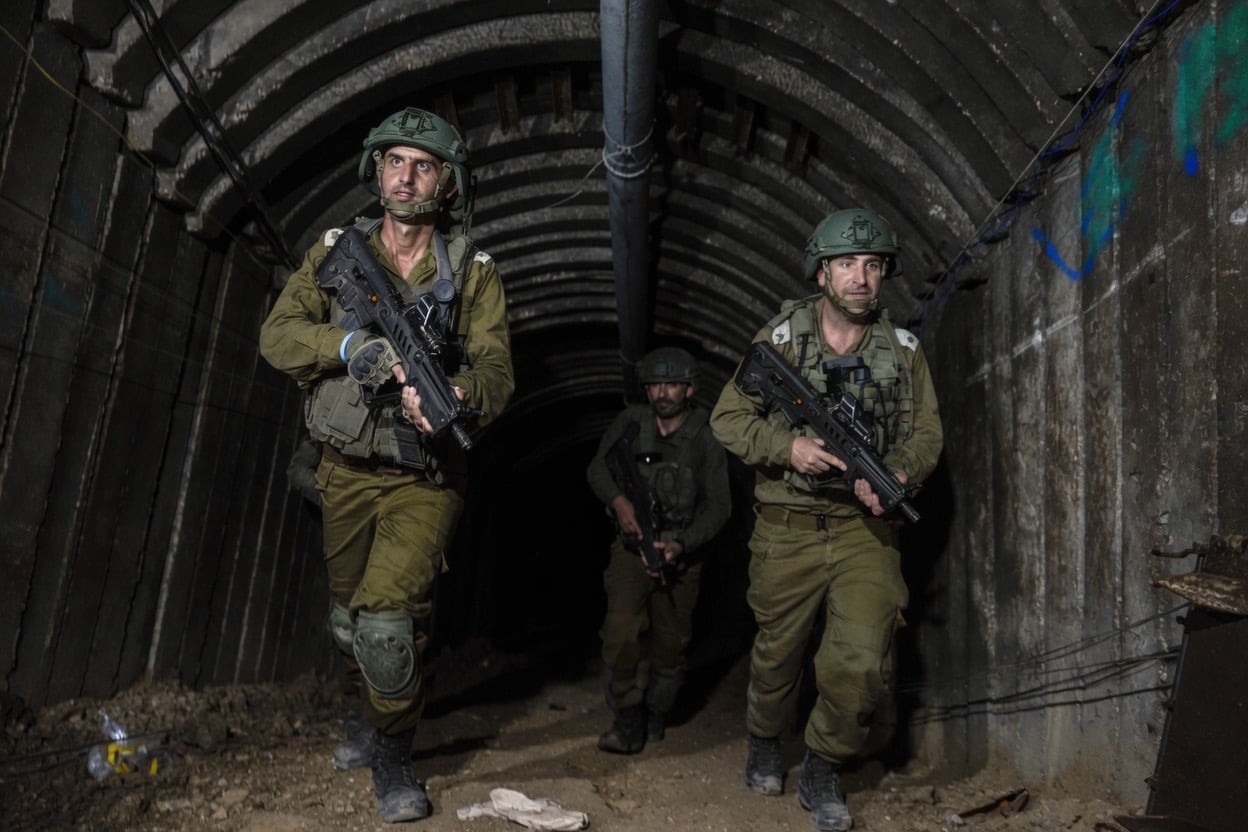
Israeli soldiers are seen in a tunnel that the military says Hamas terrorists used to attack the Erez crossing in the northern Gaza Strip, Friday, Dec. 15, 2023 (AP Photo/Ariel Schalit).
Israel has repeatedly shattered Hezbollah and Hamas on the battlefield, only to watch them rebuild for the next war. The problem is not a lack of Israeli military power or resolve, but a lack of political will to resist international pressure, reject premature ceasefires, and refuse withdrawals until enforceable arrangements lock in those battlefield gains.
Hezbollah and Hamas occupy different positions within Tehran’s network, but both function as the mullahs’ forward armies against the Jewish state. They bleed Israel’s armed forces, obstruct Arab-Israeli normalization, and weaken Jerusalem’s regional partnerships. Both also embed weapons and military infrastructure in civilian areas, exploiting Israeli restraint and converting their own survival into propaganda victories.
Israel’s May 2000 withdrawal from southern Lebanon remains the clearest warning. The withdrawal was supposed to bring quiet. Instead, Hezbollah portrayed the Jewish state’s departure as a historic defeat and used the territory the IDF had vacated to prepare for the next confrontation. Backed by around $1 billion annually from Tehran, the Lebanese Shiite terrorist organization strategically rearmed and entrenched itself along Israel’s northern border.
Following the 2006 war, Hezbollah openly violated UN Security Council Resolution 1701, which prohibited unauthorized armed forces and weapons between the Blue Line and the Litani River. By late 2023, its arsenal had grown from a few thousand rockets to an estimated 150,000 rockets, missiles, and drones. Hezbollah also built an extensive network of tunnels, bunkers, and fortified positions across southern Lebanon. After October 7, 2023, those capabilities sustained attacks that forced roughly 80,000 Israelis from their northern communities.
Gaza followed the same pattern. Israel removed every soldier and civilian from the Strip in 2005. The Palestinian Authority initially assumed control, but Hamas won the Palestinian parliamentary election the following year and, after a bloody civil war, seized Gaza from Fatah in 2007. Within two years of Israel’s departure, the territory had become an Iranian-backed terrorist stronghold.
Once entrenched, Hamas transformed Gaza into an authentic military fortress. Israeli assessments placed its underground network at hundreds of kilometers, with approximately 5,700 access shafts, many near or beneath civilian infrastructure. Between 2001 and 2026, Palestinian terrorist organizations have fired around 50,000 rockets and mortars at Israel, progressing from crude Qassams to longer-range Fajr-5, M-75, and Ayyash-250 projectiles. That buildup culminated on October 7, 2023, when Hamas-led terrorists killed approximately 1,200 people in Israel and abducted 251 others.
Recent Israeli operations demonstrate what sustained military pressure can accomplish—and what happens when that pressure ends prematurely. Jerusalem’s 2024 campaign severely damaged Hezbollah’s chain of command and its multi-domain leverage. Yet the terrorist Shia group began rebuilding almost immediately. By the eve of its renewed entry into the regional war in March 2026, analysts estimated that it had already reconstituted an arsenal of approximately 25,000 rockets and missiles.
In Gaza, Israeli forces currently control approximately 64 percent of the territory. Defense Minister Israel Katz has also said that the IDF destroyed 83 percent of Hamas’s tunnels in Israeli-held areas. These are significant achievements, but they represent leverage rather than a finished victory. Territorial control and destroyed infrastructure will mean little if Hamas can rebuild its tunnels and Hezbollah can replenish its missile stockpiles as soon as Israel withdraws.
The lesson is straightforward: proxy regeneration slows when rebuilding remains costly, dangerous, and uncertain. Withdrawal should follow verified disarmament, not serve as a down payment on promises that Israel’s enemies have no intention of honoring. Jerusalem therefore needs a regeneration-denial doctrine that attacks the four systems on which Hezbollah and Hamas depend: command cohesion, funding, resupply, and physical infrastructure.
Precision should form the doctrine’s first pillar. The operational principle is simple: strike the room, not the entire block. Small loitering munitions, miniature drones, and persistent surveillance can help Israeli forces isolate individual targets without producing broad fields of rubble. Networked scout drones could identify threats while precision systems engage them, but a human operator must authorize every lethal strike.
Reducing unnecessary civilian harm is both a moral obligation and a strategic necessity for Israel. Hezbollah and Hamas deliberately place civilians in danger because every casualty becomes ammunition in their information war. Thus, greater precision would deny them that advantage while preserving Israel’s freedom to destroy legitimate military targets.
The same precision must extend underground. Seismic, acoustic, and electromagnetic sensors can help identify tunnel voids and renewed excavation. Engineers could then neutralize specific sections rather than demolishing everything above them. No technology will deliver perfect underground visibility, but layered sensors, aerial surveillance, patrols, and human intelligence would make tunnel reconstruction slower, more expensive, and easier to expose.
Israel should also capture operatives when operationally possible rather than relying exclusively on assassinations. Mid-level logisticians, tunnel engineers, financial facilitators, and safe-house managers often possess detailed knowledge of the wider network. Killing them removes individual operatives; capturing them can expose command relationships, weapons routes, financial channels, and hidden infrastructure.
A separate defection program could offer carefully screened operatives safe passage or third-country relocation in exchange for actionable intelligence and public testimony. Captured terrorists and voluntary defectors would remain distinct legal categories, but both could help fracture internal loyalty and spread suspicion throughout the organizations.
Iranian resupply networks form the doctrine’s second pillar. Tehran’s ability to replace money, weapons, and specialized components ultimately determines how quickly its proxies recover. The Jewish state should expand financial tracking, expose front companies, disrupt procurement networks, interdict military shipments, and deepen intelligence cooperation with governments positioned along Iranian supply routes.
No interdiction campaign will stop every component from reaching its destination. Nor must it. Success means forcing Iran, Hamas, and Hezbollah to question whether shipments have been tracked, compromised, or exposed. Uncertainty alone increases the time, cost, and risk involved in rebuilding.
Holding cleared territory forms the third pillar. Israel does not need to station large formations indefinitely across southern Lebanon or Gaza. Temporary security zones should instead combine Israeli forces with seismic, acoustic, and visual sensors and large numbers of inexpensive, replaceable drones. Attempts at reinfiltration would generate actionable intelligence for capture teams or human-authorized precision strikes.
In tandem, unattended sensors could remain inside cleared tunnels to detect renewed movement or excavation. These systems would reduce the burden on Israeli soldiers and reservists while preserving continuous surveillance. Yes, technology cannot replace troops or political decisions, but it can make territorial supervision less manpower-intensive and far more difficult for terrorist organizations to penetrate.
Lebanon’s political end state must also be unambiguous. The Lebanese government must choose between national sovereignty and submission to an Iranian terrorist army. Israeli forces should withdraw from security positions only after the Lebanese Armed Forces become the sole armed force south of the Litani, inspectors receive unrestricted access, supply routes are monitored, and every Hezbollah violation triggers immediate consequences. Israel must retain full freedom to strike renewed terrorist infrastructure whenever Beirut fails to act.
In parallel, Gaza requires an administration with no role for Hamas, the Palestinian Islamic Jihad, or an unreformed Palestinian Authority that continues rewarding terrorism. A carefully vetted local government, supported by Arab states willing to enforce demilitarization, could manage civilian affairs and reconstruction. Every border crossing, shipment of dual-use material, and major construction project would require strict monitoring.
Military success must also survive the information war. Every precision strike, capture, and tunnel operation should produce a releasable evidence package containing footage, intelligence, and contextual information about embedded weapons, subject to protecting sensitive sources. Releasing that evidence quickly would leave Hamas, Hezbollah, and their foreign supporters less time to establish a false account of events.
Critics will argue that maintaining territorial control strains Israel’s reserves, creates diplomatic pressure, and prolongs conflict. Those costs are real, but withdrawing before the enemy’s rebuilding mechanisms have been dismantled carries a far greater price. Israel has already paid that price in rockets, displaced communities, murdered civilians, abducted hostages, and repeated wars.
The experiences of Lebanon after 2000 and Gaza after 2005 demonstrate that withdrawal without enforceable security arrangements does not create peace; it simply gives terrorist organizations the territory, time, and confidence required to prepare their next attack.
Hence, success cannot be measured by territory cleared or commanders eliminated alone. The true test is how long Hamas and Hezbollah need to replace their losses, how much Iran must pay to rearm them, and whether Israeli civilians can return home without facing yet another rebuilt terrorist army. The objective is neither endless war nor permanent Israeli administration over hostile populations. The goal is simple: Israel’s battlefield victories must endure after its last battalion leaves. Anything less is merely an intermission before the next war.
Related Topics
Related Posts