A Moroccan Journalist
Israel Must Stop Treating the ‘Arab World’ as One; Moroccan Jews Are Not Arab
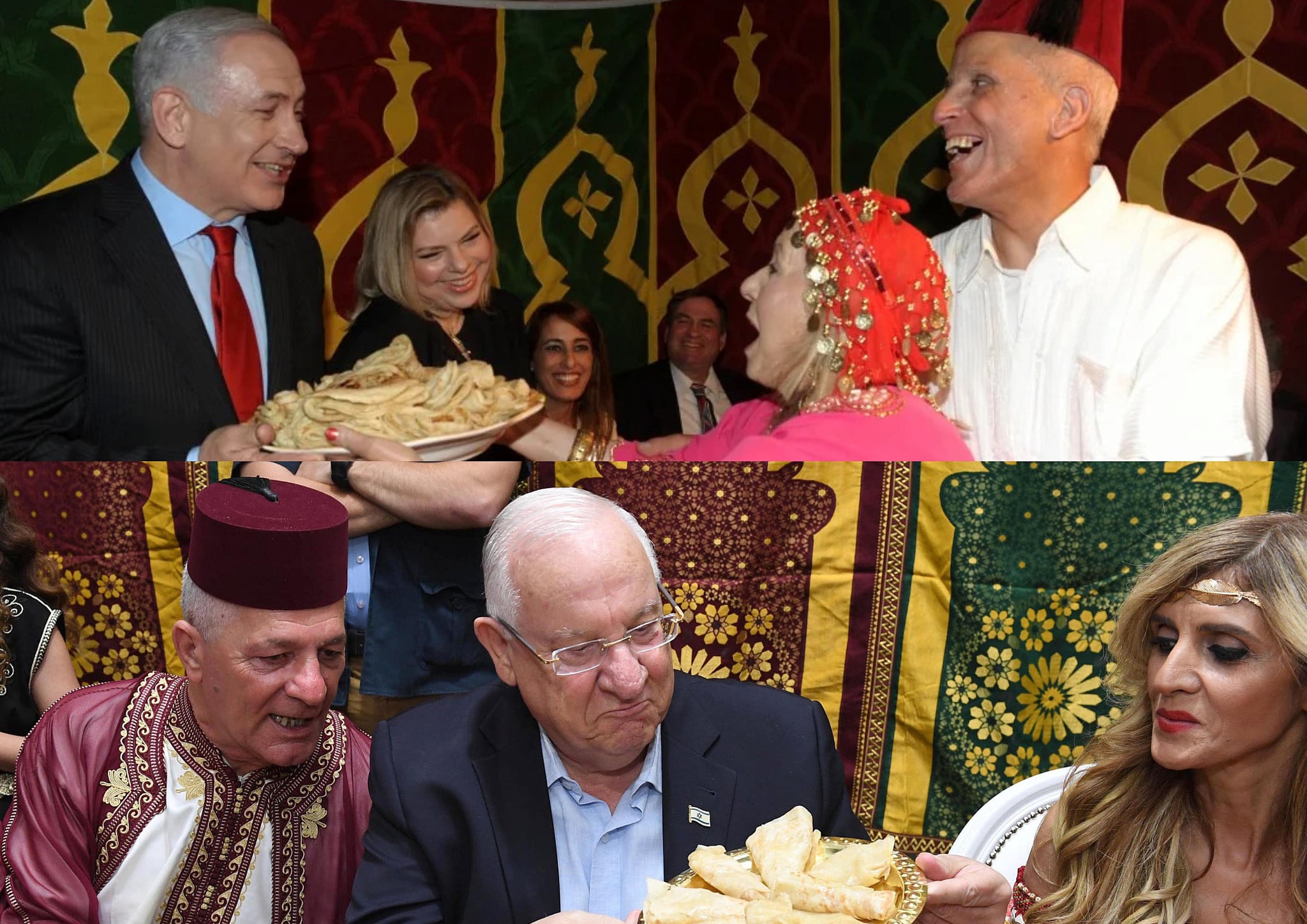
A collage of two images: the upper photo shows Benjamin Netanyahu and Sara Netanyahu celebrating Mimouna, the traditional Moroccan Jewish holiday marking the end of Passover (Amos Ben Gershom/Flash90). The lower photo features former Israeli president Reuven Rivlin at a Mimouna celebration in 2023 (Mark Neiman/GPO).
The Moroccan Jewish culture as manifested in Israel today is a lamentable distortion of its authentic Maghrebi essence. What was once a multi-stranded cultural matrix of Amazigh (Berber), Andalusian, and Sephardic threads has been bleached and contorted by decades of cultural myopia. In Israel’s early statehood, Moroccan Jews – heirs to a proud North African heritage – were subsumed, as Moroccan professor Mohamed Chtatou explained in a TOI Bogs article, under a monolithic “Eastern” or “Arab” label, an ignorant mischaracterization that crushed nuance under the weight of stereotype. The Ashkenazi establishment, gripped by a fin de siècle Orientalist bias, saw Jews from Morocco not as bearers of an ancient, sophisticated culture but as mere “Orientals” to be civilized or ignored.
Thus began a tragic cultural disfigurement: a Maghrebi legacy forced into a Mashriqi mold, its uniqueness dismissed as part of some amorphous “Arab world” that, in truth, exists only in geopolitical fantasy. One might as well equate Brazil with China as lump Morocco with Iraq – the distance in both geography and culture is vast and profound. Yet Israeli society, in the thrall of pan-Arabist simplifications, long failed to grasp this reality.
Indeed, the very concept of an “Arab world” as a single cultural sphere is a fallacy born of nationalist reductionism. Pan-Arab ideology in the mid-20th century assumed an imagined unity that never genuinely existed: “Arab-ness” was assumed for any population living in an Arab state… Arabic-speaking Coptic Egyptians, as well as non-Arabic speaking Kurds… were covered by the Arab identity umbrella. Diverse peoples – Amazigh Berbers, Levantines, Gulf Arabs, Kurds – were swept under one crude umbrella, erasing countless distinct tongues and traditions. Israel’s leaders and intellectuals uncritically inherited this fallacy.
To them, a Jew from Casablanca was indistinguishable from one from Baghdad – both mere “Arab Jews,” their specific histories of little import. Such gross simplification not only betrayed ignorance but perpetuated injustice. By reducing Moroccan Jews to an “Arab” monolith, Israel effectively stripped them of their Maghrebi identity and treated their culture as suspect, even subversive.
Moroccan Jews had lived for centuries in a land at Africa’s gateway to Europe, cultivating a unique hybrid culture; yet in Israel they were met with “disdain for Moroccan culture, probably because it was associated with [Israel’s] Arab enemies”. In the paranoid young Israeli nation, anything remotely “Arab” was eyed with contempt or fear. Thus the treasures of Moroccan tradition – its dialects, music, cuisine, costumes, and customs – were initially shunned and caricatured.
The consequences of this cultural chauvinism were severe. Moroccan Jews arrived in Israel only to find their heritage relegated to the bottom of the social hierarchy, derided as a folkloric curiosity or an embarrassment. The European-born elite openly or tacitly deemed Moroccan heritage a “lower culture,” pressuring immigrants to shed it in favor of the new Israeli identity. In the mid-century Zionist mindset, there was room for only one homogeneous culture in the Jewish state – an Ashkenazi-inflected, Western-facing modernity – and Sephardic traditions were left by the wayside, if not outright debased.
Israeli schools taught “only Ashkenazi history… as the nationalist narrative of Zionism, leaving no room for the diverse traditions that the Sephardim carried with them”. This enforced amnesia severed the younger generations of Moroccan Jews from their ancestral language and lore. Judeo-Arabic dialects like Darija, once the mother tongue of Morocco’s Jews, fell into disuse; Hebrew and an Israeli lingua franca prevailed. Even names were recast: Moroccan surnames and given names were often replaced with more “proper” biblical or Hebraized ones, stripped of their Maghrebi cadence in favor of a standardized Jewishness. At home, grandparents might whisper Moroccan folktales or hum Andalusian melodies, but in public sphere their culture survived mostly as parody. The much-vaunted Israeli “melting pot” was in practice a crucible where ancient identities were meant to be dissolved. Non-Ashkenazi cultures were tolerated only as quaint exotica – a pretty costume at best, a mark of primitiveness at worst.
As Israeli historian Yigal Bin-Nun acidly observes in a TOI Blogs article, Israeli multiculturalism often amounted to “an ideological screen intended to promote an impoverished ethnic folklore at the expense of genuine cultural and intellectual engagement”. In place of true appreciation came tokenism: a Moroccan dish savored occasionally, a Mizrahi pop tune on the radio, or a decorative phrase of Moroccan Arabic – superficial trappings masquerading as respect.
And yet, through those dark decades of condescension, Moroccan Jews did not wholly forget who they were. Insulated by shared memory and the stubborn pride of exile, they nurtured fragments of their identity in private, even as the state pigeonholed them as generic “Orientals.” A sense of community solidarity – forged in adversity – helped Moroccan Jewish culture survive in Israel, albeit in diminished form. Still, the culture that endured was largely impoverished, a shadow of its former self, cut off from its wellsprings in North Africa.
It is a bitter irony that a people uprooted from Morocco in search of a Jewish homeland found themselves in a new kind of exile – alienated from their own cultural heritage. They became, in effect, exiles within Israel, their “new diaspora” defined not by geography but by the loss of identity, esteem, and self-worth. The grand story of Israel’s ingathering of exiles glossed over the trauma inflicted on the ingathered: a “festering psychological wound” where pride once flourished.
Over time, many internalized the very Orientalist gaze that had been imposed upon them, adopting the rhetoric that cast Arabs – their culture, religion, and by extension their own past – as backward or hostile, and expressing this internalization through mockery, caricature, and warped representations of what they had been taught to disown. Such a situation was further compounded by the rise of extremist political Islam in the Arab world and the extremist far right in Israel. This inversion was profound: communities that had lived for centuries in relative coexistence came to view Morocco as an adversarial land, embracing the myth of expulsion despite historical evidence showing that Moroccan Jews were neither systematically persecuted nor driven out. This dynamic has also, in some ways, made it harder for Morocco to benefit from this diaspora, despite it being regarded as the country’s second largest after the community in France.
In many cases, it was Zionist networks that actively facilitated – and at times pressured – their departure, even as large numbers initially resisted leaving a society in which they were rooted. According to Bin-Nun, emigration was less a messianic impulse than a process actively structured by Zionist emissaries, who framed departure as emancipation amid political uncertainty. Many Moroccan Jews left not from faith, but from fear – not of persecution already endured, but of what might one day occur. In doing so, they abandoned stable bourgeois lives for a collectivist ideal often experienced as social downgrading and loss rather than salvation – an experience framed as redemption but often felt as dispossession. One is left to ask: how could a Jew who had lived as a merchant, artisan, or businessman be expected to abandon that life, only to be recast at the margins as a kibbutz field worker? Today, a homogenized nationalist discourse often prevails, to the point that even Moroccan Jews – once carriers of a rich, plural memory – are heard denouncing Morocco itself, rehearsing a hostility learned rather than lived.
Only in recent years has this lamentable course begun to correct itself – though often in imperfect and superficial ways. What is presented as “Moroccan” culture is still frequently blurred into a generic Arab aesthetic: Moroccan “Arabic” (Darija) diluted with Egyptian inflections; the Moroccan caftan embellished with Ottoman, Algerian, or Tunisian elements that bear little historical connection to it; and music folded into an undifferentiated Eastern repertoire. Even the catch-all label “Mizrahi” reproduces this flattening, grouping radically distinct histories and traditions into a single, misleading category. Rather than a true restoration, these gestures often reinscribe a reductive logic beneath a celebratory surface, replacing one mode of cultural erasure with another.
The turning point has come with a growing recognition – both within Israel and through its renewed ties with Morocco – that Moroccan Jewish culture is not an Oriental oddity but an integral, dignified civilization in its own right. The 2020 renewal of diplomatic relations between Jerusalem and Rabat heralded what Dan Illouz, a Jewish Knesset member of Moroccan origin, described in an interview with Jewish News Syndicate (JNS) as “not only a diplomatic agreement but also a cultural revolution.” Suddenly, Morocco was no longer a distant, half-forgotten birthplace of grandparents; it was a living, friendly nation eager to share its heritage.
The psychological alchemy of peace transformed Morocco in the Israeli imagination from “enemy” to “ally,” and with that shift came permission to cherish Moroccan culture rather than scorn it. “After all these years in which Moroccan culture was shunned by mainstream Israel, it can now receive proper appreciation because it is not the culture of an enemy but of a friend,” Illouz exclaimed. Indeed, Israeli Jews of Moroccan descent are reclaiming their roots with a vigor that commands admiration.
They are relearning the old tongue of their forebears – studying Moroccan “Arabic” (Darija) and even Amazigh phrases to reconnect with the true voice of their ancestors. They are reviving musical and religious traditions, from the liturgical piyyutim to the festive Mimouna, not as museum pieces but as living practices infused with new pride. In this renaissance there is a poignant lesson: what the forced homogenization of the 20th century tried to erase, the honest multiculturalism of the 21st century can restore.
Yet this restoration is not won without a rigorous critique of the past and a resolve for the future. The time has come for Israeli society – and especially its opinion-makers and educators – to abandon the lazy conflation of all Eastern peoples as one “Arab” mass. It is an intellectual crime to conflate the Maghreb with the Mashriq, to pretend that the Atlantic-breezed alleys of Casablanca are culturally akin to the deserts of Arabia. The Arab world, as a cultural unit, is a fiction: a shorthand that masks myriad nations and ethnicities with little in common beyond some linguistic overlap and historical religion.
Morocco in particular has always been a world unto itself – a crossroads of Africa and Europe, where Amazigh (Berber) chiefs and Sephardic rabbis, Sufi saints and Andalusian poets crafted a civilization utterly distinct from that of the Middle East. Israeli observers must finally recognize this reality and cease applying outdated Orientalist paradigms to their Mizrahi citizens – paradigms that many Mizrahim themselves have internalized and continue to project onto their countries of origin. To continue viewing Moroccan Jews as though they were merely an offshoot of an imagined pan-Arab culture is an insult not only to the Moroccan Jews but to the truth of history.
In reclaiming the authentic Moroccan culture, Israeli Moroccans are not indulging in nostalgia – they are righting a historical wrong. They are dismantling the internalized shame and false narratives imposed on their parents and grandparents, and replacing them with knowledge and pride. We now see third-generation Moroccan-Israelis discovering that their heritage is something to celebrate, not hide.
They learn that their grandparents came from a society where Jews and Muslims coexisted for centuries, where scholarship and art flourished, where the Judeo-Moroccan dialect was rich and expressive. They begin to appreciate that Moroccan Jewry’s story – its “golden age” in medieval Fez, its later trials and triumphs – is an epic not inferior to the European Jewish narrative, but different and equally magnificent. As these truths take root, the distorted caricature of Moroccan culture in Israel crumbles. In its stead rises a more accurate image: a culture that is vibrant, multi-layered, and not Oriental but Moroccan above all.
The critique must be sharp and unflinching: Israel’s past treatment of Moroccan Jewish culture was a failure of vision and respect. The old elite’s attempt to melt diverse communities into a uniform mold impoverished Israel’s soul, creating an “artificially created melting pot” instead of the rich mosaic that could have been. But there is still time to learn from these mistakes.
As Moroccan Jews and their Israeli-born descendants reconnect with Rabat, Casablanca, and Marrakech – and as Israeli tourists marvel at the streets of Fez or the music of Essaouira – a new understanding dawns. Israelis are beginning to see that Moroccan culture was never “backward” or foreign; it was a missing piece of themselves, a piece they were taught to discard. With every Darija course taught, every traditional couscous recipe shared, and every joint Jewish-Muslim melody sung, the Moroccan soul returns to the land of Israel, to the benefit of all its inhabitants. This is a cultural homecoming long overdue.
In the end, the journey of Moroccan Jewish culture – from distortion to redemption – stands as both a cautionary tale and an inspiring example. It warns us how easily precious heritage can be lost when societies chase monolithic identity myths. Ironically, this erasure unfolded as a two-way process: on one side, post-colonial states seeking to subsume plural histories under an exclusive Arab banner; on the other, Israel attempting to compress radically diverse Jewish worlds into a single, homogenized national identity.
But it also shows the resilience of culture and the power of truth. No amount of forced forgetfulness could extinguish the ember of Moroccan identity among its exiles; with the right spark, that ember has burst again into flame. It is incumbent on Israel’s cultural leaders and thinkers to tend this flame, not stifle it. Let them encourage Moroccan Jews to be unapologetically Moroccan, to contribute their ancestral genius to the Israeli mosaic. Let them celebrate the differences within the so-called “Arab world,” rather than denying them. Only by embracing the authentic diversity of its people can Israel fulfill the promise of being a true ingathering – not just of bodies, but of cultures and souls.
The Moroccan Jews have given Israel so much – labor, loyalty, even blood – and now they offer something gentler but no less profound: a chance to enrich and correct Israeli culture by restoring a piece of its own heritage. It is time to cast off the false lens of pan-Arabism and Orientalism, and behold the Moroccan Jewish culture in Israel in all its undistorted glory – as a proud legacy reborn, and a living bridge between nations.
Related Topics
Related Posts