
Leadership With Heart
Israel Needs a Drone Army—Before the Next War
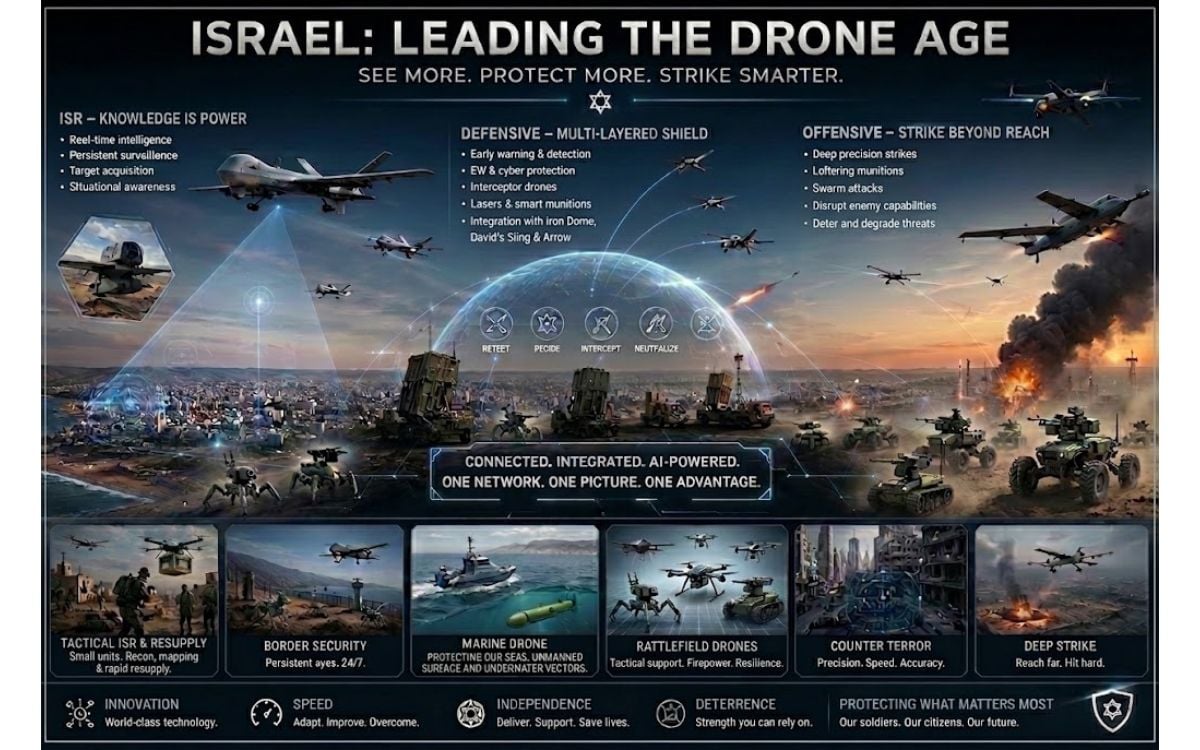
AI generated image
At the Combined Resolve exercise in Germany this spring, Ukrainian drone operators faced US forces and reportedly detected and simulated strikes against American troops and armored vehicles so effectively that exercise controllers had to return “destroyed” units to the scenario to keep it running.
The lesson was not that American armor is obsolete, or that every battlefield will resemble Ukraine. It was that militaries built around yesterday’s assumptions can be exposed quickly by inexpensive drones, skilled operators, and tactics that evolve faster than procurement systems. The encouraging part is that the US force adapted during the exercise, improving dispersion, camouflage, and its use of electronic warfare. The warning is that such lessons are best learned in training, not after soldiers and armored vehicles have been exposed in combat.
Israel should take notice. So should the United States. Both are technologically advanced militaries with exceptional high-end capabilities. Both now face a world in which cheap, expendable drones can find forces, expose armor, strain defenses, and impose costs far beyond their price.
Israel helped pioneer military drone warfare. It now needs to adapt again—quickly and at scale. It needs a force able to find and disrupt threats before they strike, and a layered shield to detect and defeat incoming drones before they reach their targets.
Ukraine’s hard lesson
Ukraine’s experience offers the clearest evidence of how thoroughly drones have changed the battlefield.
Far from the front, Ukrainian drones have forced Russia to protect infrastructure, move equipment, disperse military assets, and devote resources to defending areas it once regarded as safely beyond Ukraine’s reach.
At the front, reconnaissance drones spot assault forces, vehicles, and supply movements before they reach Ukrainian positions. FPV and other attack drones can disrupt attacks, damage vehicles, and force attacking troops to move more slowly and cautiously.
Drones have not replaced infantry, artillery, intelligence, electronic warfare, or capable command. They have made each of them more effective. For an outnumbered force, that can mean the difference between holding a position and giving it up.
Ukraine’s other advantage has been its pace. A soldier reports a failure or a new enemy tactic. A small team changes the design. The revised system goes back to the field.
Israel does not face Ukraine’s war, and should not pretend it does. Israel’s small geography means that threats launched near its borders can reach civilians, bases, and critical sites within minutes. Long-range threats from Yemen and Iran add a separate challenge. But the lesson is clear: the military that learns and adapts fastest gains an advantage.
Iran and the armed groups it arms and supports have demonstrated the other side of the same problem. Cheap drones can travel far, arrive in numbers, and force a sophisticated military to spend far more defending against them than the attacker spent launching them.
Israel has felt the cost
For Israel, this is not an abstract warning.
In October 2024, a Hezbollah drone struck the Golani training base near Binyamina, killing four soldiers and wounding more than 50 others. In July 2024, a Houthi drone struck Tel Aviv, killing one civilian and injuring others.
Those attacks exposed a hard truth: even a relatively cheap drone can penetrate defenses, kill, disrupt daily life, and damage public confidence. Israel’s air-defense systems have intercepted many drones and missiles, and they remain indispensable. But no one should confuse a high interception rate with immunity. One drone getting through can be enough.
Israel has the talent
Israel has the people and institutions needed to meet this challenge: skilled soldiers, exceptional engineers, defense companies, intelligence services, universities, and a technology sector that knows how to move fast.
The problem is not talent. It is turning talent into fielded capability at the speed modern warfare demands.
Israel is rightly proud of its high-end systems. We need them. But high-end systems alone are not enough for a fight in which cheap, expendable drones can be lost, adapted, and replaced every day.
Israel must also build a parallel model: modular drones and counter-drone systems that can be tested in realistic conditions, repaired in the field, improved quickly, and produced in large numbers.
Israel should establish a small, permanent joint body for drones, counter-drones, and electronic warfare. The body’s job should be to set common standards, run realistic exercises, test systems under field conditions, and move proven capabilities quickly into service. It should connect operational units directly with engineers and manufacturers—not add another headquarters that slows decisions.
Put drones throughout the IDF
The sword begins with giving commanders and troops the tools they need when they need them.
Not every soldier must carry a drone tomorrow. But every level of the IDF—from small units and battalions to brigades and national commands—should have ready access to systems suited to its mission.
A small reconnaissance drone can inspect a dangerous route, watch a border, or warn a unit about an approaching threat. Whenever possible, the machine should take the first look, so a soldier does not have to take the first unnecessary risk.
This is also a manpower issue. After years of fighting on several fronts, Israel cannot assume that the same reservists can be called up again and again without cost to their families, employers, and readiness. Drones cannot replace the need for more soldiers or for broader, fairer participation in national service. But they can reduce the number of missions that require troops to enter danger first, help smaller units cover more ground, and allow commanders to use scarce manpower more carefully.
Drones can scout ahead of armored columns, carry sensors forward, extend communications, and help crews see threats before a tank or troop carrier enters danger. At sea, they can extend the Navy’s awareness around ports, sea lanes, and offshore energy infrastructure.
The IDF should preserve accountable offensive drone capabilities: systems used, under clear military command, to find and disrupt confirmed military threats before they can attack Israeli communities or troops. Coordinated operations can combine reconnaissance, communications relay, electronic support, decoys, and authorized strikes.
Build sword and shield
A drone force without a counter-drone force is incomplete.
That requires a layered shield able to detect, track, and defeat incoming drones at a cost Israel can sustain. Iron Dome, David’s Sling, Arrow, fighter aircraft, and other high-end capabilities will remain essential for threats that only they can defeat. But Israel cannot routinely answer a cheap drone with an expensive interceptor.
The response must be a layered system: better sensors, electronic warfare where it works, interceptor drones, short-range interceptors, lasers where appropriate, and physical protection for critical sites. It also includes the unglamorous measures that often matter most: camouflage, dispersal, hardened shelters, covered positions, and rapid repair after a strike.
The shield must be built for mass attacks. Enemies may launch drones from several directions and at different altitudes, alongside missiles, decoys, and electronic interference. Their aim may be to destroy a target, exhaust interceptor stocks, overwhelm sensors, and create a path for a few drones to get through.
That requires more than hardware. Relevant IDF units must train routinely against drone threats, with clear warning procedures and close coordination among air-defense, electronic-warfare, intelligence, and drone teams.
The sword and shield should reinforce each other. Drones that find launch teams, operators, or command sites can help interrupt an attack before it begins. The shield must protect Israel when prevention fails: soldiers at bases, families in border communities, airports, ports, power systems, and the infrastructure that keeps the country functioning under fire.
Any armed drone operation must remain under accountable military command, reliable target identification, applicable rules of engagement, and Israel’s obligations under international humanitarian law.
Make AI the connector
Drones by themselves are not the answer. The advantage will come from the network that connects them.
The IDF needs data and artificial-intelligence systems that can combine information from drones, cameras, radar, intelligence feeds, and other sensors into a usable picture for commanders. They can sort urgent alerts from background noise, flag possible threats for human review, map terrain, help coordinate defenses, and assist navigation when GPS or communications are disrupted.
This is not about handing life-and-death decisions to an algorithm. It is about helping operators see more clearly and decide faster. Human commanders must retain responsibility for identifying targets and authorizing lethal force.
Scale quickly, learn faster
Israel must be able to build and replenish both the sword and the shield inside Israel.
That requires a fast-track process linking frontline units, reservists, engineers, universities, startups, and established defense firms. Units must be able to report failures, vulnerabilities, and new enemy tactics directly to those designing the systems. Engineers and manufacturers must then test changes under realistic conditions and return improved equipment to the field without delay.
Where practical, Israel should standardize components—batteries, cameras, sensors, communications equipment, software interfaces, and replacement parts. Standardization will lower costs, simplify training and maintenance, and allow the IDF to expand more quickly.
Israel must also train and retain enough drone operators, maintainers, intelligence analysts, and electronic-warfare specialists to use these systems effectively under combat conditions.
Build for Israel first
In wartime, supply chains are strategic vulnerabilities.
Israel must have domestic capacity for drones and their critical components, from sensors and batteries to secure communications, software, spare parts, and counter-drone systems. It needs stockpiles and the ability to surge production when the next war begins—not after foreign suppliers decide what they can spare.
Israel’s defense companies should innovate and export responsibly. But the first duty of Israel’s drone industry must be to equip the IDF and protect Israeli civilians. First meet Israel’s operational needs. Then build reserves and surge capacity. Then export.
This will require sustained, multi-year funding—not emergency procurement after the next attack—but the cost of preparation will be far lower than the cost of being unprepared.
Israel should lead again
Israel helped pioneer the drone age. It should not be caught trying to relearn its lessons in the next war.
We have the people, the technology, the combat experience, and the urgency. What is missing is a national decision to move faster, build at scale, and treat drones and counter-drones as a core element of Israel’s security—not a niche capability or a future project.
Israel needs a sword that can see, deter, and disrupt threats before they strike—and a shield that can stop incoming drones when they penetrate Israeli airspace.
The next war will not wait for a committee, a procurement cycle, or another warning. Israel should act now.
Related Topics
Related Posts